

As we approach the 2026 midterms, it’s becoming clear that it will be a very favorable year for Democrats nationwide, much like it was in 2018. While your first thought may be to see what happened in 2018 to predict what’s going to happen in 2026, I’d caution against that. Even if the overall results look the same, or perhaps even better for Democrats now than eight years ago, the way Democrats will win, and the reasons for it are MUCH different.
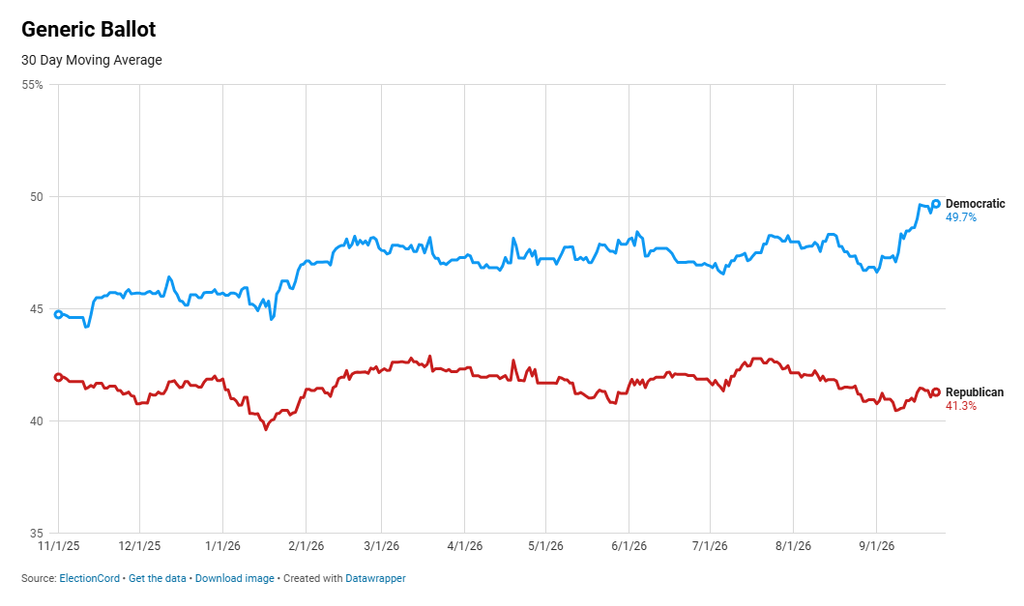
Because there is no Presidential race in midterms, the best way experts can gauge how the election went is using the overall House vote, which is also called the Generic Ballot. In 2018, Democrats gained a net of 41 seats, while winning the popular vote by 8.6%. It’s the largest margin of victory for either party since 2008, and led to Democrats flipping the House. While we don’t obviously know what will happen this year, polls indicate an environment matching exceeding 2018, with our Generic Ballot average sitting at D+8.4%.
With that, let’s look at the why and the how: Why will the electorate be different, and how will it be different?
The Why
The biggest factor in the difference between 2018 and now is President Trump’s approval. As crazy as it might sound, he was not that unpopular in 2018! Per FiveThirtyEight (via the Wayback Machine), President Trump had a net approval of -11% (42% Approve, 53% Disapprove).
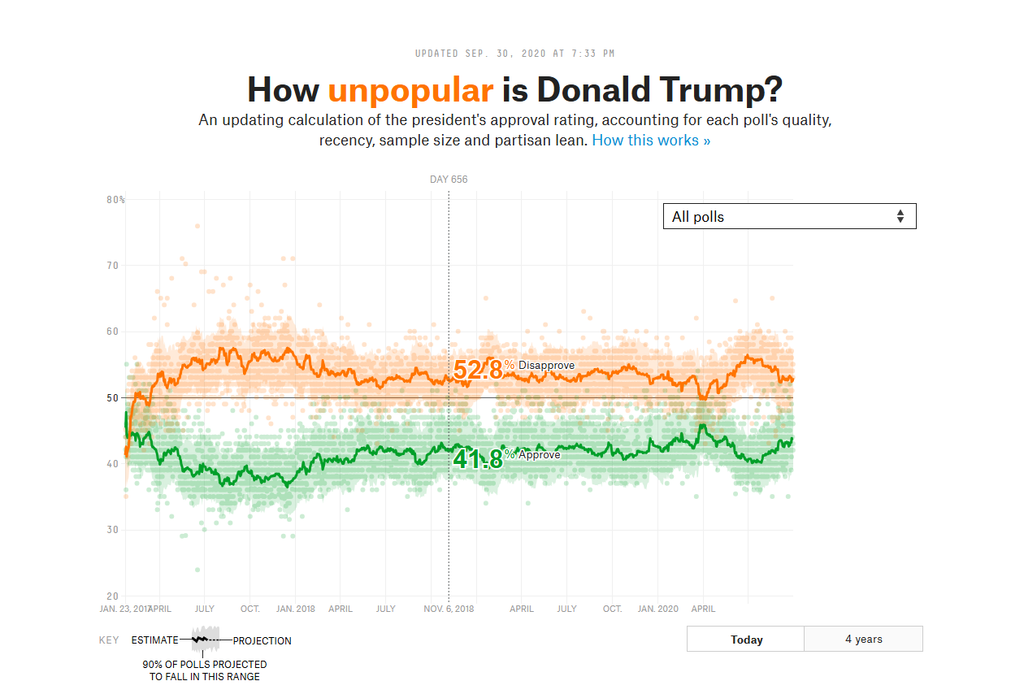
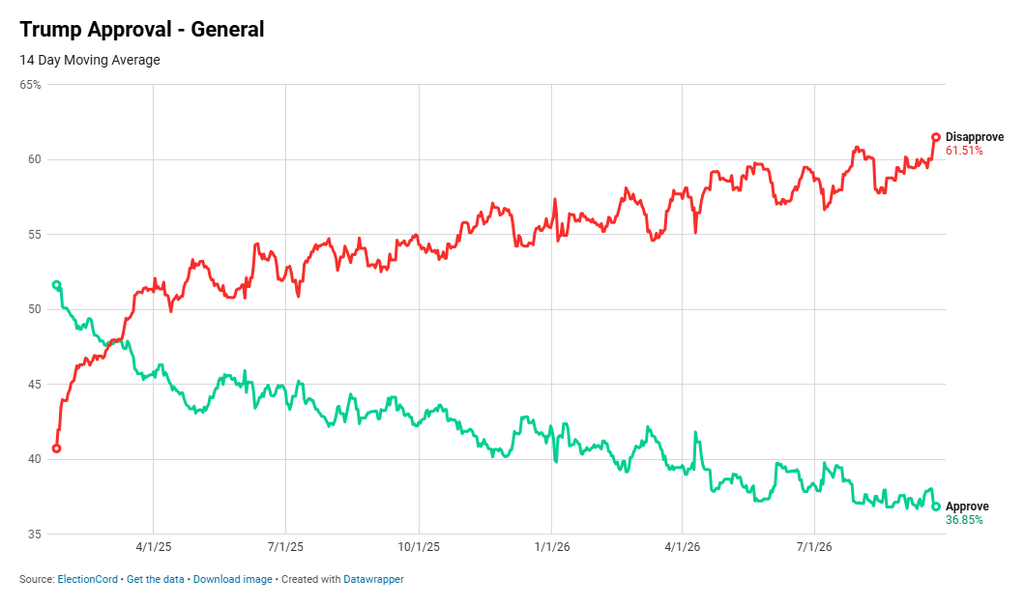
While not ideal, his approval wasn’t so bad that it completely crippled Republicans. Now though, that’s different. President Trump is considerably less popular, according to our own averages. Trump is sitting at a net approval of nearly -25%, and over 60% of people disapprove of him!
There are a lot of reasons for the big difference, but the biggest reason is likely the economy. No one kept track of issue polling averages in 2018, so we will use three high-quality polls, YouGov/Economist, CNN/SSRS, and Ipsos/Reuters, to get an idea. In all 3, Trump was not only positive on his handling of the economy, but it was his best issue. YouGov had his economic approval at Approve +5, CNN had Approve +11, and Ipsos had Approve +7. Conversely, we estimate his approval of his handling of the economy in 2026 is -36. That is not a typo. It went from his best issue in Term 1, to literally his worst issue!
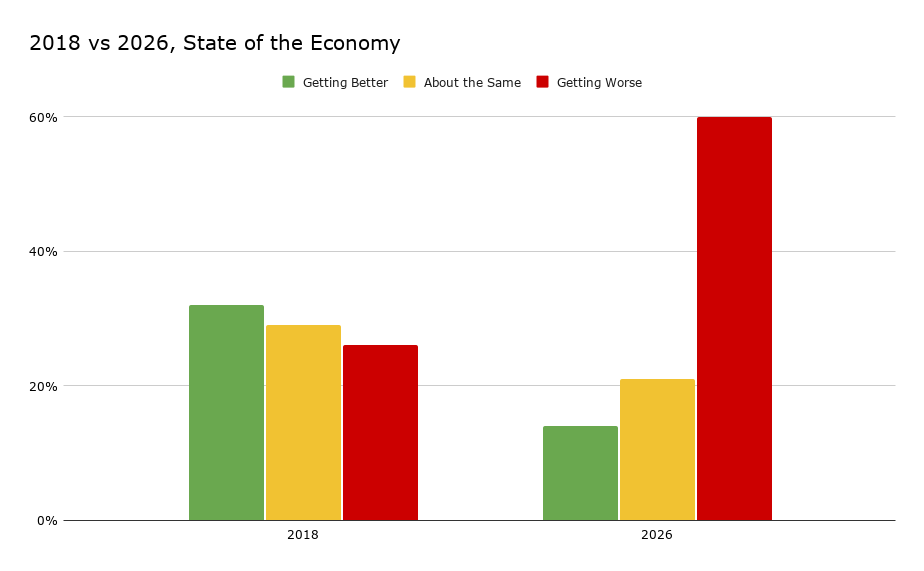
There is concrete evidence that people think the economy is worse now too in general. For instance, in the YouGov poll from 2018, 32% said the economy was getting better, 29% say it’s the same, and 26% say it’s getting worse. In our averages though, 14% say the economy is getting better, 21% say the same, and 60% say it’s getting worse.
There is some other evidence that the economy is actually bad, such as gas being 1.5 dollars more per gallon now than in 2018, but it doesn’t really matter if the economy is actually bad or worse. What matters is people think that it is worse.
According to polling, Democrats likely did well in 2018 because Democratic voters were exceptionally motivated to vote, with the electorate in 2018 likely being more Democratic than even in 2026. Another factor was issue importance. According to CNN’s exit poll in 2018, a full 41% of people said healthcare was the most important issue facing the country. According to a ABC/WaPo poll from November 2018, more people trusted Democrats (50%) than Republicans (34%) on the issue. Nowadays, it seems that Inflation/Prices (34%) are seen as the most important issue, according to a 2026 YouGov/Economist poll.
The How
So now that people’s priorities and opinions on President Trump are considerably different, what demographics are driving this change? From 2016-2018, the shifts (in the Senate) were dead simple. White people, regardless of education, swung left.
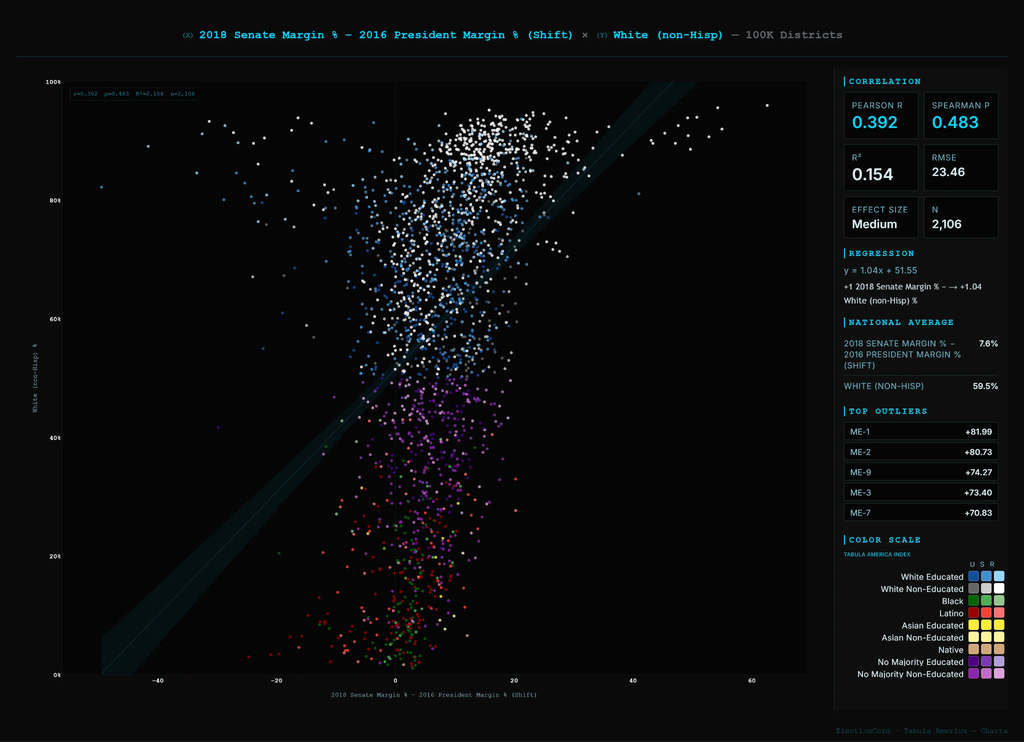
According to our Tabula America Suffragium program, majority White 100K Districts (districts of 100,000 people in the US) shifted left 10% from 2016 President to 2018 Senate! Conversely, majority-minority areas only moved left about 2%, and majority-Hispanic areas moved right by 1%. This was a clear sign of things to come in 2020, yet it went under the radar even then. Throughout the Trump-era, Republicans have continued to improve with minority groups, to the point where all majority-minority 100K Districts shifted right 12.5% from 2016-2024, and it’s really the main reason why President Trump got elected to a second term.
However, this trend seems to be coming to a sudden halt. It’s clear that minority groups liked Trump more than other Republicans because of the state of the economy under his watch. As we’ve established though, no one thinks the economy is good right now, and as minority groups like Hispanic and Black are disproportionately poorer than White people in the US, they feel those effects more than anyone else. We have evidence that this is causing them to “come back” to Democrats in droves, both in polling and in other elections. For instance, in 2025, we had Gubernatorial elections in New Jersey and Virginia. There were 70 majority-minority 100K Districts between the two states, and these areas shifted left 15% from 2024’s Presidential Election.

Of course, these were off-year elections, and they were almost a year ago now, so they won’t be entirely indicative of what happens, but even 10 months ago, these non-white areas were rebelling against President Trump and the Republicans he endorsed. If you compare YouGov/Economist polls from 2024 and 2026, you can see this as well. In October 2024, they had Harris winning Hispanics by 12%, which turned out to be pretty spot-on. But in their latest poll, they had Democrats winning Hispanics by 24%.
White people will likely move left as well, but probably not by this much. In particular, it seems like one of the groups that will most left the least (relatively speaking) are educated White people. It’s not because they love Trump or anything now, but the economy is less important to them, because educated people also tend to be better-off. According to our averages, Republicans are currently leading among White people by about 5%, compared to Trump winning them by 10% in the 2024 YouGov poll.
Conclusion
The most important thing to remember is that all elections are different. There’s always something new going on, and the priorities of people simply change. AI was not in the top 100 most important issues in 2018, and now it’s being talked about daily! In 2022, abortion being such a big deal was a big factor in saving Democrats from a red wave, and now, they see it as a huge priority. You can make changes under the hood that meaningfully change what 90% of the electorate will think about, yet the overall results barely move. What matters this year might not even matter in 2028, and vice versa! Think of the COVID-19 pandemic for example. The most important thing though, is that you don’t make assumptions about what will happen, based on what you want to happen.
Resources
St. Louis Fed: https://fred.stlouisfed.org/series/apu000074714
538 Trump Approval: https://web.archive.org/web/20201001042728/https://projects.fivethirtyeight.com/trump-approval-ratings/?cid=rrpromo
YouGov/Economist Poll 2018: https://d25d2506sfb94s.cloudfront.net/cumulus_uploads/document/p8wvf16d2j/econTabReport.pdf
CNN/SSRS Poll 2018: https://cdn.cnn.com/cnn/2018/images/11/04/rel10a.-.2018.pdf
Reuters/Ipsos Poll 2018: https://www.ipsos.com/sites/default/files/ct/news/documents/2018-10/2018_reuters_tracking_-_core_political_10_31_2018.pdf
CNN Exit Poll 2018: https://www.cnn.com/election/2018/exit-polls
WaPo/ABC Poll from 2018: https://www.langerresearch.com/wp-content/uploads/1202a2The2018Midterms.pdf
2026 YouGov/Economist Poll: https://d3nkl3psvxxpe9.cloudfront.net/documents/econTabReport_5WiMaRX.pdf
2024 YouGov/Economist Poll:
https://d3nkl3psvxxpe9.cloudfront.net/documents/econTabReport_NgtZTja.pdf
About the Author