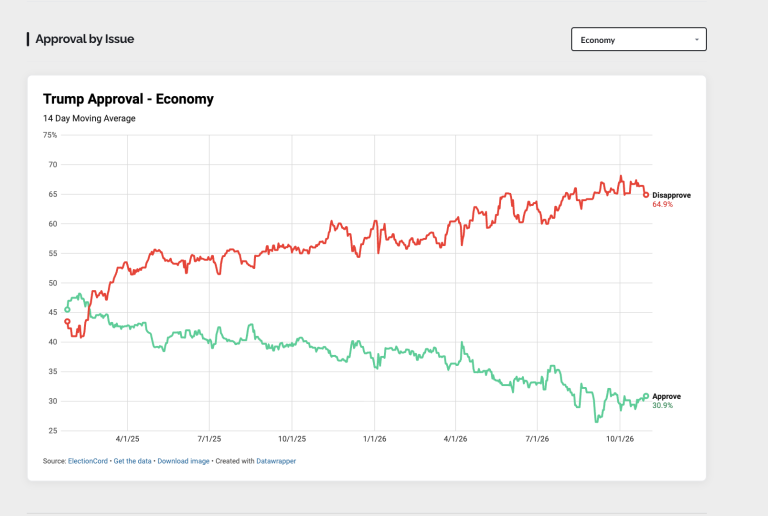


The Democrats won a landslide victory. Indeed, they did more than win a landslide, they won their greatest victory in 50 years. The final generic ballot is set to be around D+14 (56% to 42%), though we won’t know for sure until blue areas count all of their late ballots.
There’s an easy explanation, which goes as follows:

But really, it does seem like millions of people, either by refusing to vote or being persuaded to flip, decided they hated Donald Trump’s presidency. On the eve of the election, I noted that our possible outcome was a wild swing election where everyone who felt personally aggrieved by Trump and his goons swung proportionally to their pain. That’s pretty much what happened.
The results were still surprising. Pre-election polls missed Democrats by about 3-5% nationwide, with some states having even larger errors. Even the Democrats’ most hopeful wishcasts couldn’t foresee 56 Senate seats and an astonishing 260 House seats (with 2 potentially winnable runoffs in Louisiana to come). Our “expert” forecasts were bullish on Dems relative to other sources (we were at a more reasonable 54 Senate seats and 240 House seats), but even those missed by a decent amount.
Were the forecasting methods bad? Not really. By the end of the cycle, betting markets, modelers, and elections addicts had all coalesced, as they always do. The polling error exceeded even the 1-2% expectations of StateNavigate’s “Nagasaki” piece on 2024 recalled vote.
On this site, we have tried to give as much objective and nonideological analysis as possible, and we will continue to strive to do that as we start to wrap up. Ultimately, this was a massive triumph for Democrats of all stripes, from center-left to far-left, and the lessons learned will take months to unravel, though we expect this year’s Catalist report to be one of the more entertaining reads in their history. Over 100 million people voted in 2026, and as one of the foremost democracy stans out there, I am happy that the public was able to make such a clear decision.
1. The Defeat of X/Twitter
[WARNING: My first reaction section is completely based on vibes, and light on data.]
For most of the last two years, we have been subjected to an endless stream of utter garbage. Among the most vindicated from Tuesday? Those who said that X/Twitter/Elonsphere was cooking the brains of out-of-touch elites and ignoring the concerns of the 341 million people that live in our great nation. I was stunned to watch Joe Weisenthal, a typically fairly smart guy who hosts the Odd Lots podcast, offer this sentiment.
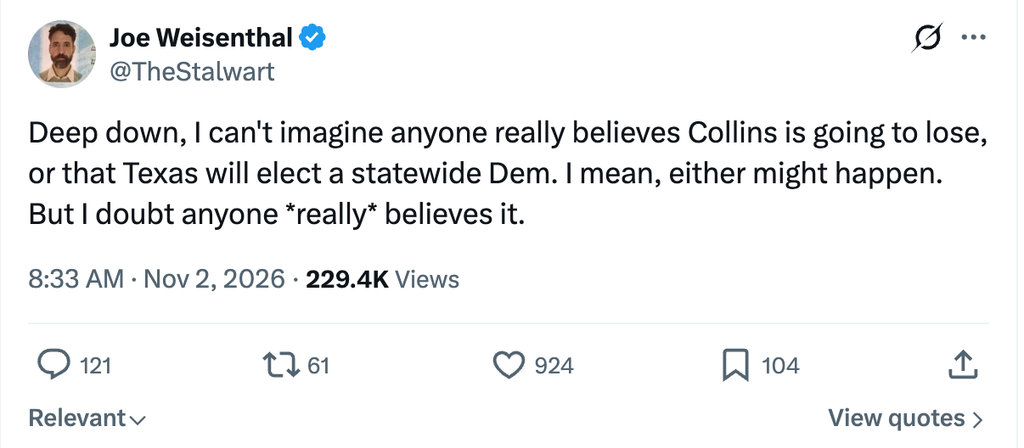
I mean, that clearly was not true. Using the imperfect betting markets, there was a 72% chance Collins would lose on Election Day, and a 71% chance that Talarico would win. I don’t know what kind of information bubble one could be in to believe that neither of these events were rather likely to happen. In a way, everyone was weighting their thoughts to 2024 recalled vote, where the politics of two years ago still resonated. But that wasn’t the case. Of course, weighting to 2024 recalled vote ended up being one of the largest sources of polling error in this election due to projecting electorates to be redder than they were in reality. In a sense, that is what the entirety of elite society did.
As I explained on stream a few times, the great issue of weighting by 2024 recalled vote is not that they will make polls less accurate (indeed, in the aggregate, I’m sure weighting by 2024 recalled vote did reduce some of the issues from the Republicans simply refusing to answer polls). Instead, while weighting by recalled vote reduces the variance of a certain result, it does open the poll to a large miss if the below scenario happens:
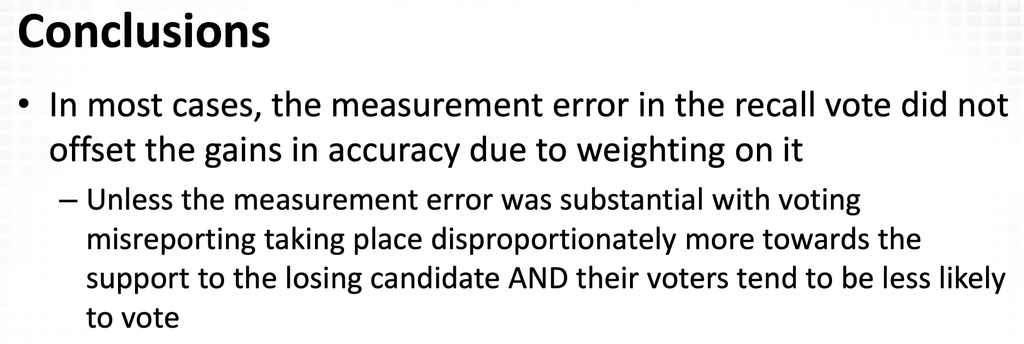
Indeed, the ultimate error on polls was, at some level, a function of this issue. By creating a turnout environment that did not exist and counting too many people who had lied about their vote, the polls failed. And then persuasion: if you weighted to 2024, you will have fewer ticket-splitters or Trump 2024 defectors than in real life.
I recently watched You Can See Everything, the new documentary by Lance Oppenheim and Nathan Fielder, and I was struck by the absurdity of Billy Evans, the tech bro-turned Elizabeth Holmes whisperer who beclowns himself for the entire picture. The farcical joke of watching Evans, presumably in 2025, solidified the truth for me that the right had simply lost all touch with reality. And it was even deeper and more delusional than any Democratic flight of fancy, which typically revolves around enriching a few nonprofits to do social services the state is too ineffective to provide. No, the right truly believed they had the public cowed, and that nothing they could do would ever have any blowback.
Except elections are always about blowback. They are an expression of a public pressure release valve, of people who are dissatisfied and want something better. The idea that people would magically like elites, or that the media would be able to persuade them of anything while gas was expensive, was always, always delusional.
2. Polling Error
Since no one in mainstream media wants to discuss it, yes, polls missed in favor of Democrats this year.
From our crosstab tracker and general vibes, I’d best summarize the cause of the miss as follows (nationally).
1-2 pts from turnout differential and “false recall” where polls got electorates that were “too Trumpy” because respondents lied and said they voted for Harris (the Chaz Nuttycombe Nagasaki article). Not to mention just assuming that the electorate would be bluer than what occurred in LV screens or whatever wizardry pollsters tried. However, keep in mind the D+10 or D+12 generic ballot polls were already projecting an enormous differential turnout advantage for Democrats, so the fact they got even more is remarkable.
The final NYT/Siena poll had a Harris +3 electorate, but the exit poll was closer to Harris +5!
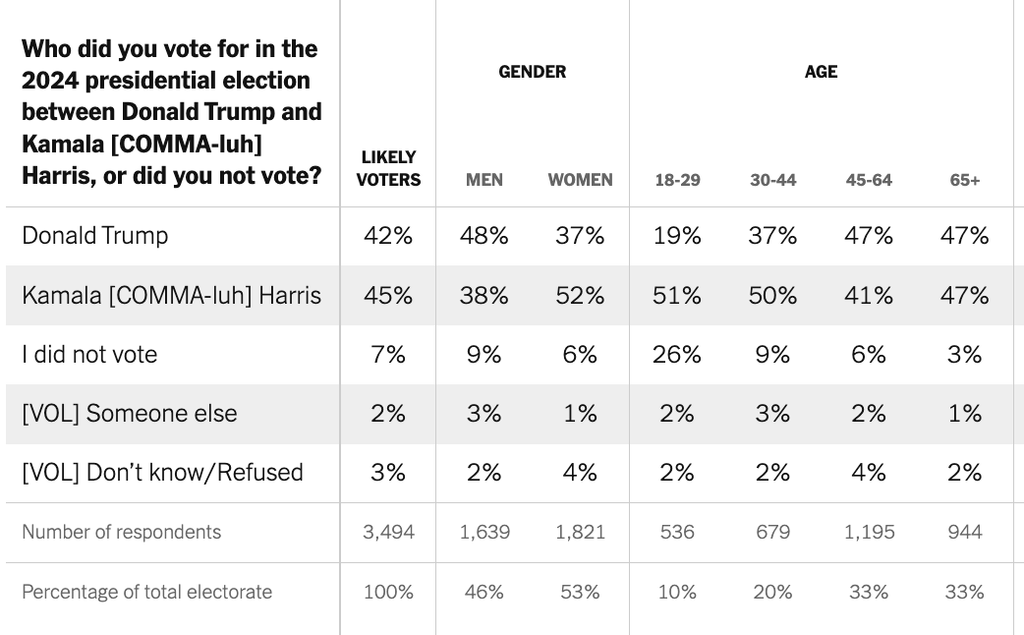
2-3 pts from persuasion: in the exit poll, Dems actually won 7% of Trump 2024 voters, while in most polls they were at 5%. They also did even better with independents than expected. Compared to the final NYT/Siena poll, Democrats did better than expected with young people and Hispanics.
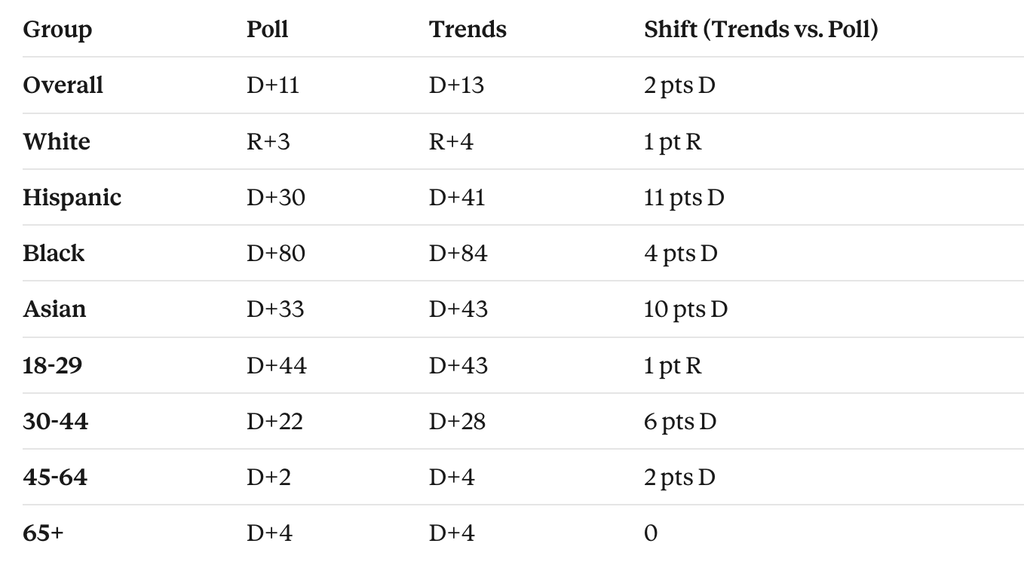
The false recall is correctable, as NYT/Siena proved with their “synthetic vote” estimates that adjust for liars. Persuasion errors are less fixable, and are downstream of repeated difficulties polls have surveying young and nonwhite voters.
Indeed, the biggest winners of this cycle were clearly StateNavigate, NYT/Siena, Suffolk, and AtlasIntel, all of whom took different approaches to accuracy. NYT/Siena, as mentioned, has novel weighting techniques, the most impressive ability to find voters, and years of data to estimate demographic swings. StateNavigate saw something with youth enthusiasm in polls and went with what made sense from 2025. Suffolk went for a more old-school approach, found lots of Dems answering the phones, and rolled with it despite past pollsters being afraid of their numbers. All were vindicated in their own ways.
This is just spitballing based on what I know of methodologies, but one factor in AtlasIntel’s now-legendary polling is heavily sourced from Instagram PPC ads. Those ads are much more likely to capture youth sentiment than phone polls or even YouGov, as the polls are generally very easy to complete
Still, no pollsters got everything right, despite the bragging of some. Some pollsters likely did get too many White Democrats in the Rust Belt and Plains in their samples (which is where recalled vote helped to balance out), while they missed the strength of Latino turnout and persuasion in favor of Democrats. The polls did worst of all in safe blue and red states, where they completely missed how badly Republican turnout collapsed. We will try to disentangle what happened once the results are fully in. In terms of accuracy, the Midwest was closest to reality, but everything else was terrible.
One tactic that is sure to go out the door for 2027 and beyond is aggressively weighting to the 2024 recalled vote, as Trump’s sinking popularity and Dem turnout strength make it a less useful metric. At this point, you have to assume the final electorate in 2028 will have voted for Kamala Harris by 1-4 points, as long as Trump’s approvals are this bad.
3. Persuasion or Turnout, the Endless Question
This question comes up in every election, even if it’s effectively the same answer every time. Persuasion and turnout are linked, and unless you have a very strange circumstance like 2022 or 1998, they will usually be tied.
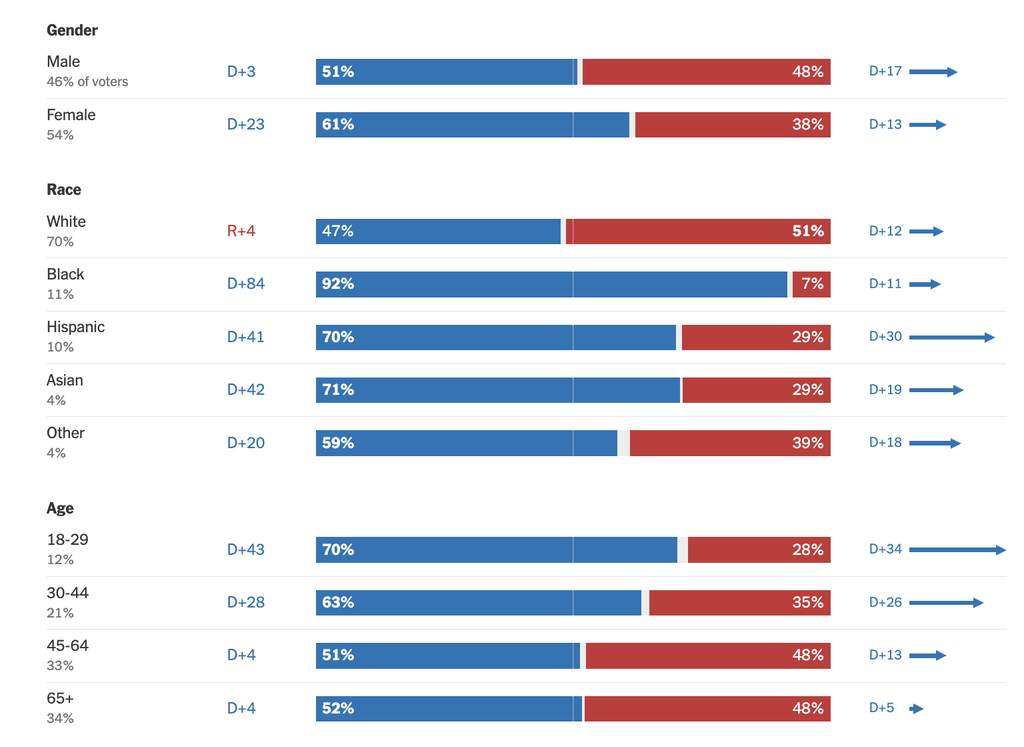
My estimate is around 60/40 or 55/45 in favor of persuasion this year. Don’t get it twisted by self-satisfied online pundits of any ideology: the Democrats persuaded a lot of voters this year. While some dissatisfaction with Trump among young voters led to poor turnout, many 18-29 voters simply switched sides, particularly nonwhite men. The Dems also made strong persuasion gains with every group, although they were heavily graded out by age.
In the exit poll and NYT Voter Trends, every year younger was indicative of greater swings to the Democrats. This led to enormous Dem waves in younger states in the South and West, where more young people live (except for Florida, rip).
And what about new voters, isn’t that a form of persuasion by default? Democrats in every state utterly dominated with new voters, winning them by 30 points according to NYT.
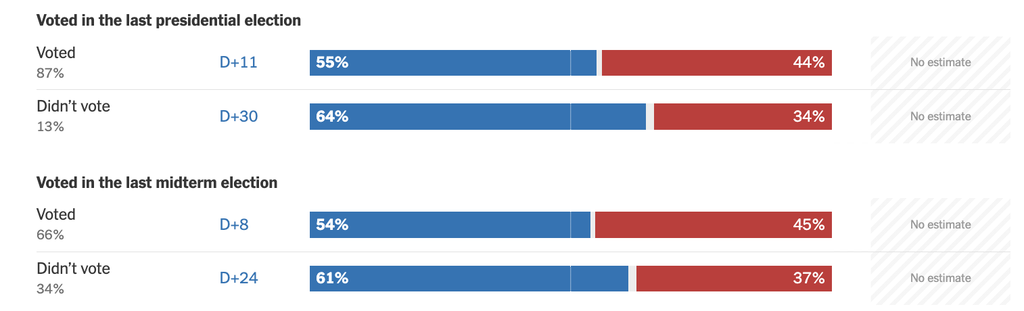
Meanwhile, Democratic turnout was simply unbelievable. In the South, supercharged Black turnout led to many counties granting some midterm candidates like James Talarico more votes than Kamala Harris received in 2024. It’s going to be hard to truly determine what persuasion was and what was turnout in a 16-point collapse like this.
Given that it was something like a Harris +5 or Harris +6 electorate, could we say 7 points bluer by turnout, and 9 on persuasion?
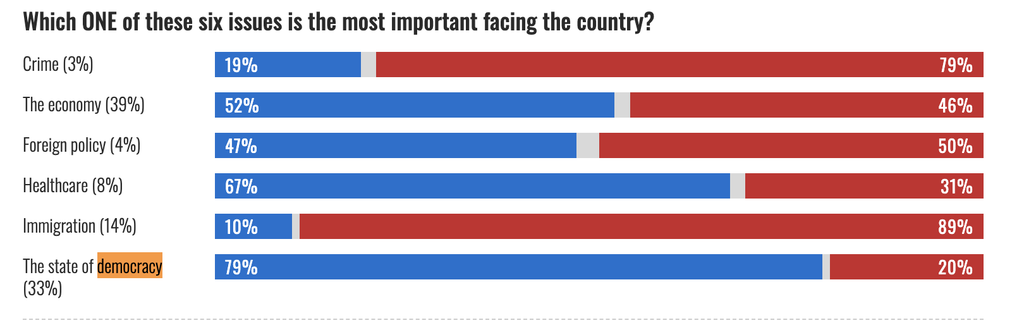
One note we harped on in our Discord was that stealing elections, gerrymandering, and threats to democracy simply boost the opposition’s turnout. The No Kings Protests and unprecedented Black turnout due to the Callais decision, undercovered at the time, were an expression of frustration at democratic backsliding and a sense that the system was rigged. Hardcore Democrats showed up to the polls with “threats to democracy” as their top issue, which was vastly different from Independents and softer Democrats who prioritized the economy. Aside from the whole business being scummy, the Republicans would simply be better off not feeding into the narrative that they are stealing elections or undermining civil society.
I find “the state of democracy” is a good issue proxy for outraged liberals and some insane Republicans who think the elections are rigged. That answer was top-of-mind for a staggering 33% of the electorate, higher than pre-election polling suggested.
Was Republican turnout bad? Yes, but not enough to ensure a loss of this magnitude. Given the amount of money they spent trying to get voters to the polls, it was poor, but the investments in states like Florida and Michigan did somewhat stop the bottom from falling out. States with little to no investment like Tennessee, Kentucky, and Utah saw epic swings left, enough to turn once safe red areas into competitive districts. But still, even without the awful turnout, Republicans were staring at a D+7 or D+8 environment on persuasion alone, as we saw they had those numbers in electorates that voted for Trump! Bad turnout caused that negative environment to turn into the Blue Tsunami.
We’ll have much more to write about what this means for 2028, but, for now, take a moment to realize that this midterm delivered the most left-wing Congress elected in the history of the United States. And all it took was the most disastrous administration of my lifetime!
About the Author