

This July marks the 16th year since Arcade Fire released The Suburbs, a Grammy-winning ode to the horrors/joys of suburban life. Since 2010, Arcade Fire’s frontman has faced allegations of being a sex pest, the band has effectively dissolved, and the country has undergone a sociopolitical sea change. But the suburbs…they’re still with us. Maybe they will always be with us, despite the best hopes of 2010s millennial urban planners and dreamers.
In the decade since Chuck Schumer infamously said that “For every blue-collar Democrat we lose in western Pennsylvania, we will pick up two moderate Republicans in the suburbs”, the suburbs have been a political cage fight. Ironically, for all the controversy and bad-faith dunks that ensued, Chuck wasn’t entirely wrong about picking up suburban votes, for a while.
In areas we consider “suburban”, 2024 was not kind to Democrats:
2016: D+5.4%
2020: D+10.8%
2024: D+6.6%
These are roughly matched by the Catalist estimates, which we assume are derived from a similar method + some polling. While the suburbs shifted left relative to the nation, they still swung 4% right from 2020-2024. And this is rather suboptimal since suburbs make up the second-largest number of 100K districts and a significant share of the overall vote.
The “suburban strategy” did notably work in 2018 and 2020, where Democrats were able to win dozens of House seats and ultimately, a trifecta through gains in suburban areas. However, the Biden era saw some serious reversion, and by some estimates (it depends on what you consider a “suburb”), we’re back to where we started in 2012 or 2008 on the exit polls and Catalist estimates, and only a tad better than 2016.
What went wrong?
What is a “suburb” anyway?
You’d be shocked how difficult this question is to answer, at least from an electoral perspective. Catalist defines suburbs as taking up a whopping 56-59% of the electorate. Edison has it as slightly less, ranging from 50-52%. What about ElectionCord? We only classify about 25% of total votes coming from suburbs, based on a metric that’s purely density. These classifications cause the margins to be very different, as getting too many “rural” or “urban” areas of the country causes compositional changes.
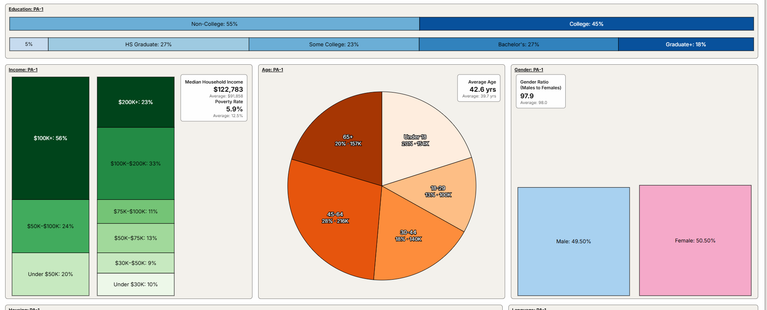
The truth is that suburbs now encompass anything that isn’t a city and anything that isn’t desolate farmland. The days of suburbs being cookie-cutter subdivisions filled with Whites, while still prevalent in many areas, are on the decline. Suburbs are increasingly diverse, growing, and getting denser than in previous years. Changes to zoning laws, a rise in immigrants and young people moving in, and expensive housing in cities have led to continued increase in suburban life, much to the chagrin of urban planners out there.
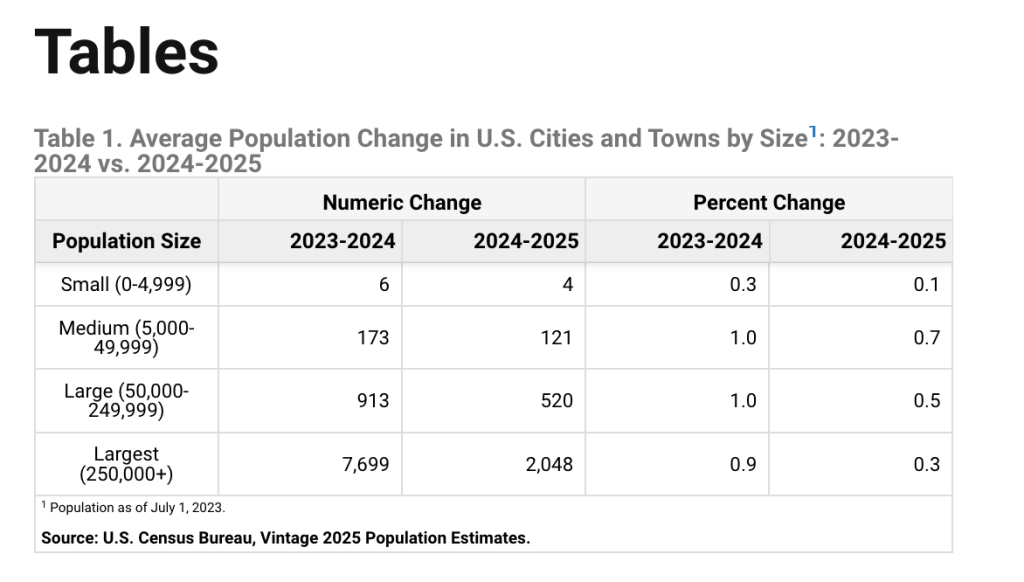
According to the latest Census data, medium-sized and large-sized areas are growing fastest.
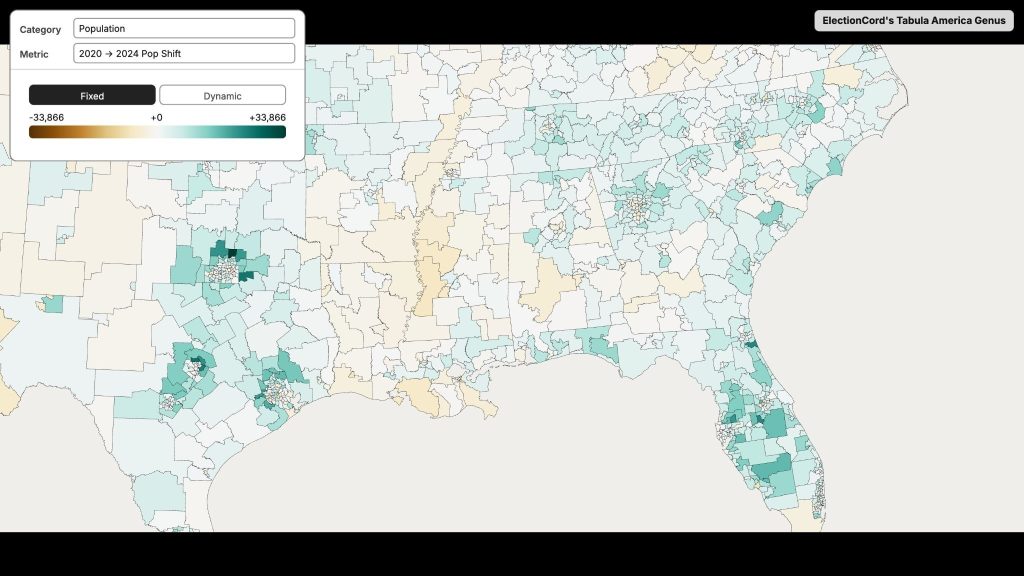
When combined with the drops in urban population due to the dislocations of 2020-2021, the result is enormous growth in suburbs and exurbs. Once again, looking at a map of population growth from 2020-24 in the South, you can see suburban areas shooting up, while urban areas stay stagnant and rural areas slightly decline.
This is repeated in blue states like Washington. Sidenote: Washington and Colorado are the only blue states that have enough population growth to even be considered in this analysis.
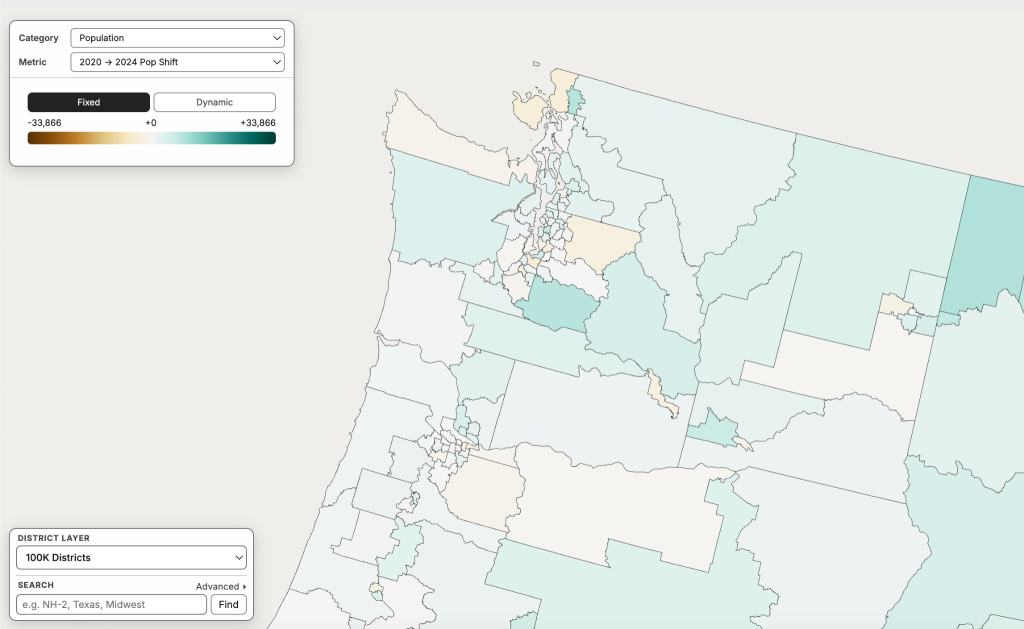
So, the suburbs are only going to continue to grow in power. Recent declines in net migration due to Trump’s inhumane immigration policies are going to primarily hit urban areas first, as they largely relied on recent immigration to make up for losses. Combined with structural factors, we can expect more suburban seats in the 2030 Census than ever before.
What can the Democrats do?
As stated, the “suburban strategy” of the 2016-era Democrats has been, at best, a complete wash. While Democrats were able to make serious gains in 2018 and 2020, they failed to hold them in 2022 and 2024. This failure is notable given Democrats banked on suburbs becoming a reliable voter base for years to come.
Compared to their abysmal vote losses in urban areas, Democrats still managed to hold up better in suburbs. In Wisconsin (Milwaukee), Colorado, Washington, North Carolina, Virginia (Richmond), and Georgia (Atlanta), the Harris campaign was able to expand on gains Democrats had been making over time. The general narrative of those states is that these suburbs are adding the Democrats’ strongest soldiers: Black voters and White college-educated professionals.
However, these gains mask atrocious suburban numbers in the Northeast, Mid-Atlantic, non-competitive Southern states, California, and the roiling nightmare that is Florida. Given that those areas have a far greater population, they managed to draw down any incremental gains Dems made elsewhere. And boy, was it bad.
Since people are tired of looking at the catastrophic New York results (and yes, the suburbs of New York were not spared), let’s take a closer look at Southern California.
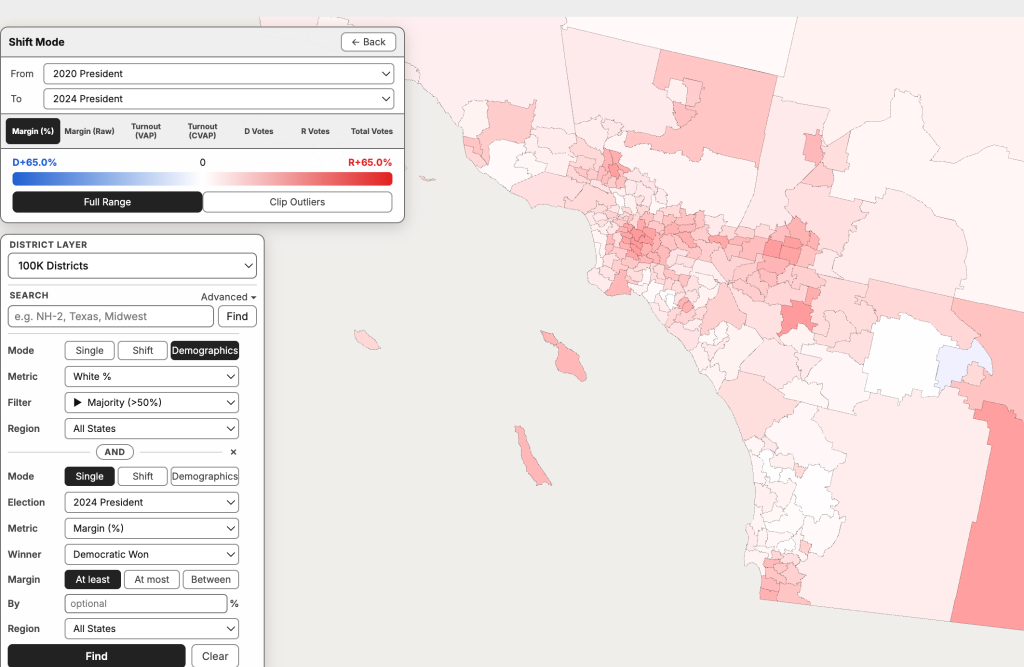
The blast radius from Dem collapses in urban areas spread to the suburbs, just somewhat less than inner-city districts.
Across our demographic research, we have found one constant: the less you spoke English at home, the more you swung right against Democrats in 2024.
When looking at all 3,392 100K districts, we found a stunning 0.594 R2 correlation between “Speaking English Less Than Well” and how much an area swung right.
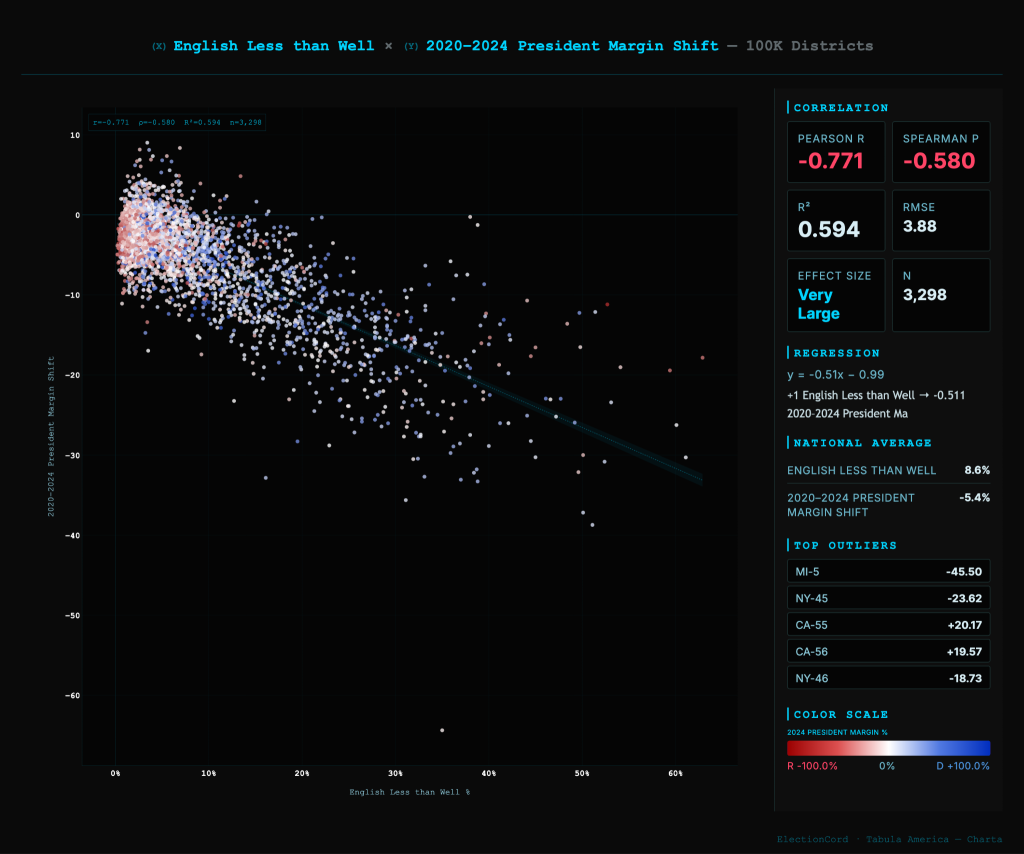
While this chart is heavily influenced by cities, we also find that more diverse suburban areas swung further right against Democrats in 2024. Suburban counties like Fairfax County, VA and Westchester County, NY did not hold up for Democrats. And they did not persuade enough White voters to make up for any of these losses, let alone the urban ones.
2016 to 2024 swings don’t look much better.
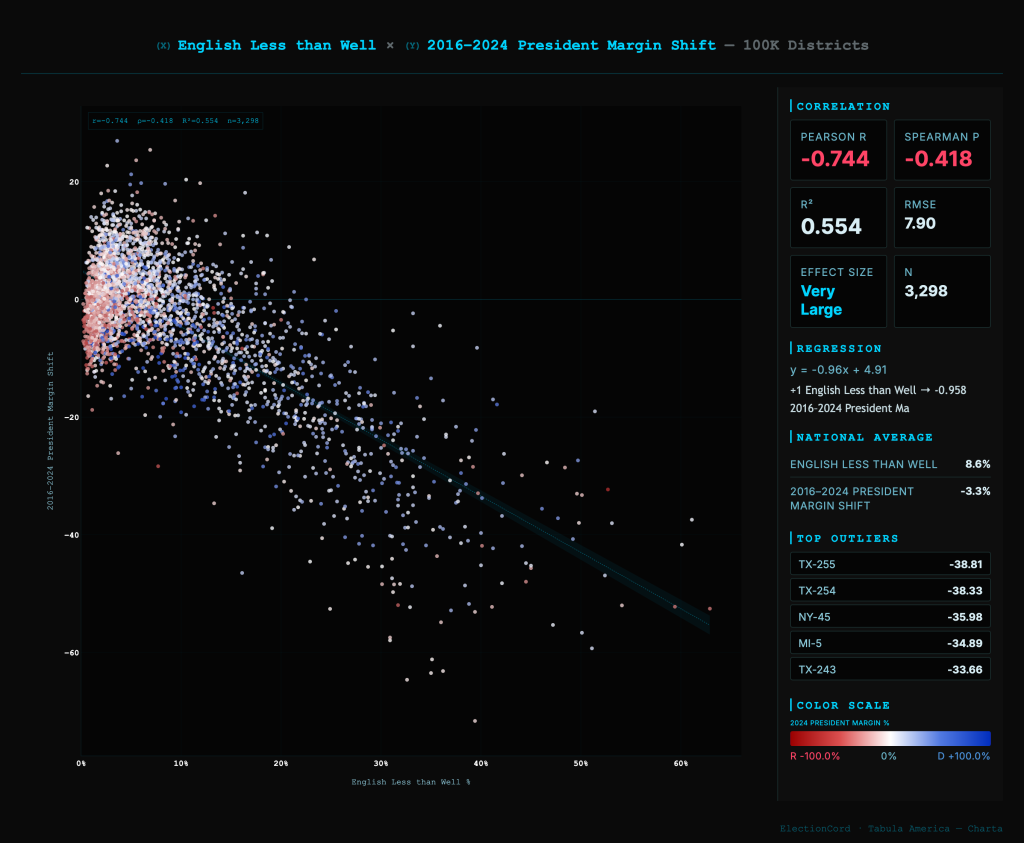
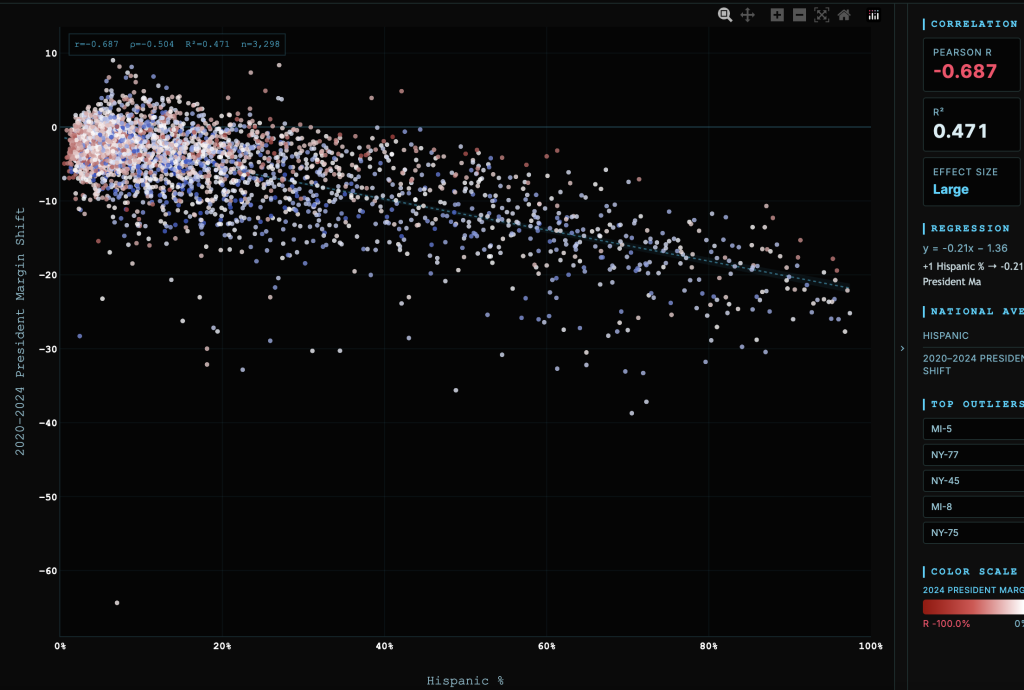
Astonishingly, this effect is even greater than just the trend with Hispanic voters (r^2 0.55 vs. r^2 0.47), suggesting Dems lost even more ground with those who couldn’t speak English as well.
And a similar effect shows up for “foreign-born” voters.
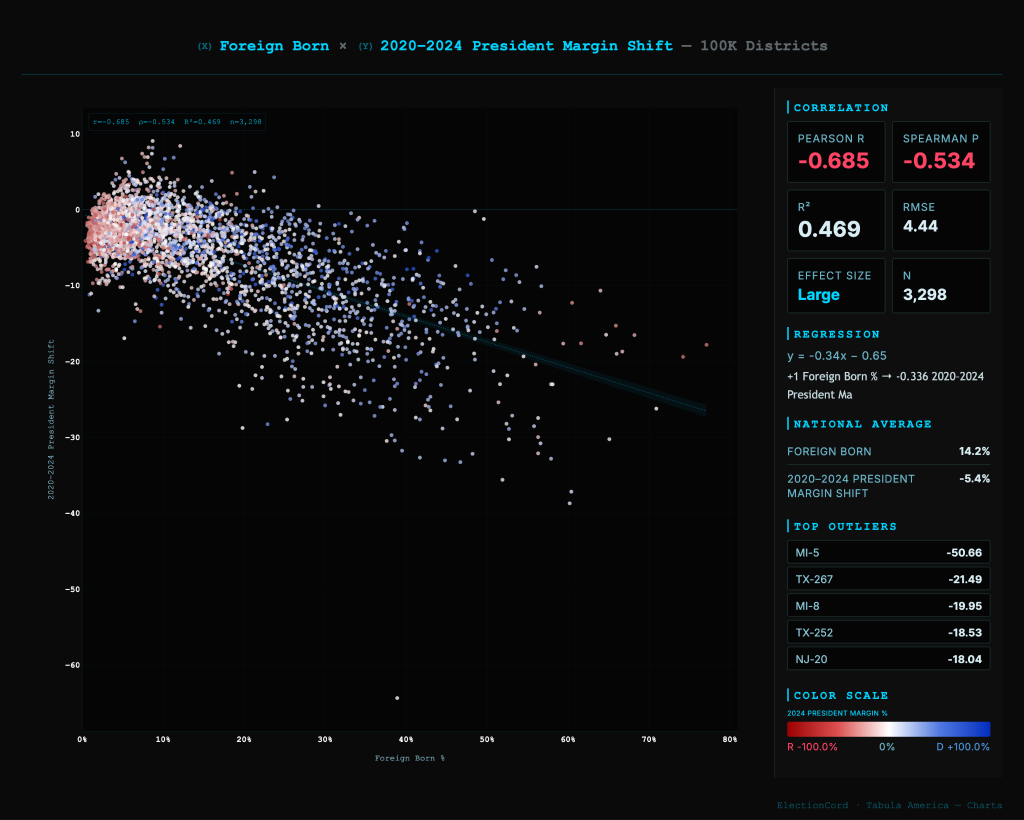
Because suburbs are rapidly diversifying, this is not a good trend, and throws a massive spanner in the works of Democratic attempts to win votes in the suburbs. Gaining with White voters is all well and good, but if you are losing another part of the coalition that also live in the suburbs, then you aren’t exactly winning the suburbs over.
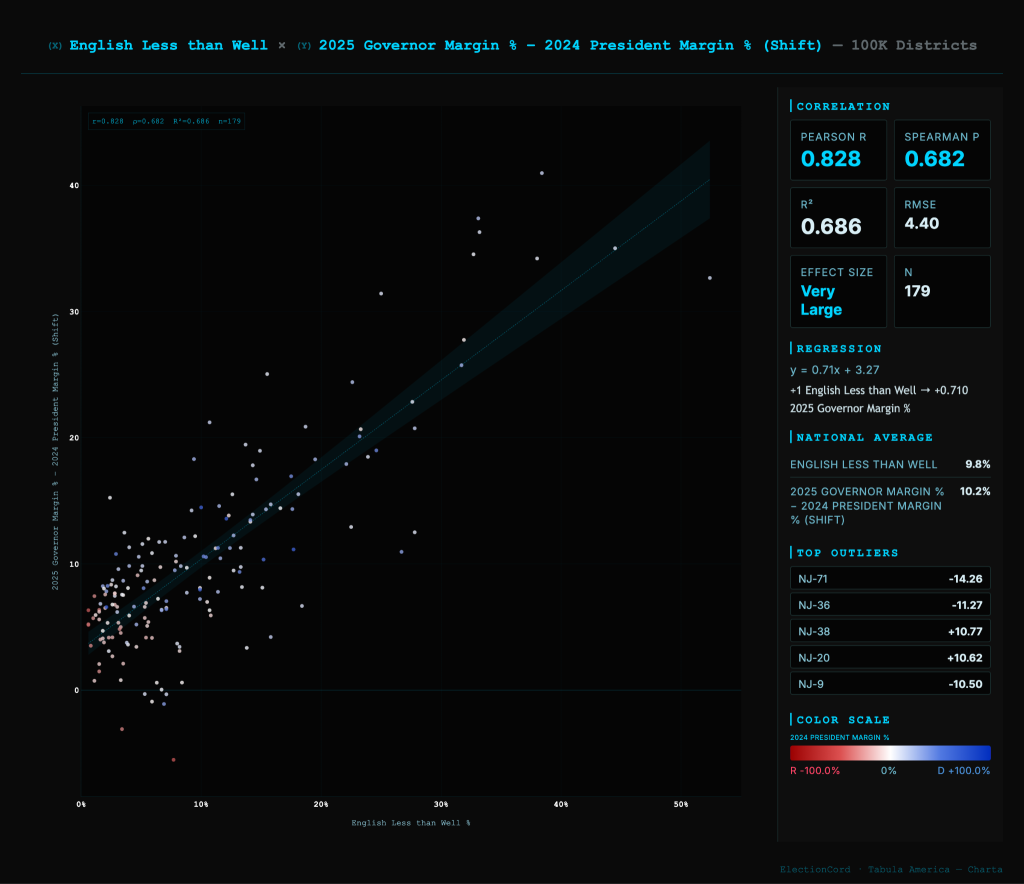
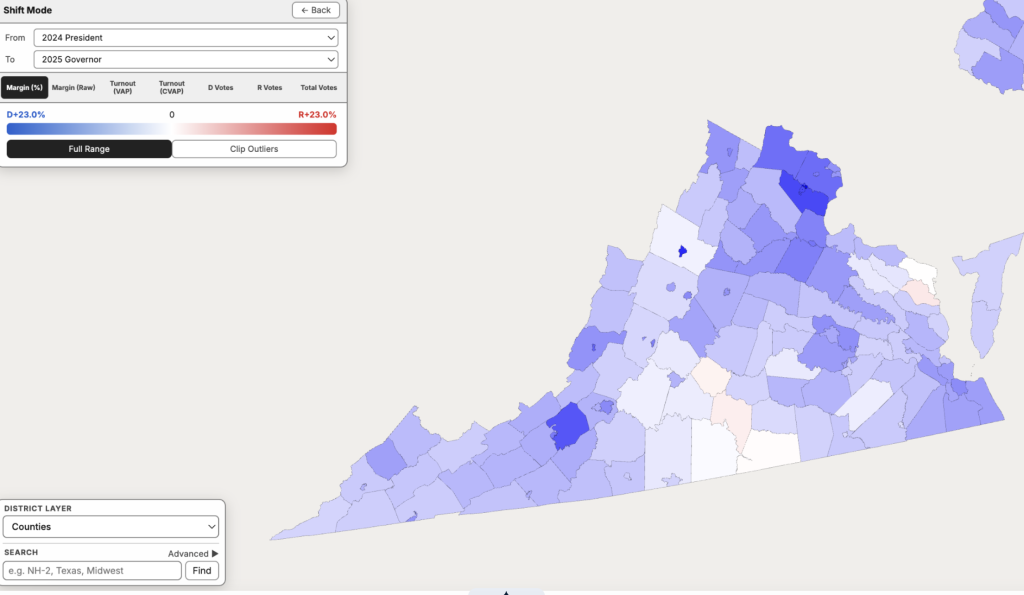
However, from 2024-2025, we saw some of the largest swings back to Democrats in those diverse suburban areas. In Virginia and New Jersey, both gubernatorial candidates saw those areas snap right back. Using our Charta tool, we found a strong correlation between speaking English less than well and swings back toward Democrats from 2024 president to 2025 governor.
There was also a weaker, but still notable correlation between increased population density and swings from 2024-2025.
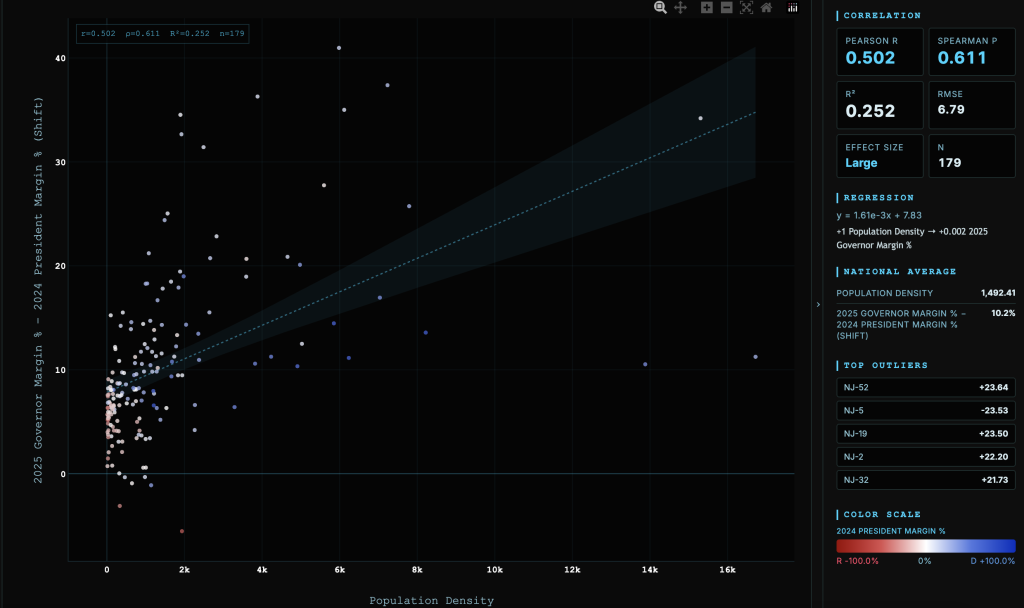
While the sample size is small, some of the biggest gains from 2024-25 once again clearly came from middle-class, diverse suburbs (think Loudoun, Fairfax, and Prince William Counties).
Why is this all happening? Good question!
Is everything ladder-pulling?
What do suburban voters really want? In the Democratic mind of 2016-2021, perhaps influenced by the experience of the 1990s, suburban voters are envisioned as White, higher-educated, and concerned with stable and responsible government, normalcy, and incremental progress.
Unfortunately, those concepts have largely failed Democrats post-2020. The easiest explanation is inflation, cost of living, and poor economic vibes, all of which were cited most often in 2024 exit polls. This would cause, in miniature, the suburban swings we saw against Democrats after the 1970s. While less dramatic than the collapse of the Great Society/New Deal consensus, it’s easy to imagine a more moderate suburban voter getting frustrated at the rising cost of living while Democrats appeared to focus on issues preferred by the base.
This is a difficult reality that the initial “Schumer suburban strategy” never accounted for, which is ironic given how many Democratic leaders grew up during the 1980s and viewed it as the optimal path. The fact that more centrist messaging on national security, the rule of law, and democracy failed is as sobering as the proposed failures of progressive identity politics. At the end of the day, perhaps the most uncomfortable truth is that the vast array of suburban voters isn’t a special class but is responsive to the same trends as everyone else.
It’s fascinating that the suburbs have still diversified significantly, giving Democrats a potential advantage under Obama-era coalitions, but has now caused significant backlash post-2020. The losses among suburban minorities bring to mind the phenomenon of “ladder-pulling”, where immigrants and second-gen Americans want to pull up the ladder and not let anyone experience their success. Since recent immigrants have no political rights and cannot oppose this, they become an easy target. In this way, suburban voters, White and Nonwhite alike, viewed the Biden administration as a threat to their position, whether it was expressed through backlash to immigration, LGBTQ+ rights, inflation, or whatever a voter sees as ragebait on Instagram Reels/WhatsApp.
Unfortunately, you do have to credit Republicans for reversing the narrative of the previous decade. The Republican economic message rarely gets discussed by Democrats, but to many suburbanites, the vague promises of tax relief and Trump’s occasional populist pablum were, at the margins, a reason for voters to flip or join the Republicans. In addition, they were able to constantly repeat this message through more foreign-language media and alternative media streams that are becoming more salient to voters than traditional news networks. After all, Trump is a businessman, he will fix everything!
However, recent poor ratings for the Republicans on economic concerns now give the Democrats a golden opportunity to make big gains in the 2026 midterms, where the suburban vote will be a larger factor than in a presidential year.
A brief note on Wisconsin
We’re just going to use this space to advocate for ranked-choice voting in Democratic primaries. There is no reason that five candidates dropping out for Wisconsin governor after ballots had already been sent (and then one going back in!) makes any sense or is fair to voters. And voters not being able to spoil and recast ballots is also a travesty.
As for general election projections, we reserve the right to comment after more polling has been established. That said, a slate of generic ballot polls point to a D+8 to D+11 environment, and it’s hard to feel good about any Republicans in close races.
About the Author