

On July 24th, the DNC seemed to decide a long-standing debate in the party: What should the order of states be for the 2028 Election to determine the Democratic nominee for President? Traditionally, Iowa has gone first, followed by New Hampshire, with Nevada and South Carolina often voting before Super Tuesday as well.
However, this order got complaints that minority support wasn’t being taken into consideration. This is a fair point, as Iowa and New Hampshire are well above 80% White. To determine a new order, the DNC decided the following: one state from each region will be picked, as well as 2 wild cards; all will take place one week after the next, before Super Tuesday. The new order goes as follows: South Carolina (South), Nevada (West), New Hampshire (Northeast), New Mexico (Wild Card 1), Michigan (Midwest), Virginia (Wild Card 2).
We wanted to take a closer look and see what this really means, and what state is the most important now in deciding who will be the Democratic nominee in 2028. We went through each state’s demographics and election history to see what kind of candidates could be favored, and what a winning strategy might look like in each state.
January 22nd: South Carolina
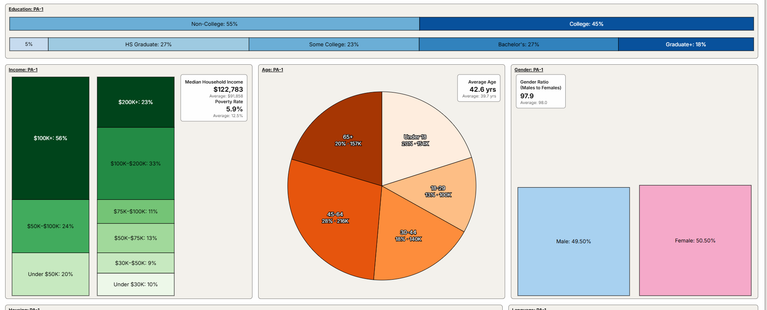
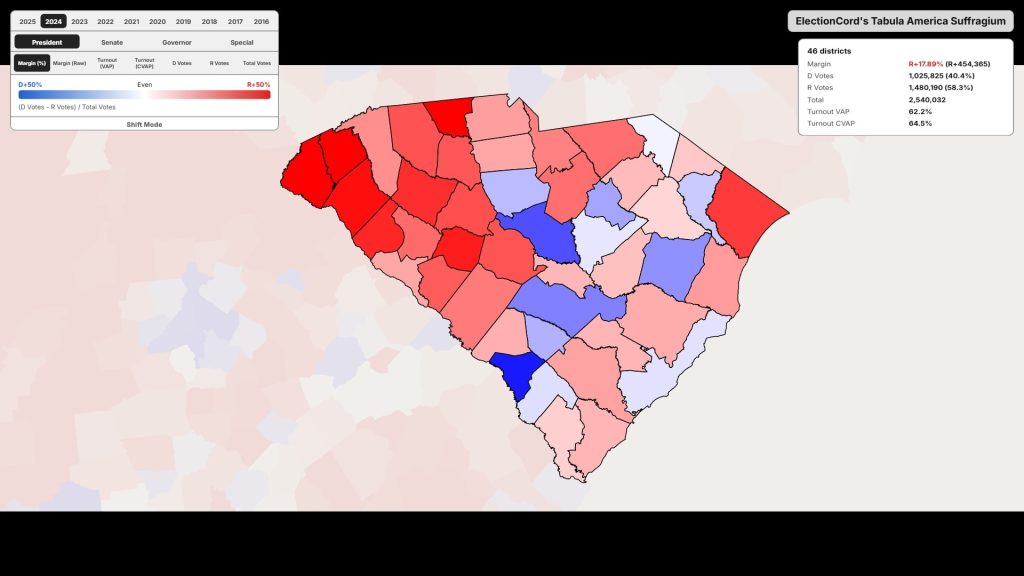
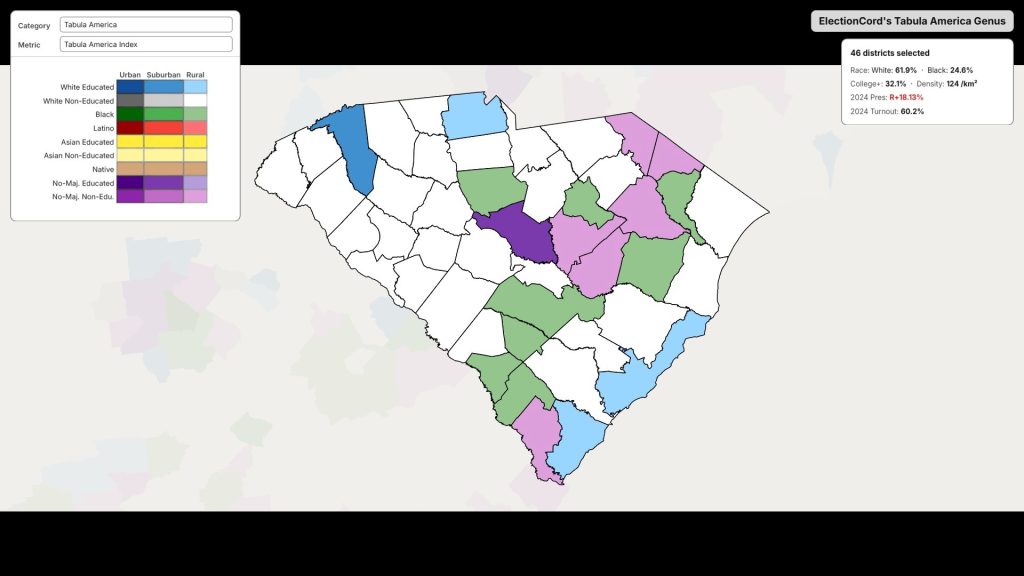
State Overview (By County)
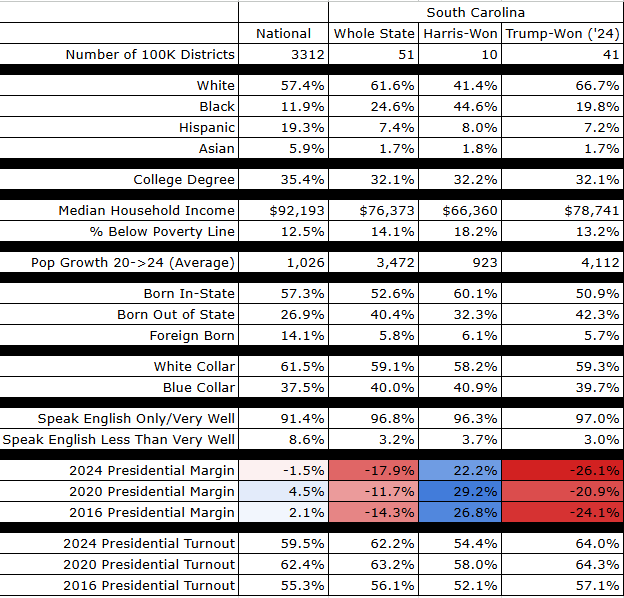
State Overview (By 100K District)
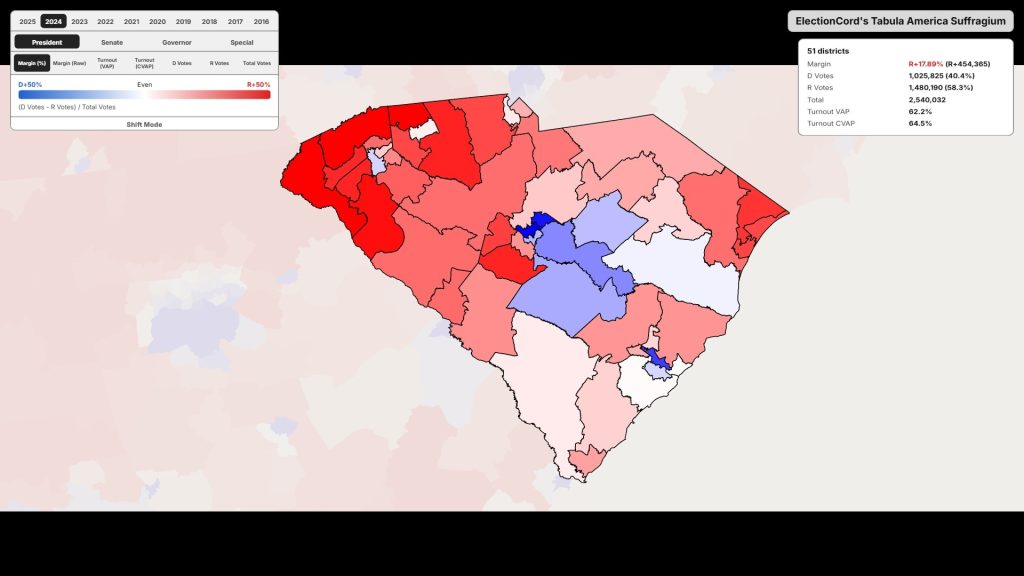
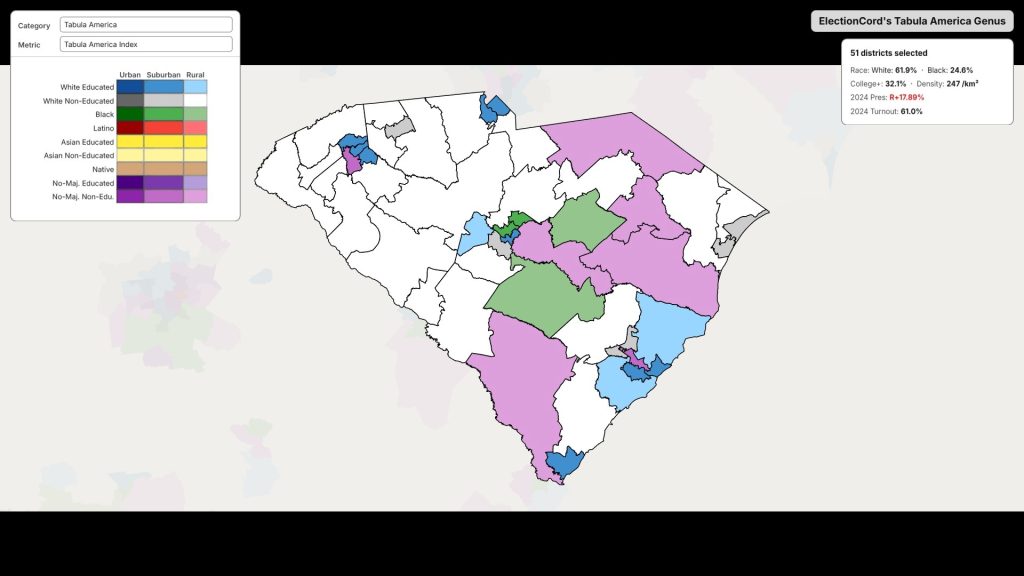
South Carolina, despite some pushback, was chosen as the first state and the “Southern” state of choice. The main reason for the pushback is because of what happened in 2020. During that primary, Bernie Sanders had the momentum, winning Nevada and doing better than VP (at the time) Biden in Iowa and New Hampshire. However, Jim Clyburn, the only Democratic Representative in the state, and one of the top Democrats in the House, endorsed Biden, leading (allegedly) to Biden easily winning the state. For the record, Clyburn’s endorsement is likely overblown, as Biden would almost certainly have won the state regardless (Biden was consistently polling ahead with Black voters, and Bernie had failed to consolidate White voters).
Its primary will take place on January 22, 2028, and interestingly, it’s the only state that’s solidly Republican among the first 6 states. While it’s been a state that’s gone early over the past 20 years, it was likely chosen first this year as a continuity pick and to gauge candidates’ support among Black voters, a key demographic in any primary. The Democratic-won areas in 2024 are plurality Black, so in theory, the key here will be to win the Black vote. The real question is, how important is South Carolina really? You’re probably thinking this is a dumb question since it’s the first. Not so fast. It makes sense, but the very early states are there to thin out any pretenders, rather than to determine who’s going to win. Buttigieg won Iowa in 2020, and dropped out before Super Tuesday. Ted Cruz won Iowa in 2016, and look how that worked out for him.
Regardless, what kind of candidates would do well in South Carolina? It’s almost certainly going to be someone who can do well with Black people, so a more moderate, establishment candidate will do well. Someone who also has high name recognition will probably win as well, given that there are going to be so many candidates campaigning in the state. While there are some pockets of high-education areas with Democratic voters, they’re certainly in the minority here, and are in places like Charleston, Hilton Head, and Greenville. Even in South Carolina, they might be split between moderate and progressive candidates.
That said, you absolutely should not put all your resources into one state, and especially not South Carolina. You should spend time in the state and spend on ads, but no one should be going all-in here. Between the 4 early small states, you should spend your time evenly in them (although we will get into the most important leg later).
Upstate South Carolina (Greensville, Rock Hill)
17/51 Districts
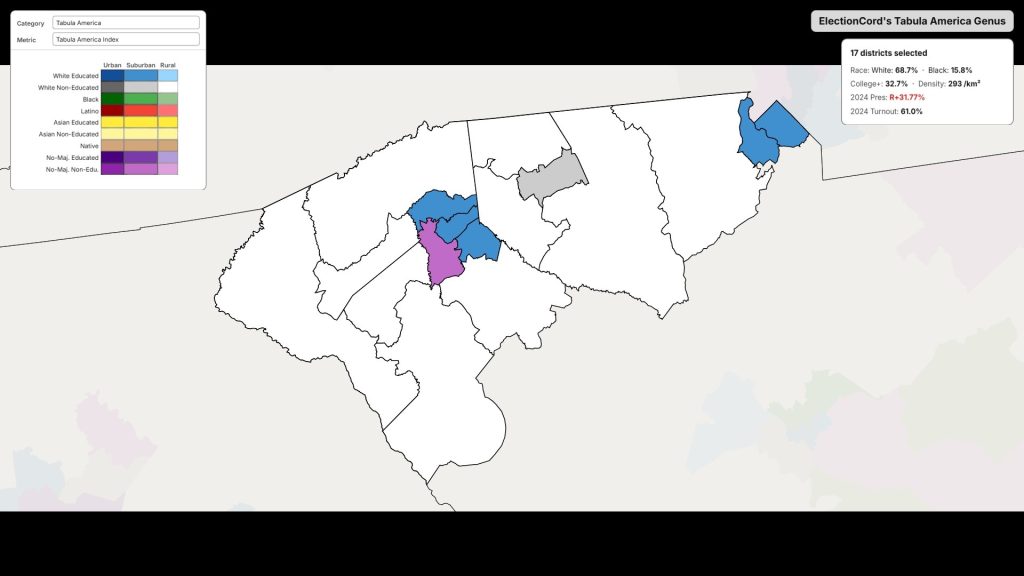
Greenville and Upstate are core Republican territory in the state. Just as a comparison, if you remove this from the rest of the State, Biden only lost South Carolina by 4% in 2020. Of course, you can’t just ignore Republican areas in a primary like this; there are still going to be a LOT of Democratic primary voters in those regions. The core areas here would be urban Greenville and Rock Hill, a suburb of Charlotte. Clemson University and Spartanburg are here as well, but Clemson (the town) is not huge, and Spartanburg is somehow more Republican-leaning than Greenville is. Upstate is not super educated and is overwhelmingly white, so who does that favor? Most likely, it will favor more populist candidates, and possibly candidates further to the left. Just a reminder that Lindsey Graham in his primary election (when he was alive) didn’t do all that well here, because of a populist that was further to the right.
Columbia and the Black Belt (Columbia, Orangeburg, Florence)
14/51 Districts
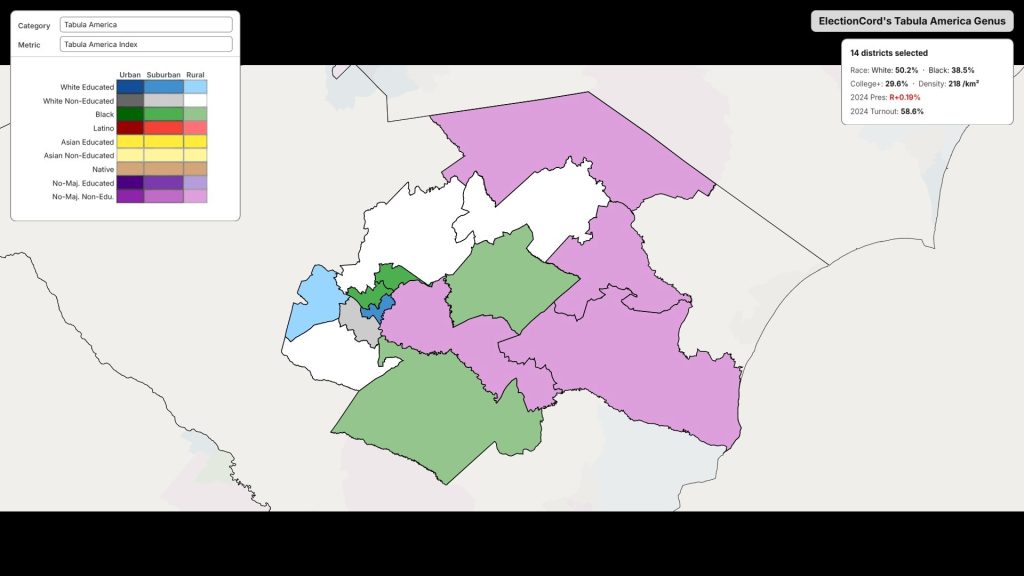
Conversely, this is core Democratic territory, what you probably think of when you hear “Democrats in South Carolina”. This is where most of the Black population lives in the state, and is a part of Jim Clyburn’s district, so he will certainly have an influence here. There’s not too much that needs to be said, other than if a candidate can win this, they will probably win the whole state. Again, someone who’s more moderate on social issues and part of the establishment wing will do well here, and a lot of candidates will set up shop in places like Columbia, Orangeburg, and Florence.
The Lowcountry (Charleston, Hilton Head)
11/51 Districts
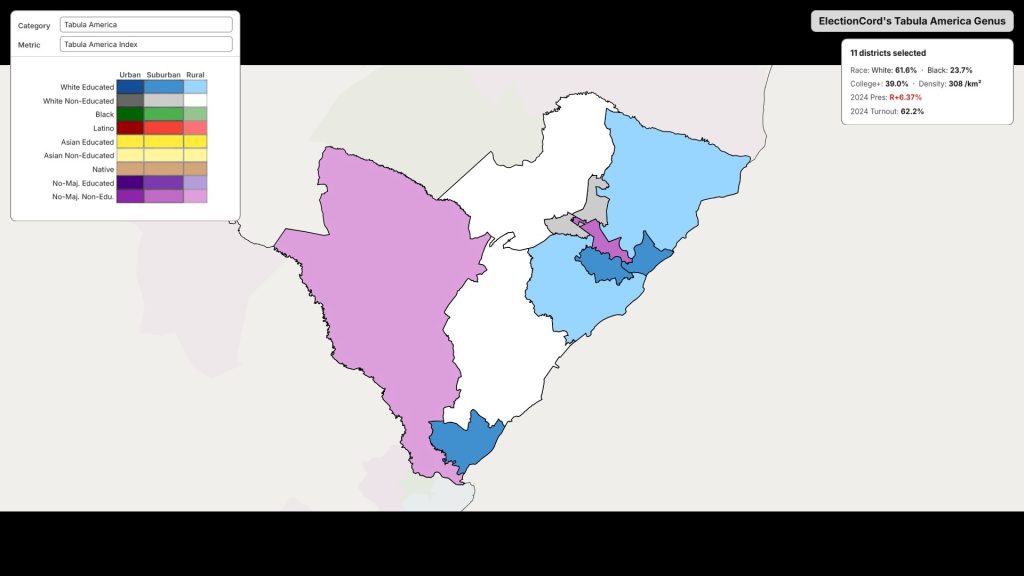
My old stomping grounds, this is where a lot of the educated people live in the state, whether that be older retirees who are more affluent, or younger families looking for a lifestyle change. This is traditionally called the Lowcountry because it’s littered with wetlands and swamp-like areas, and well… it’s at sea level. While the area tends to be white-collar, because of its high education, there’s also a big tourism industry throughout the area, with a lot of beach resorts in Charleston and Hilton Head. The kinds of candidates who will do well here are people who are in-between establishment moderates and the more “insurgent” left. Basically, anyone from AOC to someone like Jon Ossoff will see a big amount of support here, and it’s worth noting this is consistently one of the highest turnout areas in the state.
Misc. White (Myrtle Beach, Aiken)
9/51 Districts
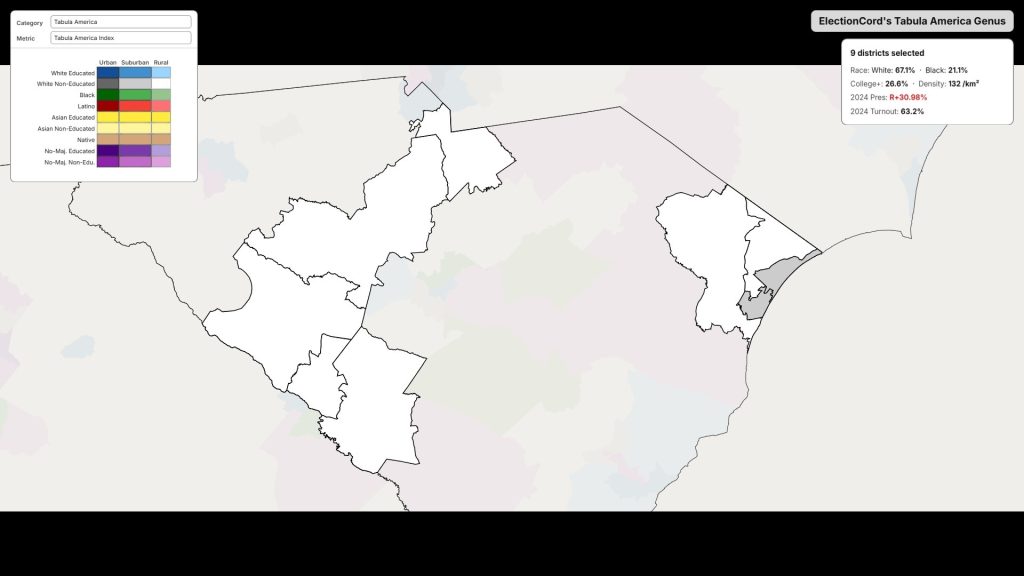
Finally, we have the other areas that don’t really fit in one of the areas of South Carolina. Myrtle Beach goes here, which, unlike the Lowcountry, isn’t educated and is way more Republican because of that. There are also a smattering of white areas like Aiken in between Columbia and Upstate. It’s the R+infinity areas, and there are not a ton of Democratic voters here.
February 1st: Nevada
State Overview (By County)
State Overview (By 100K District)
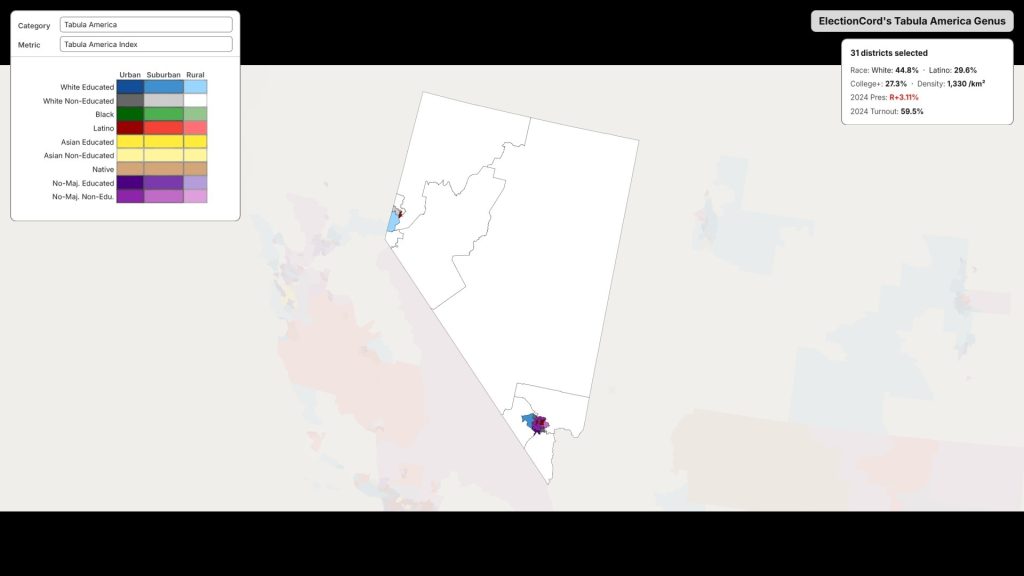
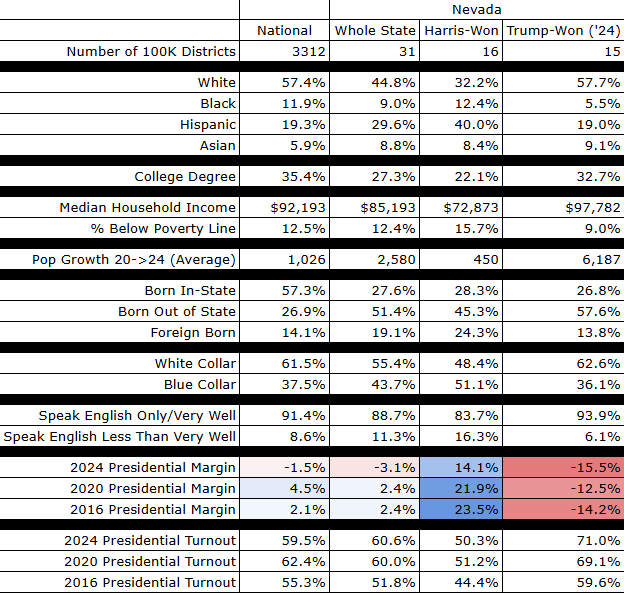
The second state, Nevada, will have its primary on February 1st. In 2020, this state was third and was Bernie Sanders’ best early state by far, who got 34% of the vote. The main reason it got bumped up to second and was a contender for the first state was that it’s a swing state with a large Hispanic population. 30% of the state is Hispanic, including 40% of the Harris-won areas in 2024. The Hispanic population will be critical in 2028; if Democrats can get back a lot of the support they’ve lost over the last 8 years, it will make things a lot easier for them, and this will be our first look at how contenders will do with them. But like South Carolina, the main thing is not who wins, but who does badly. If a candidate does badly with Hispanic voters, it should probably take them out of contention, as Dems can’t afford any more losses.
Besides that, it’s a pretty interesting state, for a few reasons. The industry and occupations in Nevada are different from every other state. If you noticed, only 55% of people in the state are white-collar, and a majority of people in Harris-won districts are blue-collar. That’s because the entertainment and hospitality industries are huge in Nevada, particularly in Las Vegas, and pretty much are the economy of the state. That’s why you’ll typically see union endorsements there be such a huge deal, especially the Culinary Workers Union. One other thing is that very few people in Nevada were born and raised there. Only about 30% of people who currently live there were born in the state, compared to 57% for the national average.
With all this in mind, who has the advantage here? It’s interesting, despite the idea that Hispanics tend to be more conservative socially, Bernie Sanders has done well here in the past. It’s likely that Sanders’ more populist and socialist flavored economic policies appeal to a lot of the blue-collar workers and Hispanic voters. Funnily enough, though, the Culinary Workers Union doesn’t like Medicare for All, so they’ve declined to endorse in 2016 and 2020 in the Dem Primary. I would imagine someone like AOC would be favored to win, as the name recognition and economic policies would appeal to a lot of Dem primary voters in Nevada, just like Bernie in 2020. If she does not run, it would be a little more up for grabs, but the more progressive candidates seem likely to be favored.
Las Vegas
23/31 Districts
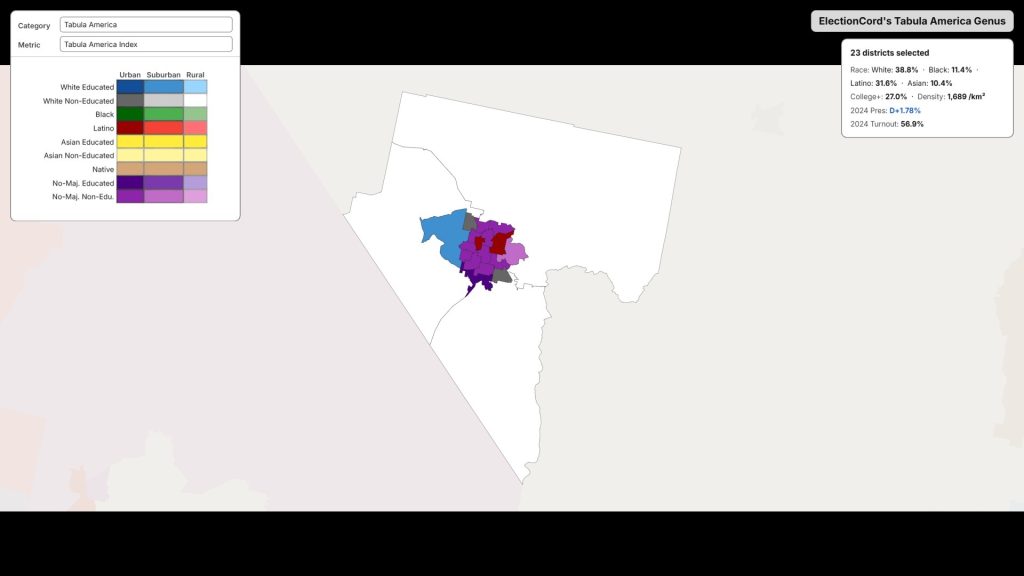
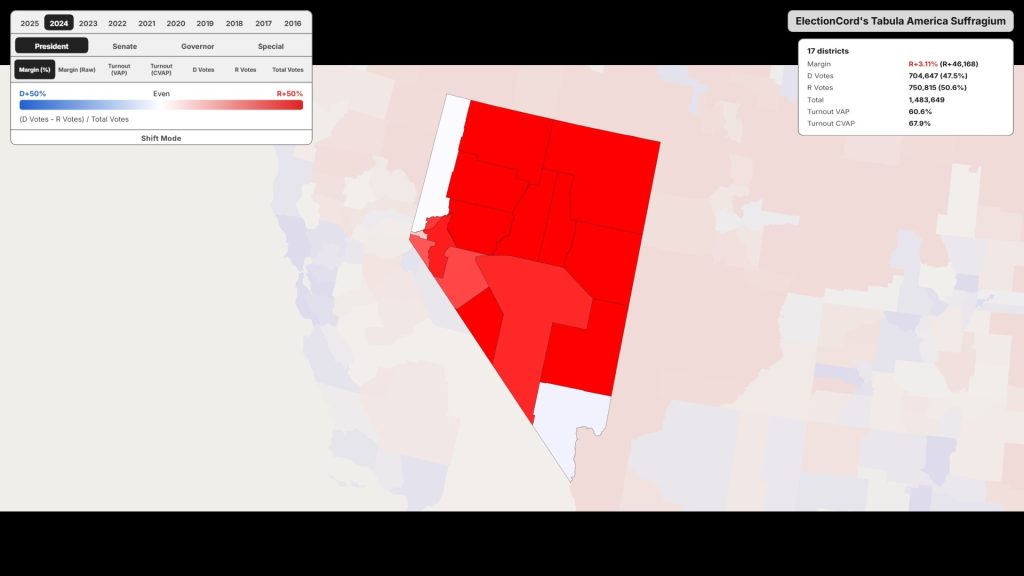
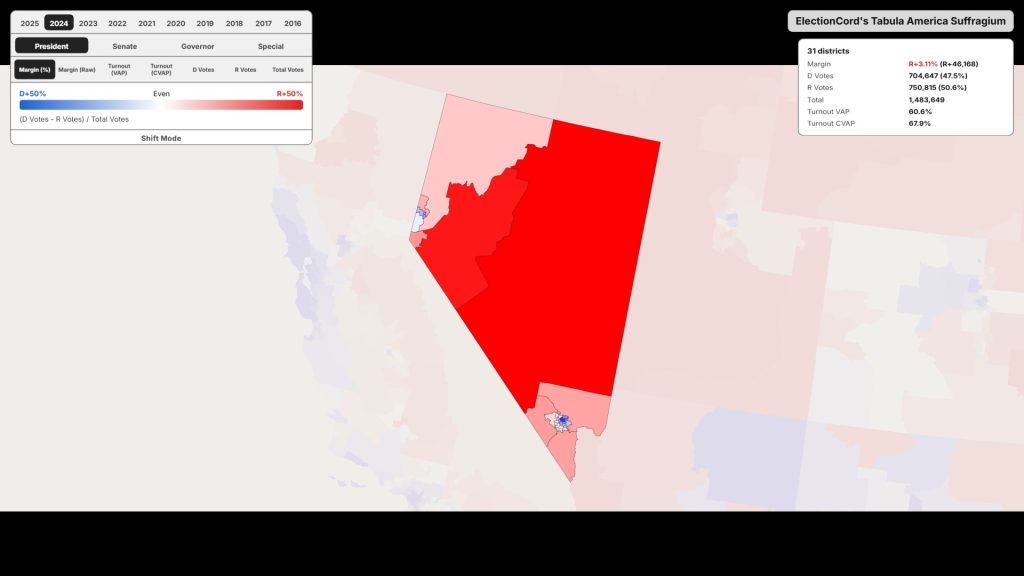
The thing about Nevada is, it’s basically just Las Vegas, with a few people living in Reno. 23 out of the 31 100K Districts in Nevada are in Clark County and Las Vegas. One thing that shouldn’t go unmentioned is that there is a decent amount of Asian people within the metro, at just over 10%. They’re a contested bloc, and tend to be in the more White areas, especially in the southwestern part of the metro. Here’s an interesting fact: NV-1, one of our 100K Districts, is both the 100K District with the lowest college graduate percentage and the highest blue collar percentage in the entire country. You can basically divide the metro into 2 parts: a Hispanic/minority core that consist of blue-collar workers, and the White suburban areas that tend to be white-collar, retired, or… chuds? It’s kind of unclear, but Las Vegas is unusual for sure.
Everything Else (Reno, Carson City, Area 51)
8/31 Districts
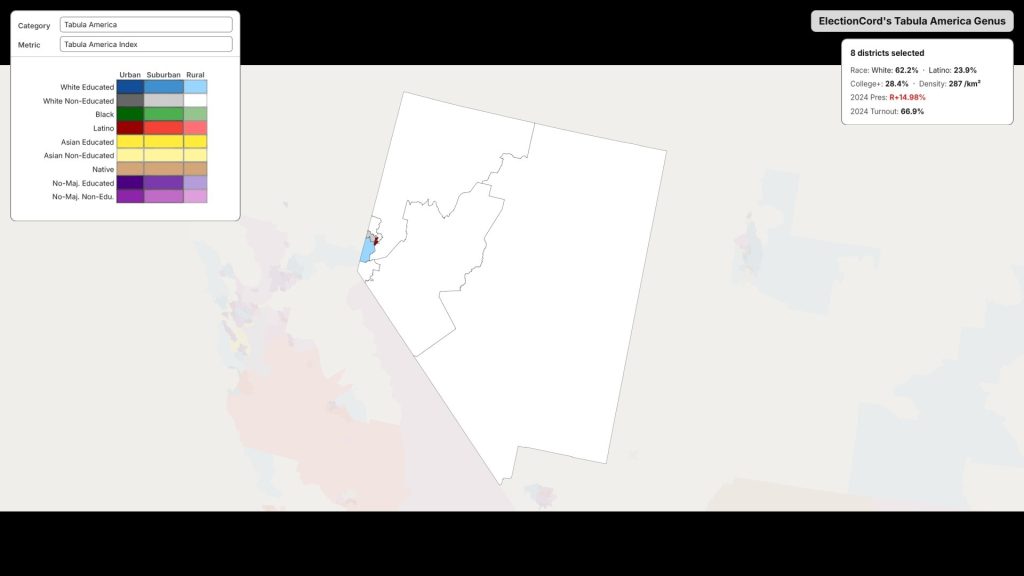
The only area of note, besides Area 51, in the rest of Nevada is Reno. The Reno metro has about 500,000 people, including the capital city of Nevada, Carson City. Reno isn’t really that different from Las Vegas, as it also has a lot of casinos and entertainment. It likes to call itself “The Biggest Little City in the World”, so take that for what it’s worth. There’s about 200-300K people in the rest of the state, so while technically not nothing, it’s probably worth it to stick to Las Vegas as a candidate.
February 8th: New Hampshire*
State Overview (By County)
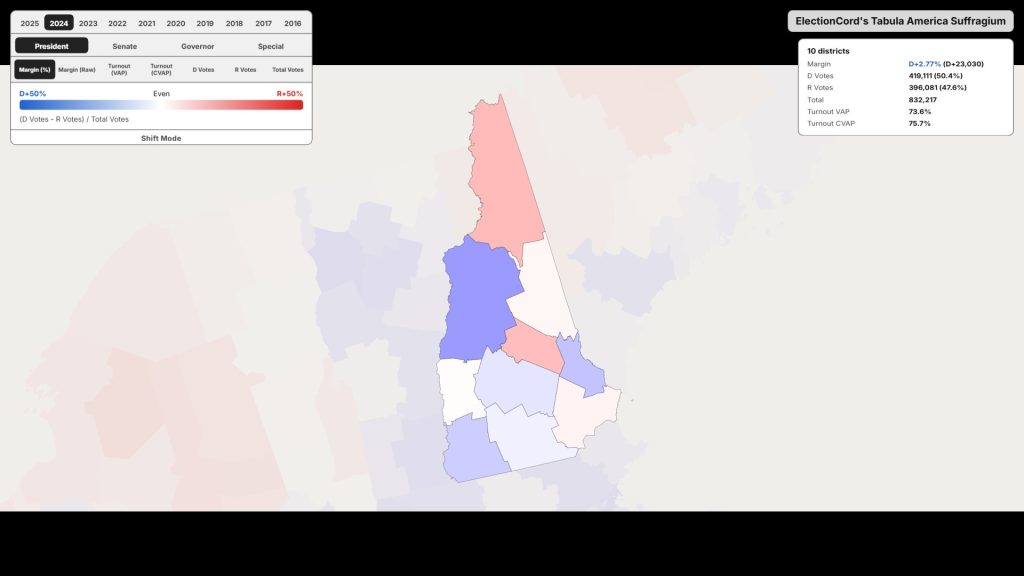
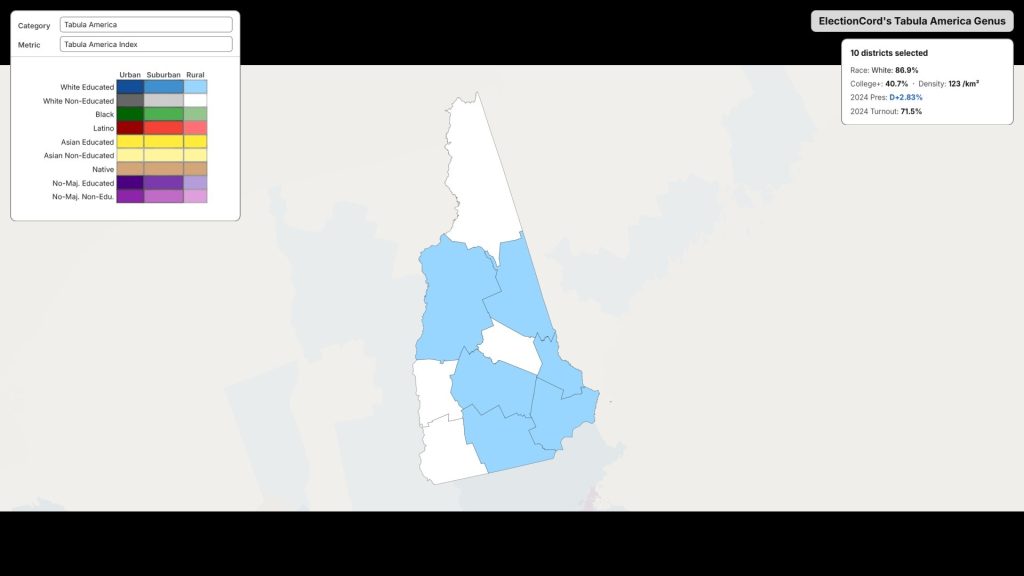
State Overview (By 100K District)
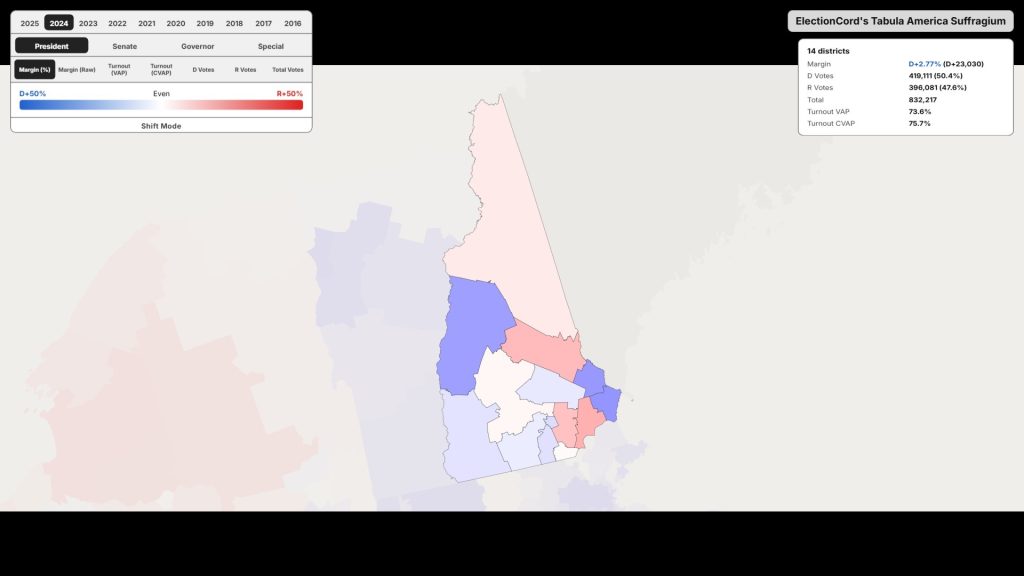
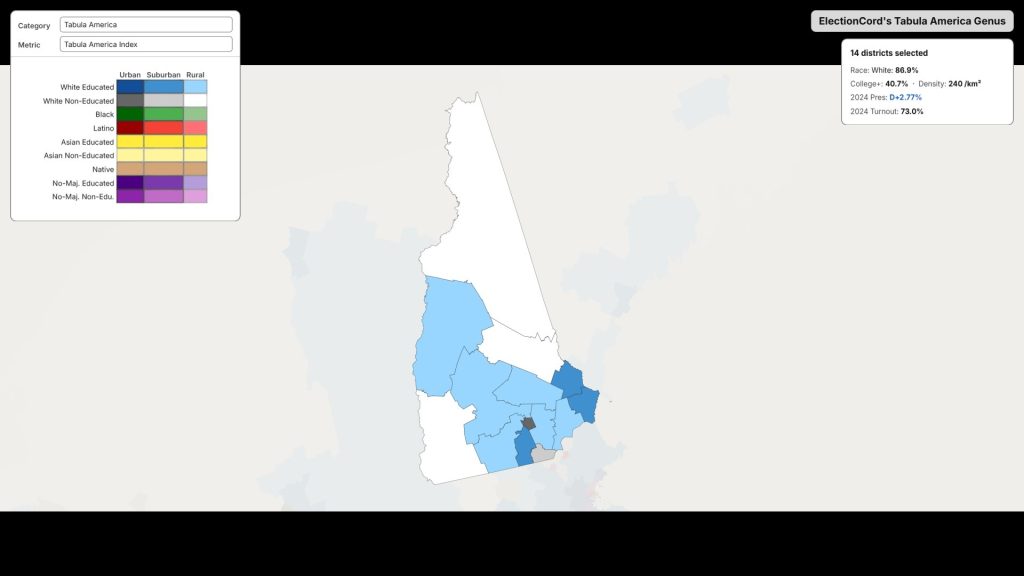
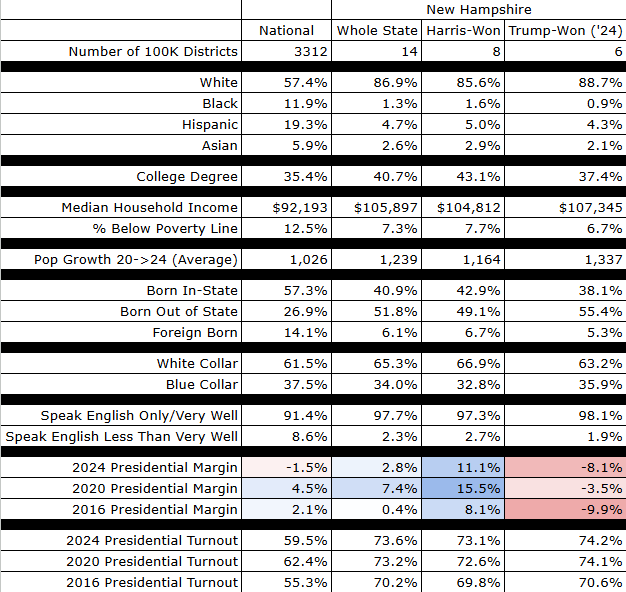
Unlike every other state in this list, New Hampshire doesn’t really have specific “regions” we will be covering, as the state is pretty small and homogenous. The only divide you could make is the Southeastern part of New Hampshire, where a lot of people who work in Boston and Massachusetts live, due to lower taxes. The state is overwhelmingly White, being the 4th-Whitest state in the country, and pretty educated, with just over 40% of people holding at least a Bachelor’s degree.
If you noticed, New Hampshire has an asterisk next to its name and date, and it’s the only state in the list that may have its primary date changed. New Hampshire famously has a law that states that it must be the first primary in the country (Iowa was a caucus), and some people in New Hampshire are not too happy about being bumped back to third. Many Democrats have been unhappy with New Hampshire being so significant in the schedule, because as noted earlier, it’s not representative of the Democratic electorate. New Hampshire may try to challenge this, or just hold their primary earlier in defiance of the Democratic Party, but for now, we’re going to assume it will take place on February 8th.
So, what kind of candidates will do well here? Well, New England is weird, especially Vermont, New Hampshire, and M*ine. There is a strong Libertarian slant in the state politics of all these states, with even some Republican politicians (like Vermont Governor Phil Scott) being socially liberal, while economically conservative. In short, people just want to be left alone. Bernie Sanders won New Hampshire in both 2016 and 2020 (technically tied in Delegates with Buttigieg), mostly thanks to him being a Senator next door in Vermont. Candidates like Buttigieg and Klobuchar also had their best performances here. In all seriousness though, New Hampshire will probably be one of the harder states to predict, at least without polling. Whoever Sanders endorses may have an automatic advantage, or maybe the voters here will go for someone who has high name recognition. Whether it’s third, or somehow becomes first though, it probably won’t be that important who wins, again, as long as you don’t do REALLY badly.
February 15th: New Mexico
State Overview (By County)
State Overview (By 100K District)
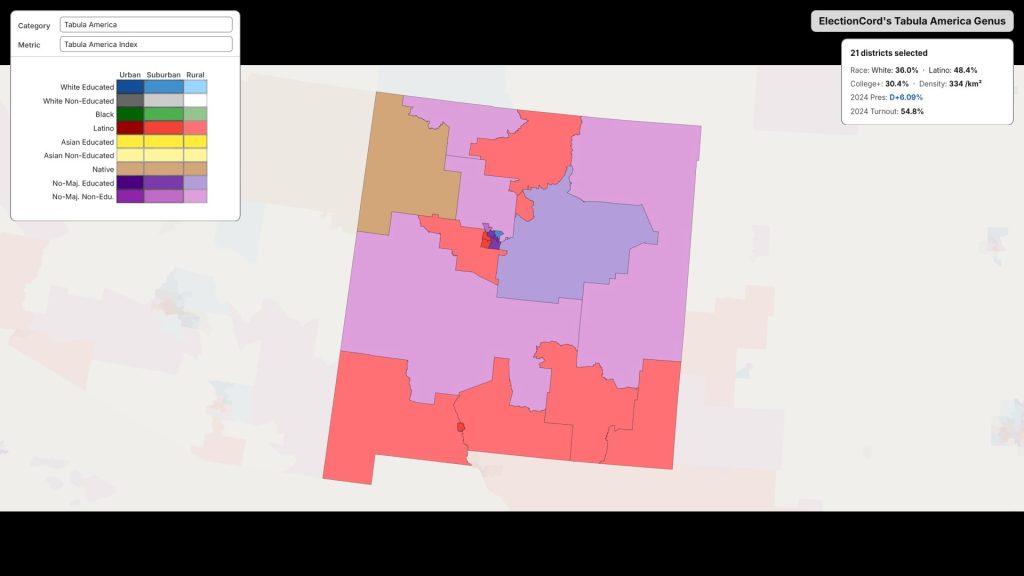
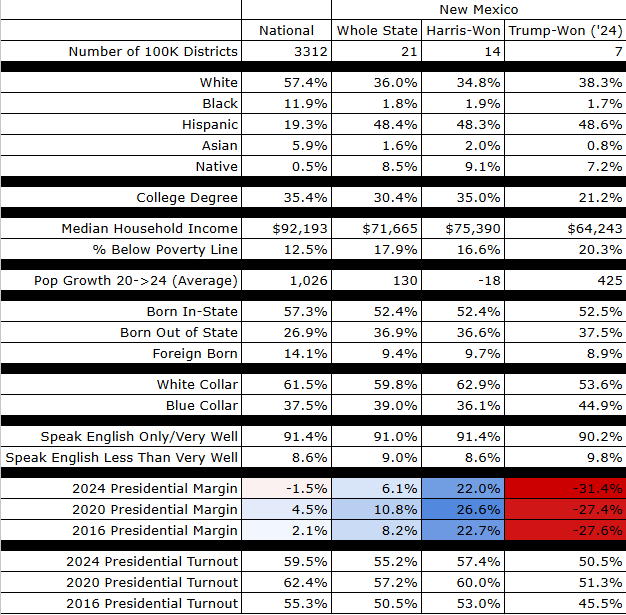
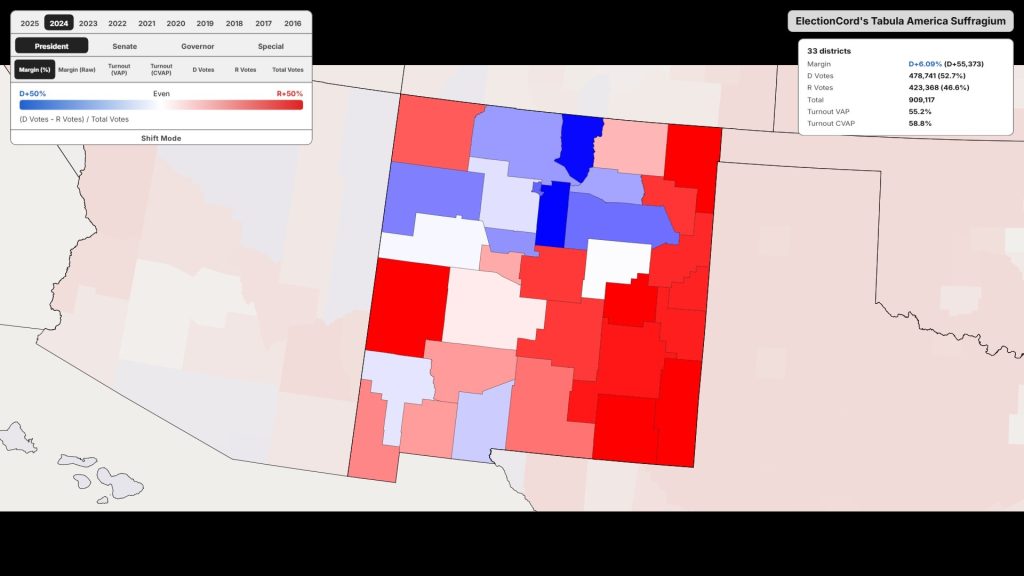
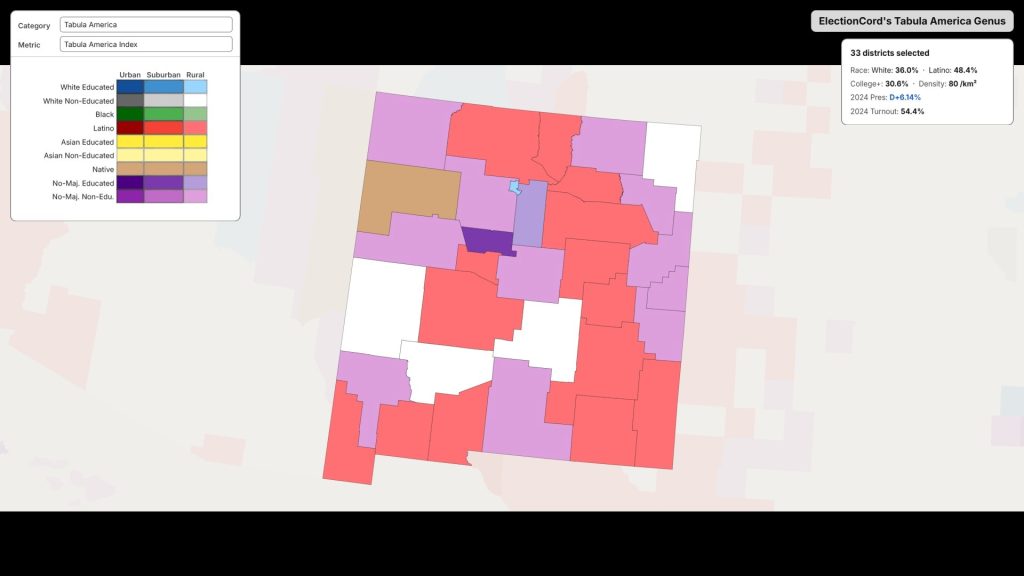
New Mexico is the last smaller state left in the early group, is fourth in the primary order, and was the first wild card state selected by the DNC. Its primary will take place on February 15th, and keep in mind, it will take place less than a month after South Carolina’s primary! New Mexico, in a lot of ways, is similar to Nevada. It is actually plurality Hispanic, one of only three states to be so, and only one 100K District is majority White. Unlike Nevada, though, the occupations and industries in the state tend to be more conventional, and unlike almost every other state, there’s a sizable Native population, mostly being Navajo in the northwest. In fact, it’s one of only three states (Alaska and Arizona) with a majority Native 100K District. While they are only 8.5% of the state, candidates will almost certainly be trying to get endorsements from Tribal leaders.
Although a plurality of people in New Mexico are Hispanics, Spanish language ads may not be as important as you’d expect. Only about 9% of people don’t speak English fluently, and only 9% of people were foreign-born. In other words, a lot of the Hispanic population were born in the state, and may be more assimilated than, say, Nevada’s Hispanic population. It will certainly matter, especially near the Mexican border, but not vital to winning here. There’s also a pretty huge divide between the Harris- and Trump-won 100K Districts when it comes to education. While the Harris-won districts are roughly average in Bachelor’s Degree attainment, the Trump-won areas are far below the national average.
While South Carolina, Nevada, and New Hampshire have traditionally been early states, and thus have had competitive primaries, New Mexico has been one of the last states in recent primaries. Biden won it with everyone else having withdrawn in 2020, while Clinton narrowly won it in 2016. Honestly, it was a great showing for Sanders, who was clearly not leading at that point, so between that and the similarities to Nevada, a progressive candidate would likely do well here. While a lot of the Democratic officials in New Mexico aren’t exactly progressive, the Democratic electorate here probably favors more left-wing economic policies. New Mexico is one of the poorer states in the country, and things like Medicare for All and an increase in Social Security payments are likely going to be winners. The final thing to be said about New Mexico is that there will likely be a deliberate strategy by some candidates to focus on both New Mexico and Nevada more than South Carolina and New Hampshire, as the two states are very similar and close to each other.
Albuquerque
7/21 Districts
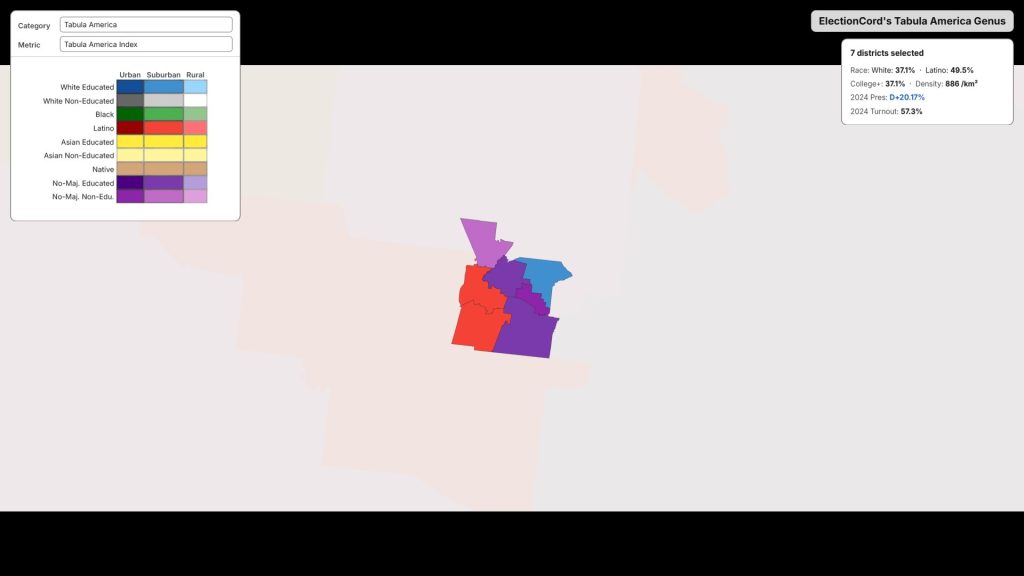
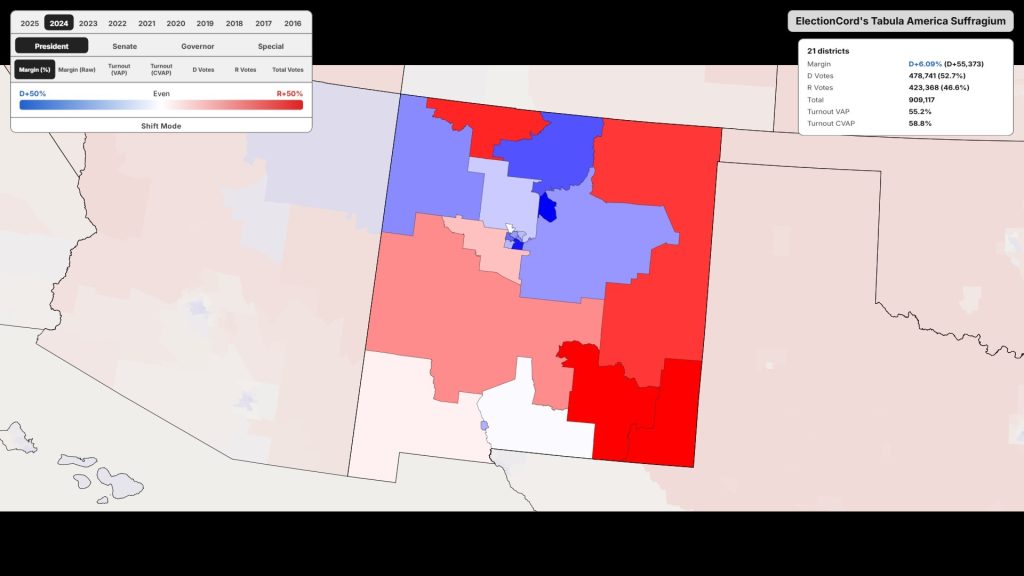
Albuquerque is the biggest city in New Mexico, and the main base of support for Democrats in the state. You have the more affluent and White parts in the north, as opposed to the heavily Hispanic parts in the south and west. Albuquerque also has some of the highest turnout areas of the state, with it being in line with the national average in 2024. Because of all that, it’s probably where socially progressive candidates will do the best in the state, regardless of their exact economic stances.
The North (Santa Fe, Navajo Nation)
7/21 Districts
The South (Las Cruces, Roswell, Truth or Consequences)
7/21 Districts
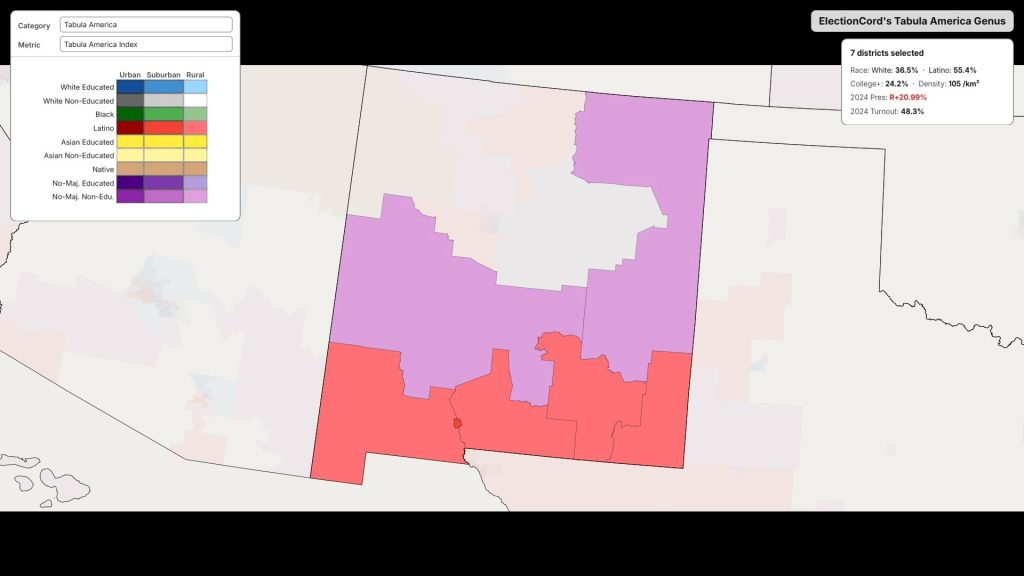
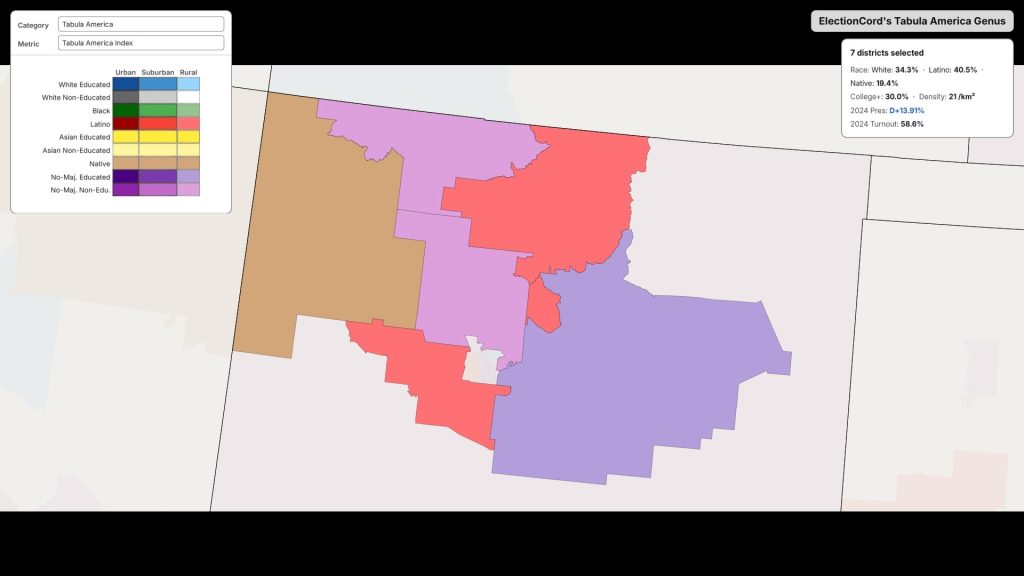
New Mexico can be broken down into 2 further regions, the northern, more Democratic-leaning part, and the southern, more Republican leaning part. The north is interesting, as it’s one of the few areas in the country that has a good amount of people that can trace their ancestry back to Spanish Conquistadors from when the Spanish first colonized the area, like Santa Fe. This also includes the majority Native district, made up mostly of the Navajo, but also the Zuni and Pueblo. The southern region is the most Hispanic part of the state, mostly made up of people of Mexican ancestry, and is the area that did see large Hispanic shifts from 2020-2024, unlike other parts of the state. Part of that is because this is the area that has more non-fluent English speakers and more immigrants. By the way, Truth or Consequences is a real city; thank Mick Foley for letting everyone know about it.
Who what candidates do well best? Despite both parts voting differently in general elections, the types of Democratic candidates who will be similar. Both areas likely have a more socially conservative electorate, with varying degrees of support for populist and economically liberal policies. Again, these are some of the poorer areas in the whole country, particularly in the south, and they will gravitate towards candidates who focus on the economy and social services, someone in the mold of Sanders.
February 21st: Michigan
State Overview (By County)
State Overview (By 100K District)
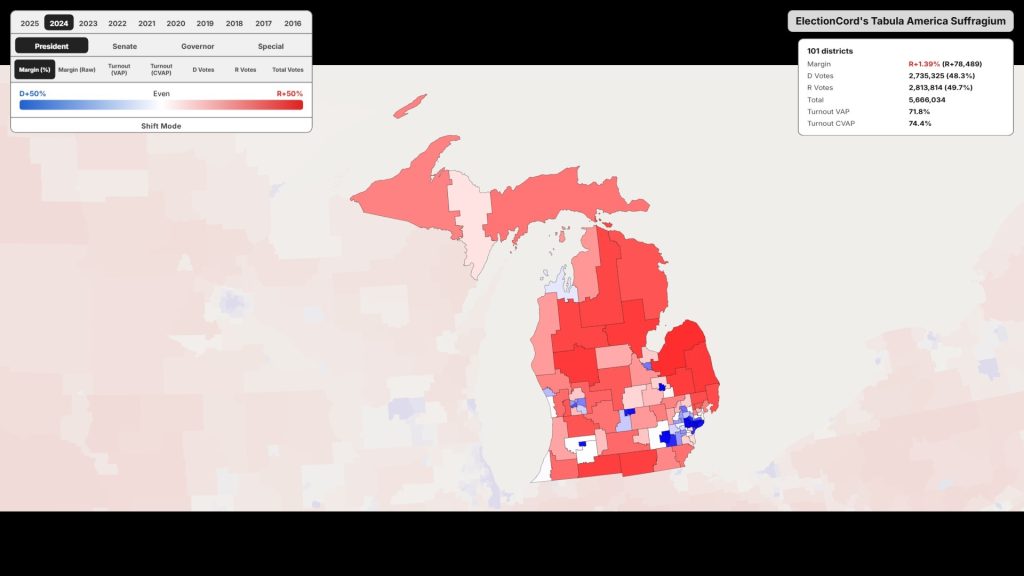
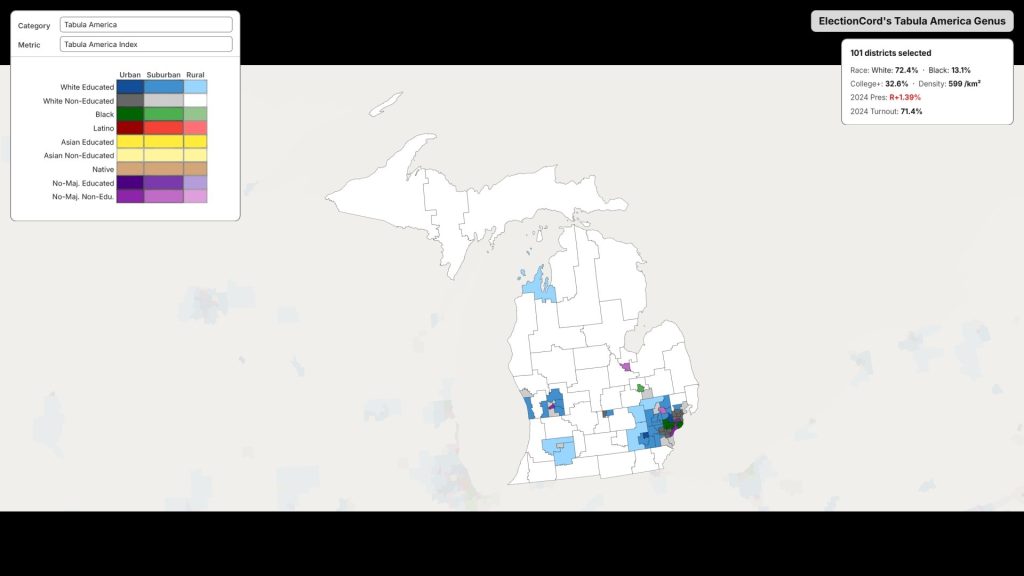
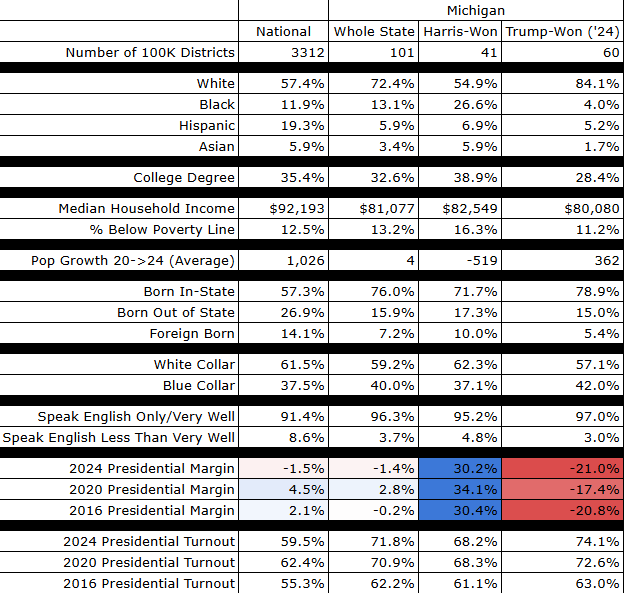
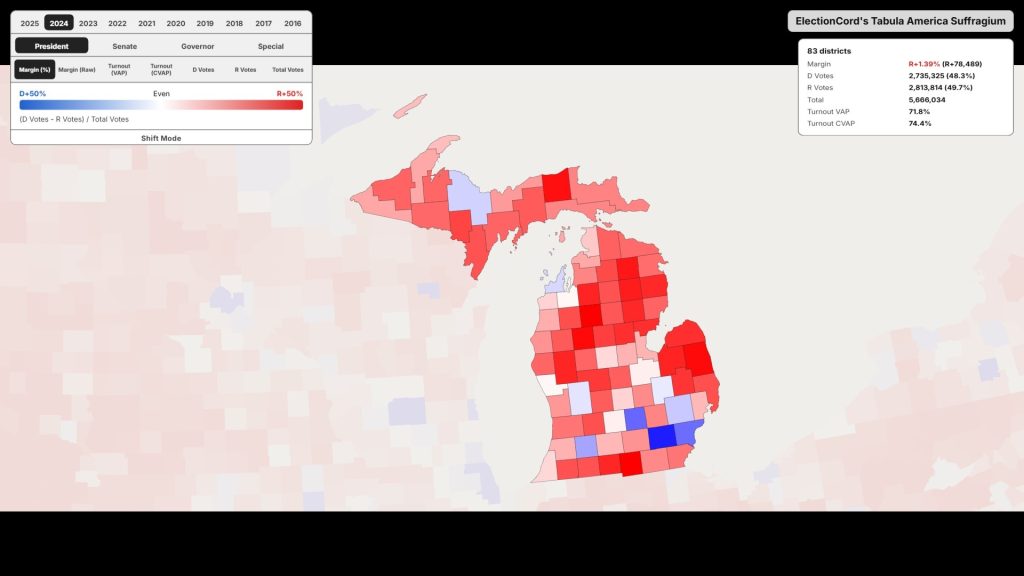
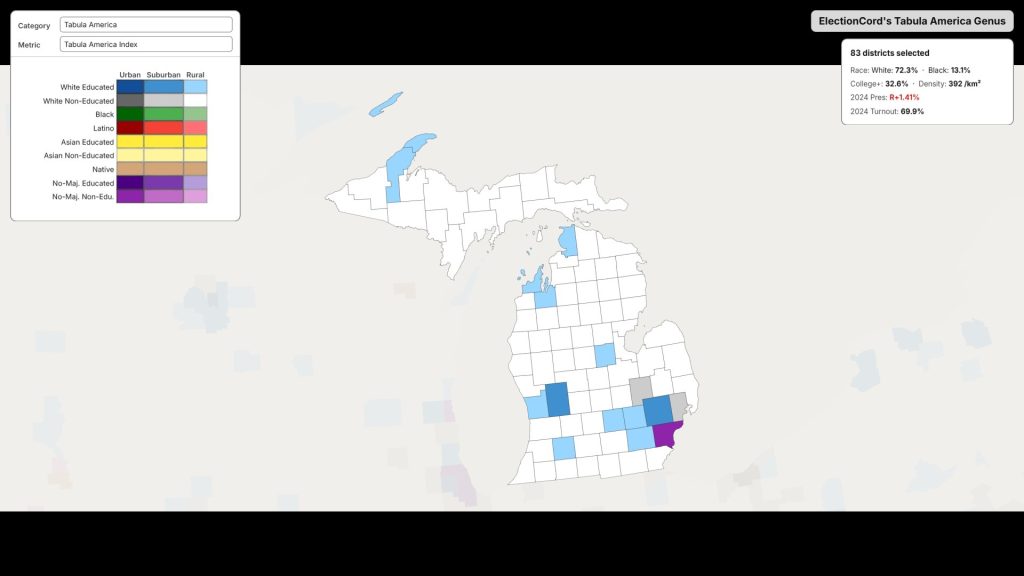
Michigan is the 5th state on the calendar, and the new Midwestern state of choice, replacing Iowa. Its primaries will take place February 21st, and it’s the first big state on the schedule. Just as a comparison, Michigan has about 10 million residents, while the previous four states combined have 11 million. This is why Michigan is the first big prize, and the first state that’s virtually a must-win. If you win Michigan, you get about as many delegates as if you won all four of the other early states, and mind you, it would cost a lot more money to put yourself in a position to do that. It’s pretty easy to see why Iowa was replaced by Michigan. In addition to being a caucus (sucks, outdated), Iowa is just not representative of the country, and especially not the Democratic electorate. While Michigan is still majority White, Detroit is a diverse city with a large Black population, as well as having more areas of highly educated people, and it helps that it’s a swing state that’s helped decide the last 3 presidential elections.
Michigan is a state that has had a lot of trouble in the past, particularly economically. As we all know, Detroit might have been the richest city in the world in the early 1900’s because of companies like GM and especially Ford. Detroit has remained culturally and emotionally relevant to Michigan since. However, as you likely know, Detroit and the whole state have seen a downturn in their fortunes since around the 1960s. Between a lot of the factories shutting down, to places where labor was cheaper like Mexico and China, and other countries like Japan and South Korea establishing dominant car companies. Thankfully, since the 2010’s, because of urban redevelopment and cheap real estate, the decline has stopped, and Michigan has (barely) grown in population since 2020.
The explanation for this was important because not a lot of other states have had histories like that, and it leads to the priorities of not only the politicians, but citizens of Michigan being different from most other states. Like Nevada, unions are a huge deal here, particularly the United Auto Workers (UAW). Rest assured, you will see most candidates sucking up to them, trying to get their endorsement. For what it’s worth, the UAW endorsed El-Sayed in the 2026 Michigan Senate primary. There are still a lot of blue-collar workers in Michigan, particularly in the inner-city of Detroit.
So, with all that being said, who will do well here? Well, we are certainly at the point where a lot of candidates will have dropped out, leaving 4-5 serious contenders at most. Like New Mexico and Nevada, more economically liberal policies will likely do well here, particularly in Detroit and places like Flint. What kind of social policies will be favored though? It’s hard to say. There are pockets of areas like Ann Arbor and Lansing, with a lot of young, progressive, college-educated people. On the other hand, there are a good number of socially conservative non-educated White people in Detroit, as well as Black people who tend to lean establishment. It’s a toss-up for now, but because of the economic policies likely to be favored, the advantage goes slightly to more progressive and populist candidates.
Detroit
45/101 Districts
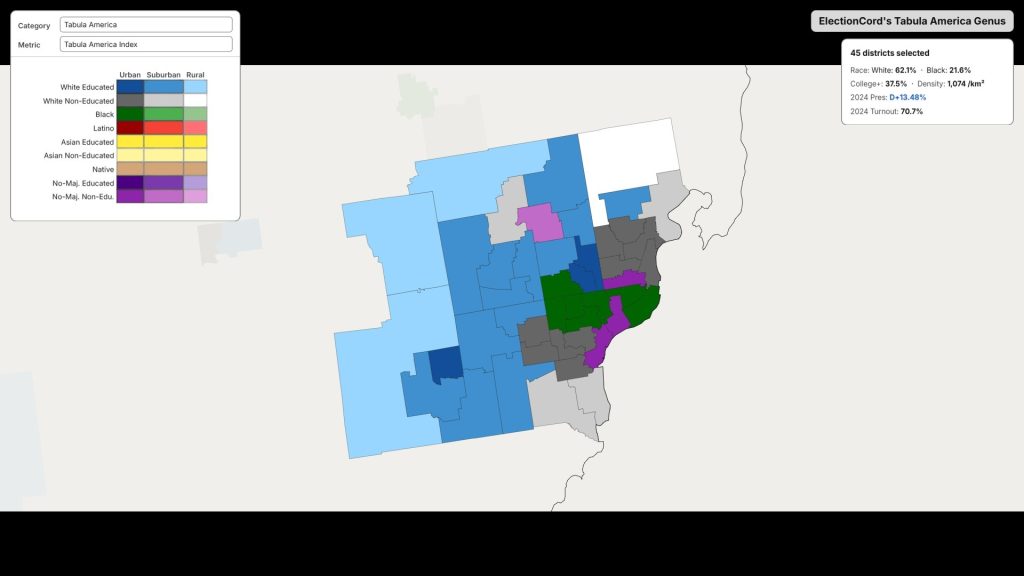
Detroit makes up about half the overall population of Michigan, and it’s likely where most of the Democratic candidates will be spending their time. One area that wasn’t mentioned before was Dearborn…which is interesting. It’s one of the few areas in the country that is mostly made up of Muslim Americans, and it’s a pretty unique place, both electorally and demographically. The 100K District in Dearborn shifted the most right out of any district, by a mile, going from D+57 to R+6 from 2020 to 2024. It also shifted right from 2018 to 2022.
Is the shift permanent? Probably not to that extreme, but it won’t be D+57 again due to a variety of factors. Other than that, you have the Black areas near the center of the city, the areas of White non-college-educated people also near the city center, and the educated suburbanites, which are the areas that have shifted left in recent years. It’s unsurprising then that Detroit will likely be the deciding factor for the primary as a whole.
Grand Rapids
7/101 Districts
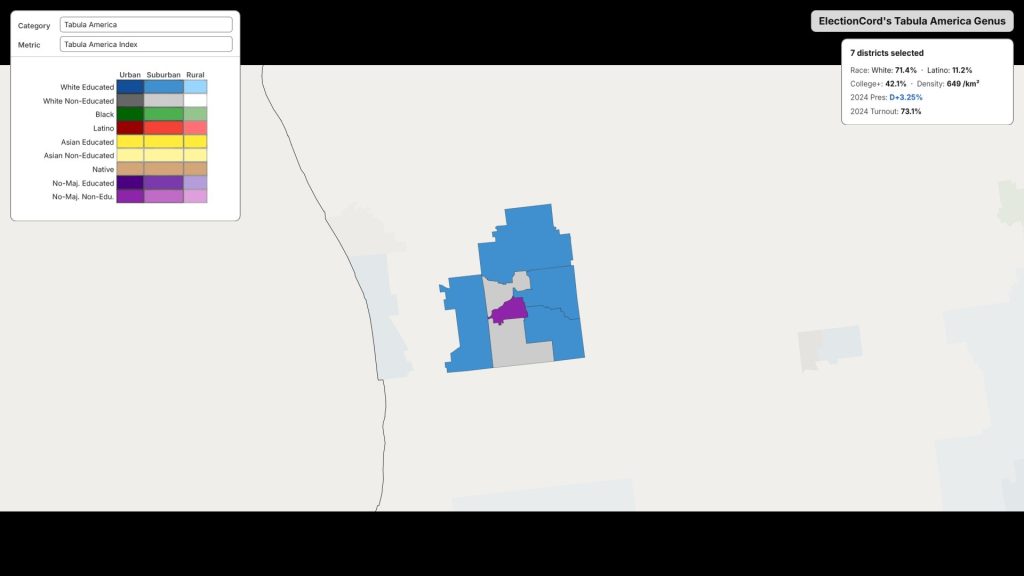
Grand Rapids is the other big city in the state. It’s a bit more educated and more White than Detroit, and is an area that Dems have done a lot better in since 2016. In 2016, Hillary Clinton lost the metro by 6%, but Harris won it by 3% in 2024. So, think about the average Trump -> Biden voter, imagine what they would like, and just imagine that would work the best here. In other words, whoever attacks Trump the most here might win Grand Rapids by default.
Mid-Sized Cities (Lansing, Flint, Saginaw, Muskegon, Traverse City)
11/101 Districts
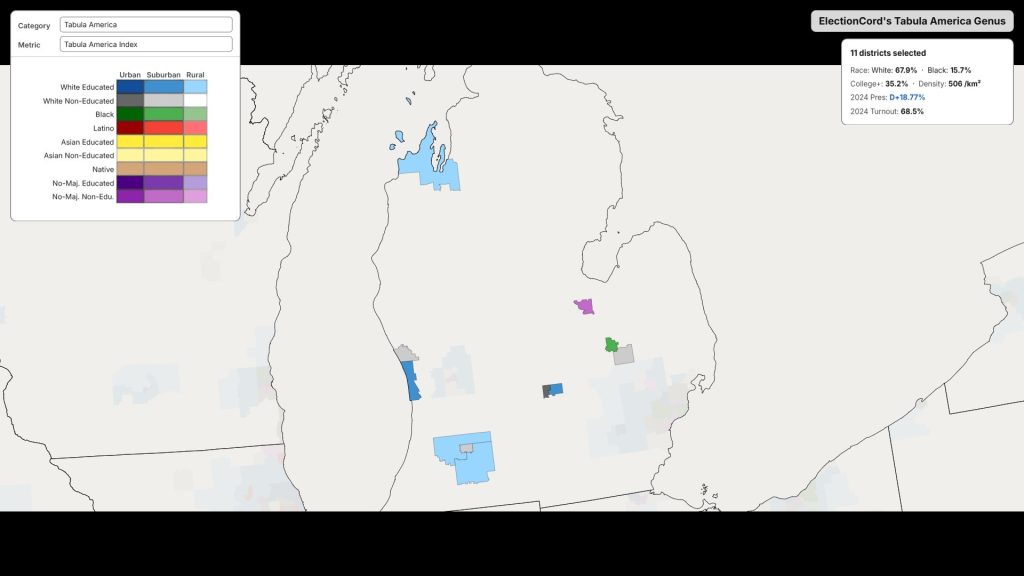
One feature of Michigan that isn’t super prevalent in the other states we’ve talked about so far is the mid-sized cities between 100,000 and 300,000 in population. These include Lansing, Flint, Kalamazoo, and Muskegon. They’re not all the same, though. While Muskegon, Traverse City, Lansing, and Kalamazoo are more educated and wealthy, Saginaw and Flint are more classic Rust Belt cities. Candidates will have to spend time in these places. They might spend too much time here, as combined these cities only make up about 10% of the total population, but that could matter if the primary is close enough. Overall though, what was said about Grand Rapids will generally apply to most of these cities, besides Flint and Saginaw, where more economically populist policies will be more appealing.
Everything Else
38/101 Districts
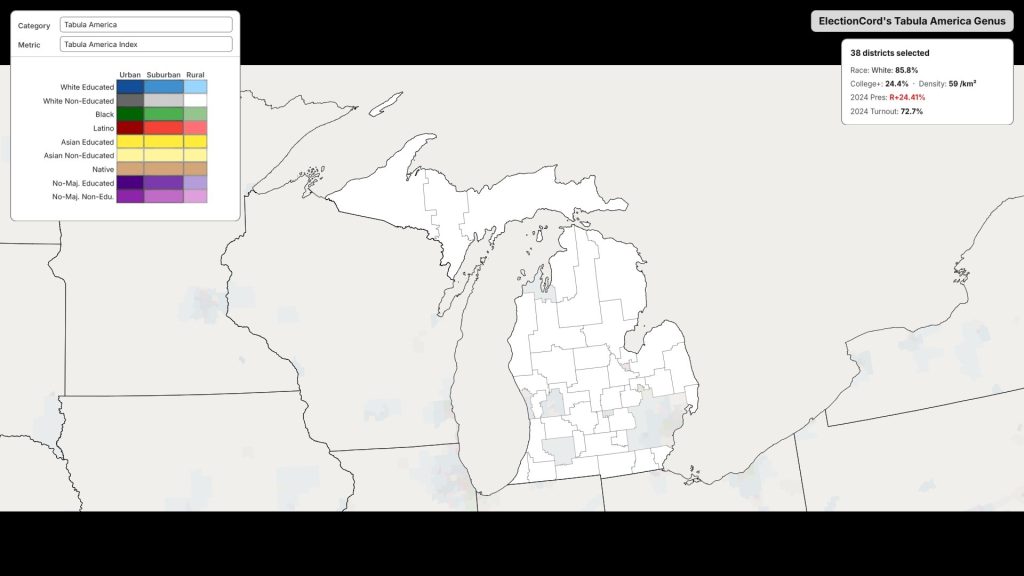
These areas are Trump’s home base, roughly about 40% of the population of Michigan, including the Upper Peninsula. Despite its size, the Upper Peninsula only makes up 3 out of our 101 Michigan 100K Districts, and is only worth making a visit or 2 at most. The rest of Michigan is kind of what you expect in rural America: very White, very non-college educated, very Republican and conservative. As opposed to caring about manufacturing and the auto industry, farming and agriculture may be more relevant industries. Rural Michigan as a whole will probably depend on what the big issues are at the time; if it’s the economy and cost of living, the progressives will probably have an edge. If it’s social issues or foreign policy, the more moderate candidates may have the advantage.
February 29th: Virginia
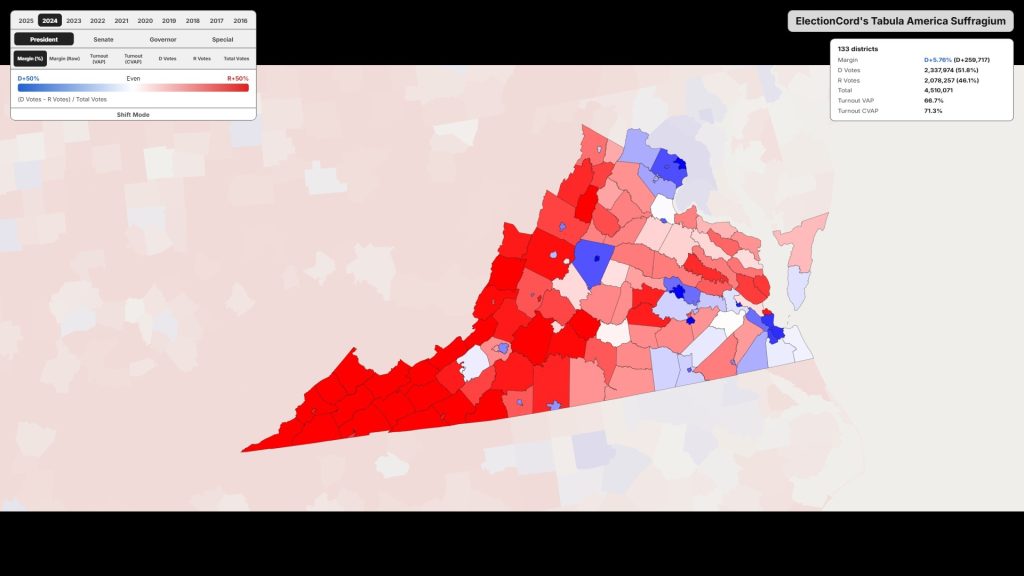
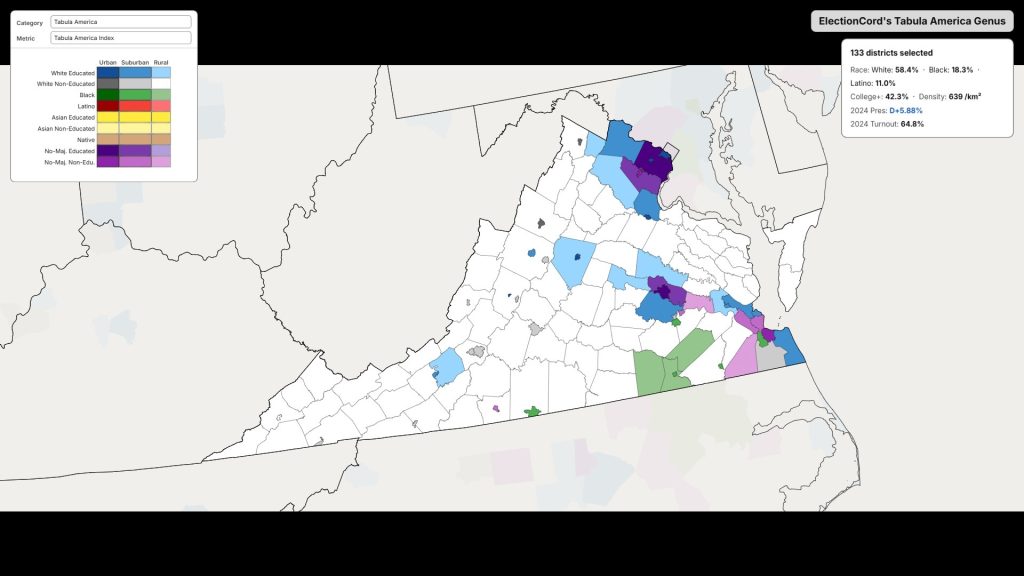
State Overview (By County)
State Overview (By 100K District)
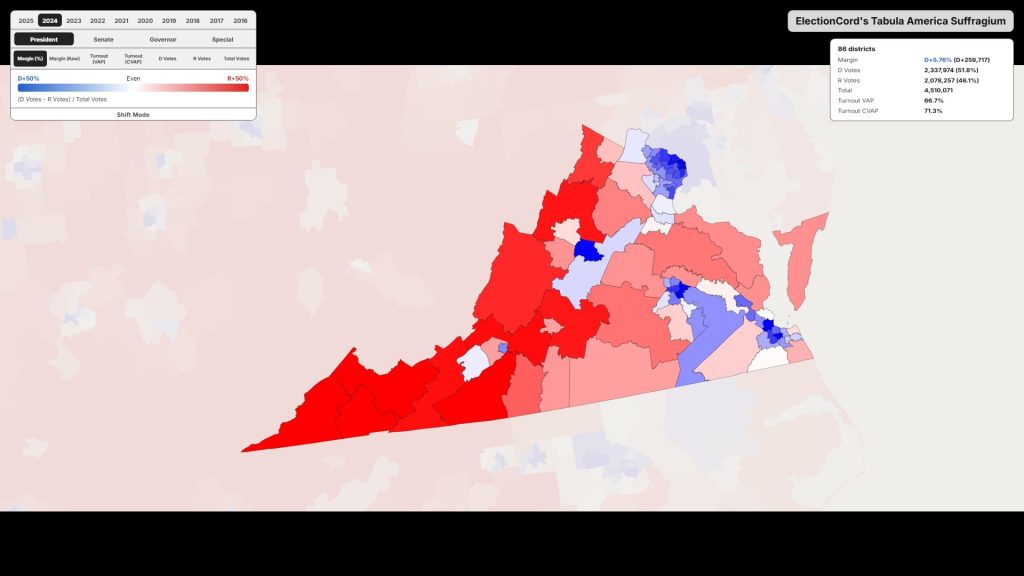
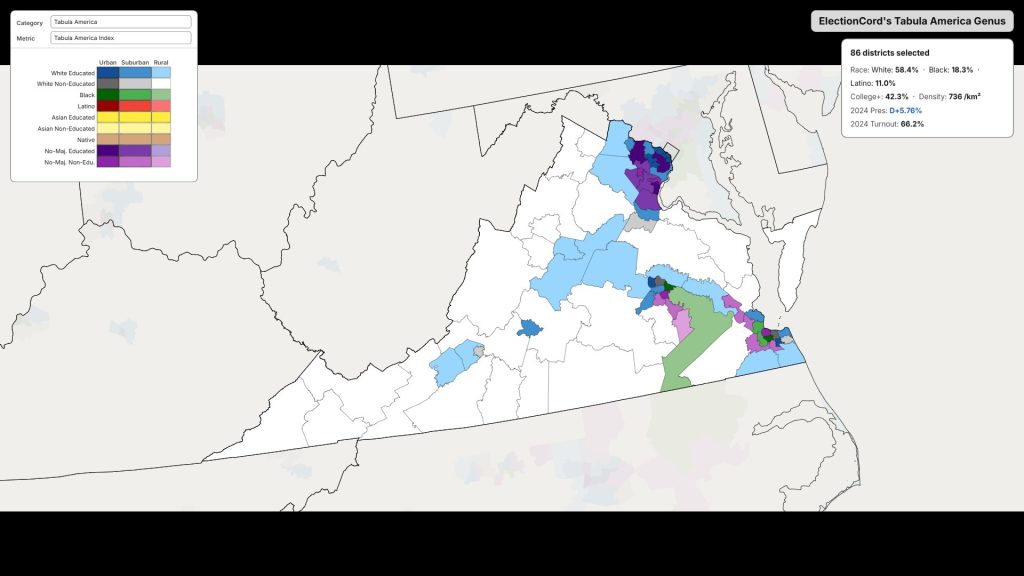
Finally, the last state before Super Tuesday is Virginia. It’s not entirely clear what states will be on Super Tuesday, so this is the last state that we know of in the schedule. Its primary will take place February 29th, likely one week before Super Tuesday. If you ask me, this might be the most important state in the entire Democratic primary. Winning the first state doesn’t guarantee you victory by any means, but winning the state before Super Tuesday virtually guarantees you it. In every Presidential primary since 2000, the person who won the state before Super Tuesday ended up with the nomination. Virginia is a state that is very representative of the Democratic Party, and one that has a little bit of each of the big coalitions in the Democratic electorate. In the South, you have Richmond and Virginia Beach, and they are about 30% Black in total. In Northern Virginia, you have areas that have some of the highest percentage of college-educated people in the whole country, as well as Arab, Hispanic, Black, and Asian communities.
While Michigan and Virginia do share some similarities, there are some clear differences. First, while Virginia has been seen as a swing state as recently as 2016, it’s now solidly Democratic. They’ve also been moving in different directions in recent elections. In 2008, Obama won Michigan by 17% and Virginia by 6%. In 2024, Harris won Virginia by 5%, and lost Michigan by just under 1.5%. What’s the difference? While there are a few, the main difference can be boiled down to college education. Virginia is one of the most college-educated states in the country, with about 42% of all residents having at least a Bachelor’s Degree, while 32% of Michigan residents hold one. This is something that has been seen everywhere in the Trump era, but this is the starkest difference of that.
So, what type of candidate will do here then? By this point, momentum will matter, and it’s hard to see someone winning Virginia as their first state. This is almost the final test, as Virginia has shadows of all the states we’ve seen. There’s the Black population of South Carolina, the unique industry of Nevada, the educated population of New Hampshire, the Hispanic communities like New Mexico, and it is relatively large. Honestly, whoever won Michigan will likely be the favorite, but in a vacuum, the advantage will likely go to a more establishment-aligned candidate.
Northern Virginia
29/86 Districts
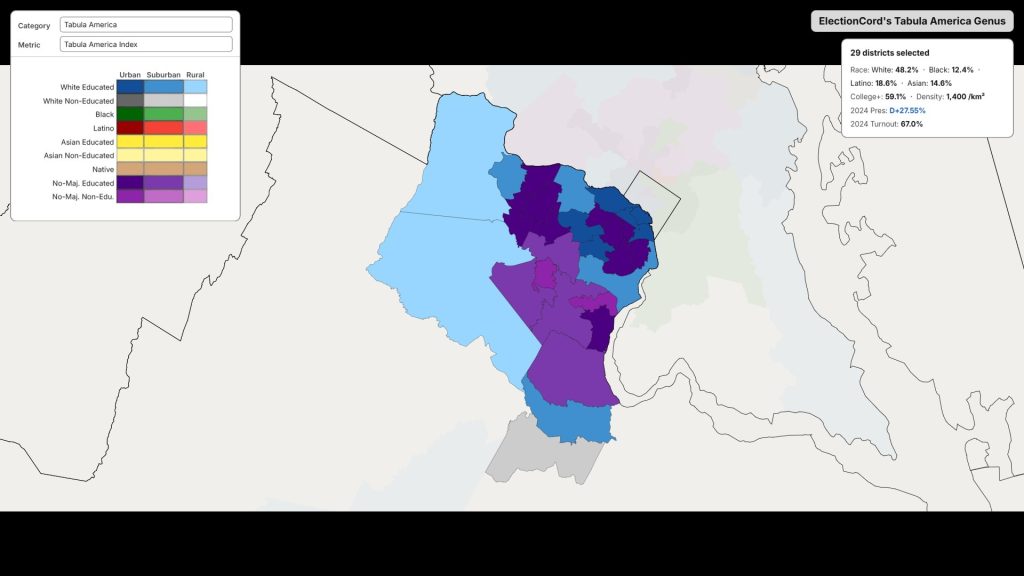
Northern Virginia makes up about a third of the state in terms of population, and it’s also the most diverse part of Virginia. Although it’s plurality White, the population is about 12% Black, 18% Hispanic, and 15% Asian. What’s really interesting is that unlike most other metros, there aren’t specific Hispanic areas, or Black areas, or Asian areas. It’s an area that has a lot of blending of cultures and ethnicities, so to say. The most important thing about NoVa is government employment. As you might expect, being so close to DC, many people in Northern Virginia are government workers.
This matters a lot, not only because DC politics will have a ton of influence on the primary, but what the federal government does matters more so here than just about any other area in the country. For instance, if the government fired a bunch of federal workers they considered “non-essential, ” people might be upset about that! Interestingly, one of the 100K Districts here (VA-3), saw the single biggest shift to Harris from Biden, where among other things, the CIA headquarters are.
Because of the industry most people work in, the area is very highly college-educated, likely one of the highest in the whole nation. This generally is good for Democrats, but what kind of Democrat specifically? On one hand, most Democrats that live in NoVa are literally part of the establishment, but there are also a bunch of fired workers who are very upset. This could be one of the ground zero areas in 2028 of the split in the Democratic Party, between candidates who are aligned with DSA, more moderate candidates, and everyone in between. The majority White areas may be more friendly to more socially progressive candidates due to being highly educated, while the more diverse areas are going to favor the socially moderate candidates left, as they tend to do nationwide.
Hampton Roads (Virginia Beach, Norfolk)
15/86 Districts
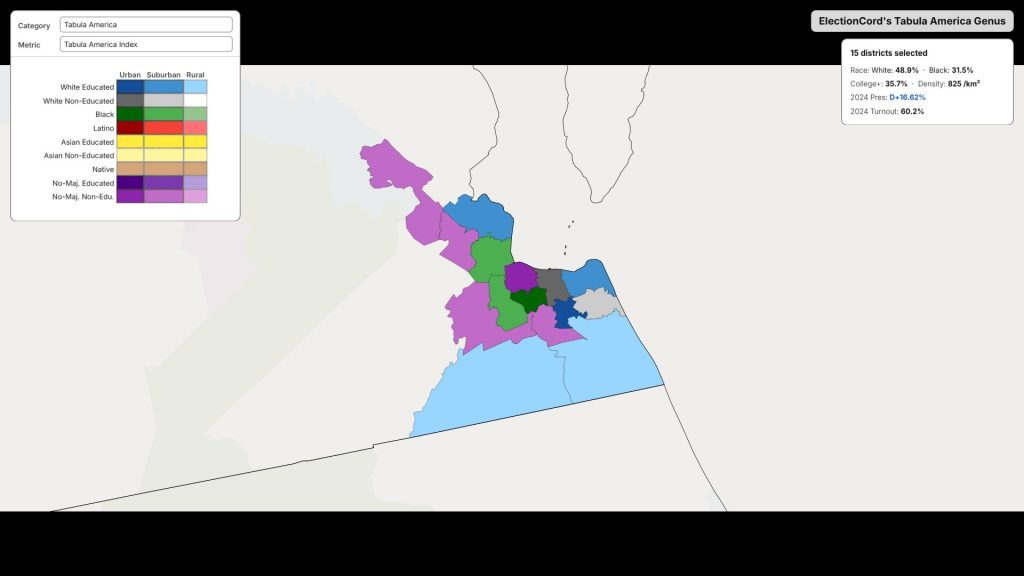
Hampton Roads, mainly comprising Virginia Beach and Norfolk, is much different than NoVa, but one thing is the same: both have huge industries that are government-related. The only difference is that while NoVa’s government jobs mostly relate to bureaucracy, Hampton Roads’ big industry is the military. Because of the Chesapeake Bay, one of the biggest natural harbors in the US, pretty much every ship in the Navy is built here. There are also Air Force and Navy bases, and it’s estimated that more active duty personnel are stationed somewhere in the metro than any other metro in the country. Per Rural Health Info, the veteran population could be as high as 15% across the metro, far higher than the national average of about 6%.
Therefore, things such as the Iran War meaningfully matter here, as well as the Department of Veterans Affairs and healthcare for vets. Other than that, there is a fairly high Black population here, at about 30%, being concentrated particularly within Norfolk and Newport News. Virginia Beach is also a popular retirement and vacation spot, and even if it’s not the center of the metro, it’s the biggest city in it.
The types of candidates who would do well here are probably veterans themselves, such as Pete Buttigieg. It’s hard to say how foreign policy will have a role in the 2028 primaries, but certain stances could be more popular than others. We just don’t know what kind of wars or conflicts will be going on, or how active-duty members feel about them. Some on the left end of the spectrum are louder about being anti-war, but depending on the stances or messaging, they could be perceived as anti-veteran and active duty, perhaps alienating them. Again though, momentum will certainly matter here.
Richmond
9/86 Districts
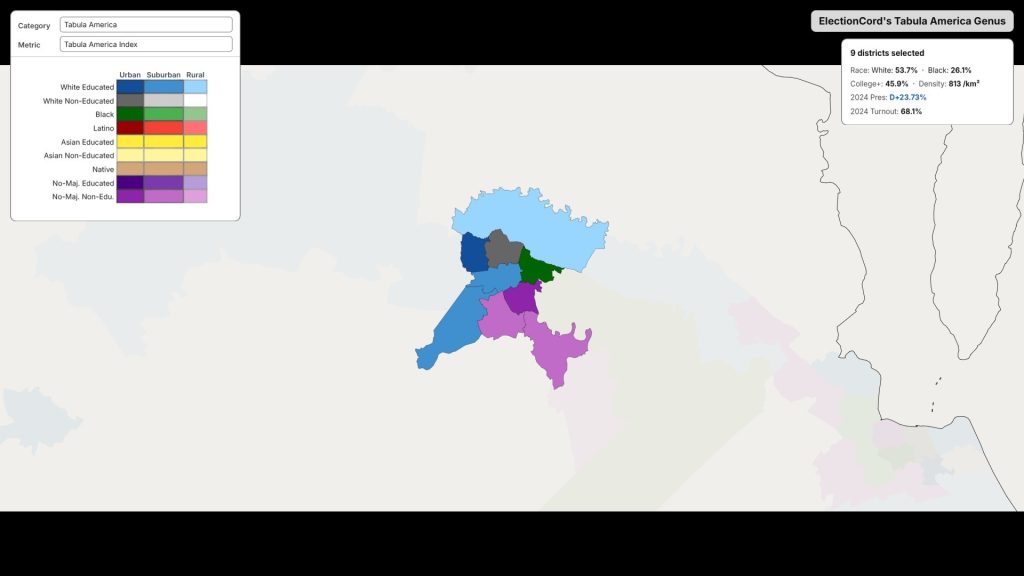
The demographic makeup of Richmond is pretty similar to Hampton Roads, just without the huge military presence. While it is less Black overall, it’s also more college educated, and that’s why Harris did about 10% better here than in Hampton Roads. Richmond was actually one of Harris’ best metros, only shifting right by 1% from 2020, and had one of only 7 100K Districts to flip from Trump in 2020 to Harris in 2024. The cause is likely population growth, as Richmond is Virginia’s fastest-growing major metro area. Socially progressive candidates will likely fare better here than Virginia Beach, mainly due to the high education rate. As Richmond is the capital of Virginia, statewide politicians and their endorsements may matter more than in other parts, particularly NoVa.
College Towns and Mid-Sized Cities (Charlottesville, Lynchburg, Blacksburg)
7/86 Districts
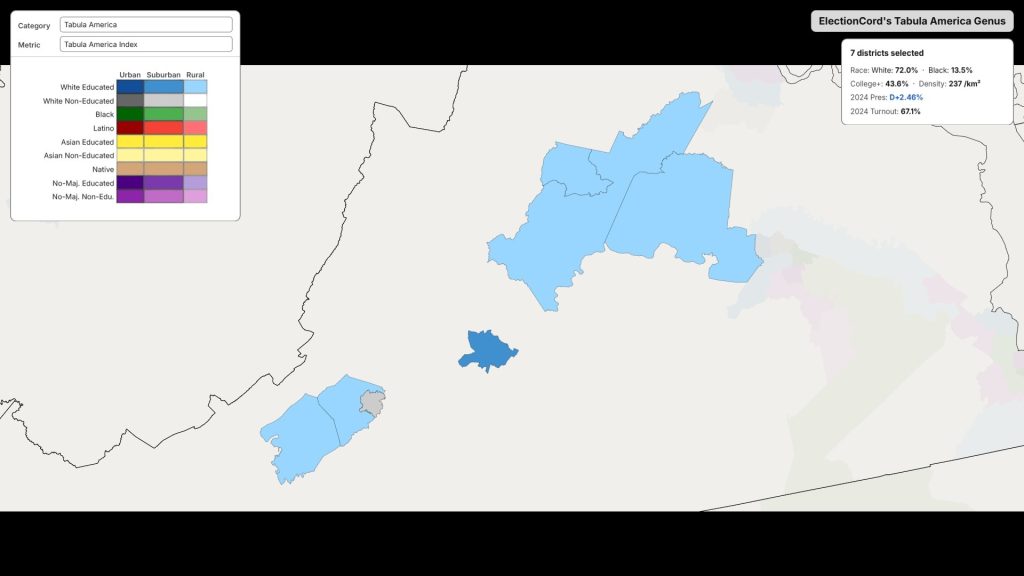
There are a few highly educated rural areas and smaller cities, due to college towns not near the big metros previously mentioned. There’s Charlottesville (University of Virginia), Blacksburg (Virginia Tech), and even Lynchburg (Liberty), which would technically fall under this category. Roanoke, even if it doesn’t have a big college, also falls in this category, as it’s pretty close to Blacksburg. This is going to be prime progressive territory; young people in college, even if they don’t tend to be the most active voters, are very politically engaged, and should favor candidates that are socially progressive and especially economically progressive. Well… everyone but students of Liberty University probably.
Appalachians (Bristol, basically West Virginia)
11/86 Districts
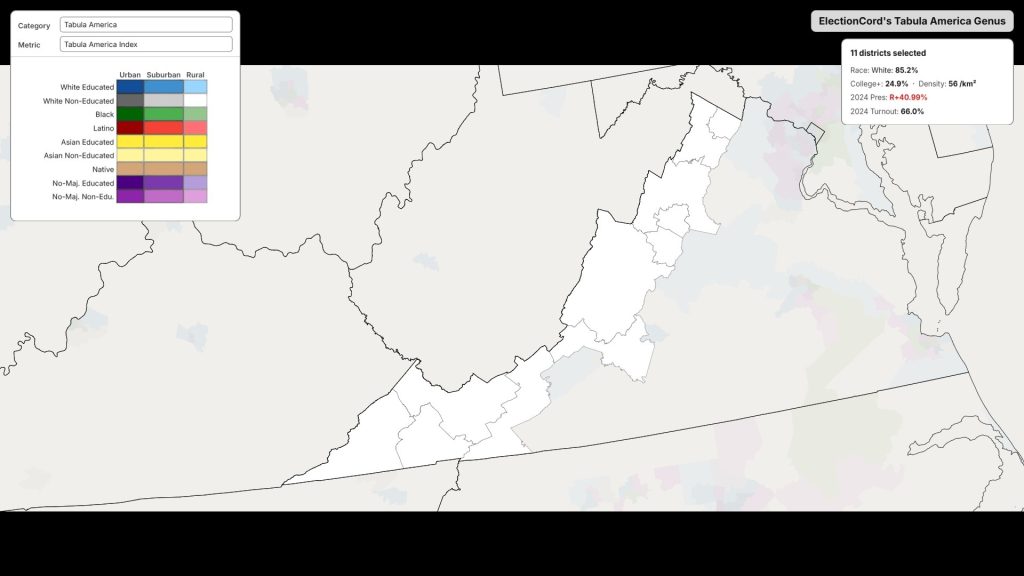
It’s the Appalachians, so there aren’t that many Democratic voters here, but they might gravitate to economically populist policies. It’s only worth noting separately because it does make up 12% of the state, and they have a unique culture and identity.
Everything Else
11/86 Districts
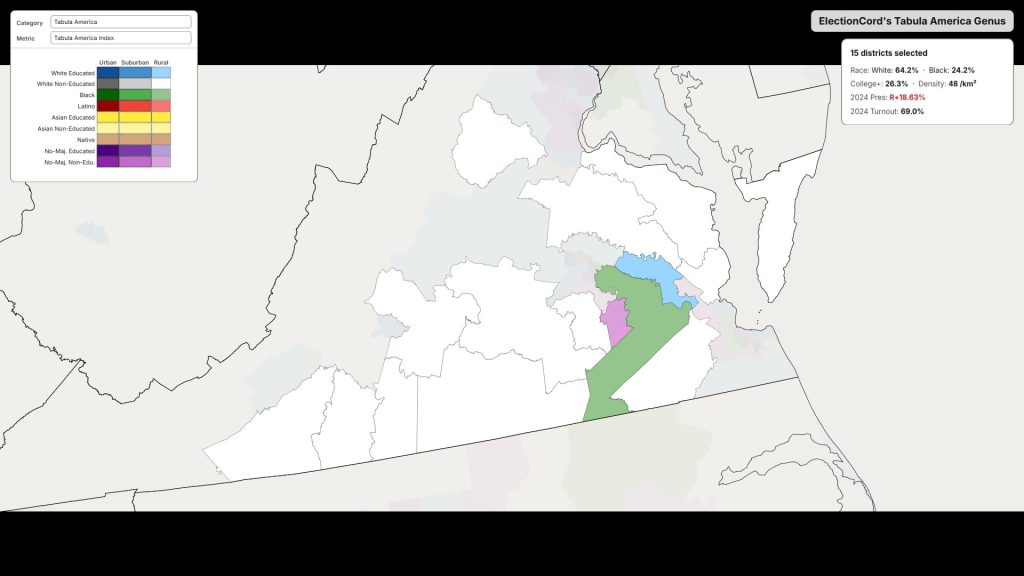
Finally, the rest of Virginia. This is everything that hasn’t been talked about yet, but does have some interesting areas. The Black Belt ends in Virginia, around Richmond, so there are some Black areas in rural Virginia. There is also an area of highly educated people that is between Richmond and Hampton Roads, but doesn’t fit neatly within either. It will probably lean socially moderate, but again, very hard to say without knowing the results of the states that come before it.
Conclusions
Who does this new schedule favor then? Despite what some people were saying on social media, the schedule is actually pretty fair to both progressives and moderates, and may even favor progressives. Taking out Iowa for Michigan is certainly an upgrade for progressives. New Mexico also will likely favor them. The only state that seems to clearly not favor progressive candidates is South Carolina, but as we’ve established, first doesn’t mean all that much. Candidates that think they must win South Carolina and everything else will be easy will be in for a rude awakening. The primary is over a year out, and no one has actually declared yet, so it’s yet to be seen how the chips will fall.
About the Author