

If you are running a campaign, what is the most important thing you should do with your resources? We at ElectionCord like to think about your money raised like Moneyball. Earl Weaver, manager of the Baltimore Orioles for 20 years, and a proto-Moneyball philosopher, once said that “your most precious possessions on offense are your 27 outs”. In other words, you only have 27 chances to mess up, and you have to make the most of all of your at-bats before that happens. The analogy with politics is that the most precious thing you have is the money you can raise, and you should spend it as wisely as possible.
So what should you do with your precious money then? Obviously you will have stuff like staff costs and whatnot, but there are 2 main goals: name recognition, making sure people know you exist, and persuasion, making sure people will vote for you once they know you exist. If you are on social media, and following the political world, you might think that everyone knows who people like Andy Beshear and Marco Rubio are, but that’s not really true. In a recent Ipsos/Reuters poll, 20% of people had not heard of Marco Rubio, 29% of people had not heard of AOC, and 60% of respondents had not heard of Andy Beshear. The point is, the median voter is checked out of politics, so your money, time, and resources have to go into making sure people know you exist.
That brings us to a very recent primary election between Francesca Hong and David Crowley, for the Democratic nomination for Wisconsin Governor. In a pretty big upset, Crowley barely defeated Hong by under 1% on Tuesday. Polls were showing Hong having a huge lead, and Crowley wasn’t even in this race the entire time! He had dropped out on July 8th, and came back in on July 18th after his endorsed candidate, Sara Rodriguez, dropped out herself because of a financial scandal.
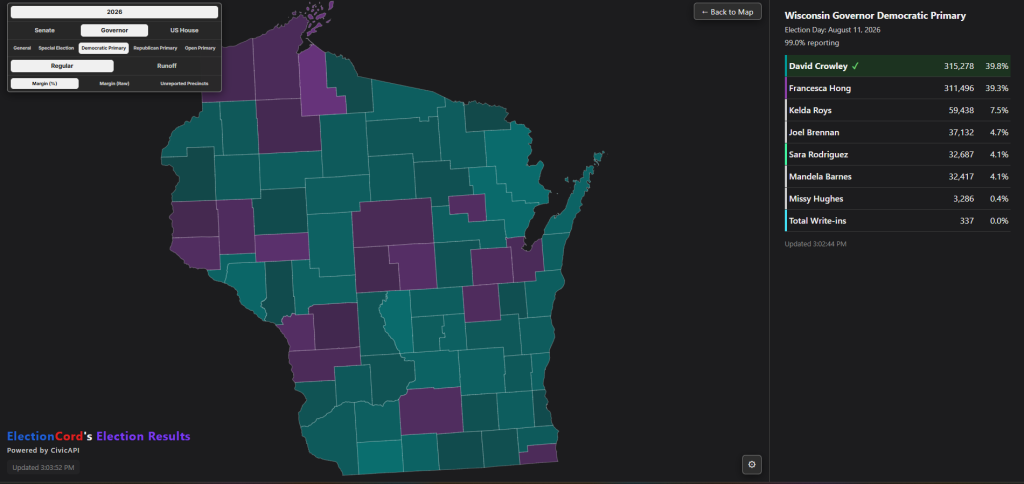
Both of these candidates ended up spending around the same amount of money ($1,200,000), but they went about it in very different ways.
Francesca Hong:
Total Money Raised: $1,774,995.00
TV Ads: $0
Online Ads: $253,851.99
David Crowley:
Total Money Raised: $1,483,509.32
TV Ads: $402,042.00
Online Ads: $126,704.63
That’s a big fat 0 on TV ads for Hong, and while she did spend more on Online Ads than Crowley, he spent about twice as much on TV and Online ads combined as she did. The point is, he spent more of his money making sure people knew he existed than Hong did, at least in a traditional way. Besides the fact that Hong had about $300,000 more on hand unspent, she had spent about $150,000 on brochures and “Printing Msc.” which includes buttons, bumper stickers, and t-shirts. Crowley only spent $15,000 on these things. Hong’s strategy was clearly to have a grassroots campaign and appeal by word of mouth rather than traditional methods, and use these grassroots efforts to get young people to vote in the primary.
The problem was, that didn’t end up happening! According to L2, a full 60% of people who voted early or absentee were over 65, and less than 1% were under 30. While it’s likely that the election day vote skewed younger than this, the primary was still majority seniors.
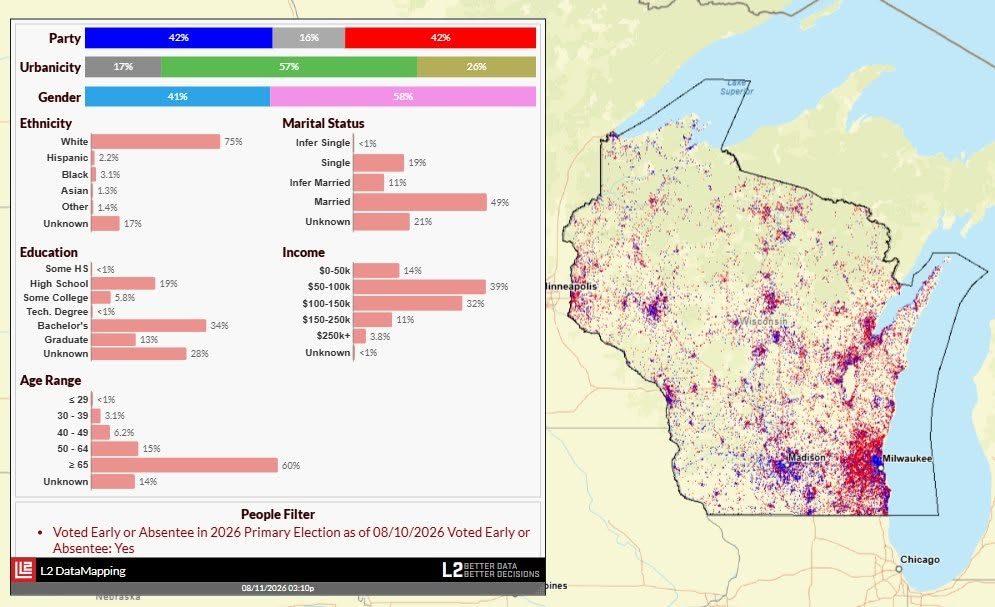
It’s been shown time and time again that it’s very hard, if not impossible to change the electorate based on your strategy as a candidate, and rather you have to base your messaging on convincing high prop voters that you exist, and to vote for you. While this debate has been going on about spending or not spending on TV ads online, in practice, very few candidates have tried this. Every DSA aligned or left wing candidate you can think of who challenged an incumbent or establishment candidate spent on TV ads. Per the FEC, Abdul El-Sayed, Daria Avila Chevalier, Claire Valdez, Melat Kiros, all either spent money directly on TV ads or had support from PACs who did. Primaries skew older, and old people really like watching TV. That being said, it’s also good to be diverse in your ad spending! Spend on TV, and online, and even traditional flyers/signs, you shouldn’t ignore any of them entirely. You should be flexible in your ad campaigns, because you never know exactly what will happen, and be prepared for all types of electorates.
One note: We have been doing a lot of general analysis articles lately, but we want to focus more on “behind the scenes”, articles meant more for campaigns and future campaigns. After all, we are first and foremost, a consulting firm.
Resources
-https://campaignfinance.wi.gov/browse-data/reports?office=%5B5%5D
-https://www.fec.gov/
-https://www.ipsos.com/sites/default/files/ct/news/documents/2026-08/Reuters%20Ipsos%20August%20Large%20Sample%20Topline%20Full.pdf
-https://www.facebook.com/photo/?fbid=1867693338002991&set=a.728236988615304
About the Author