

On July 20th, 2026, Iowa State Auditor Rob Sand announced a record-breaking 9 million dollar quarterly fundraising haul in his campaign for Iowa Governor. To the delight of Democrats in Iowa, Sand currently has $17.9 million cash on hand, and 95% of it is from donors giving $100 or less. Sand’s impressive war chest and magnitude of grassroots enthusiasm, along with favorable polling against Republican nominee for Governor Zach Lahn, has caused some political observers to pay attention to a state that has become much redder in recent years. After voting for Barack Obama in 2012 by about 6%, the state swung hard to President Trump in 2016, backing him by almost ten percentage points, and stayed with him in his failed reelection campaign in 2020. In 2024, Trump was able to win Iowa by the largest margin for any Republican since the 1980 Presidential election.
Given these developments, one would be forgiven for writing the state off as yet another state lost to time for Democrats. So why are they optimistic about the Governor’s race? Two major reasons: the Democratic nominee for Governor and the local issues that plague Iowa’s Republican led state Government and its current leaders.
On Rob Sand:
Rob Sand started his political career working as Assistant Attorney General to then Attorney General Tom Miller (D) in September 2010. He quickly gained a reputation for combating financial crime and was the lead prosecutor on the biggest lottery scam in American history. These prosecutorial successes greatly increased his notoriety. Shortly after prosecuting the scam, he resigned from the Attorney General’s office so that he could run for Iowa State Auditor in 2018.
2018, as we all know, was a blue wave year with red state Democrats like Joe Manchin and Jon Tester winning reelection. In Iowa, it was no different. Despite narrowly losing the Gubernatorial race, Democrats picked up 2 seats in the congressional delegation and almost defeated Steve King in Iowa’s 4th congressional district, which Trump carried by 27% in 2016. Similarly, Rob Sand defeated the incumbent auditor Mary Mosiman by 4.54%, whom he outraised 3 to 1.
2022, however, was a different story. Though Democrats outperformed expectations in the Upper Midwest, forty year Democratic incumbents like incumbent AG Tom Miller and incumbent State Treasurer Mike Fitzgerald both narrowly lost reelection, Republicans took every Congressional District and nearly took every executive office… except for the State Auditor’s office. Rob Sand was able to outrun the national headwinds and narrowly win reelection by 0.25%. He won 3 out of 4 congressional districts and significantly outran Democratic Gubernatorial nominee Deidre DeJear by nearly 19 percentage points.
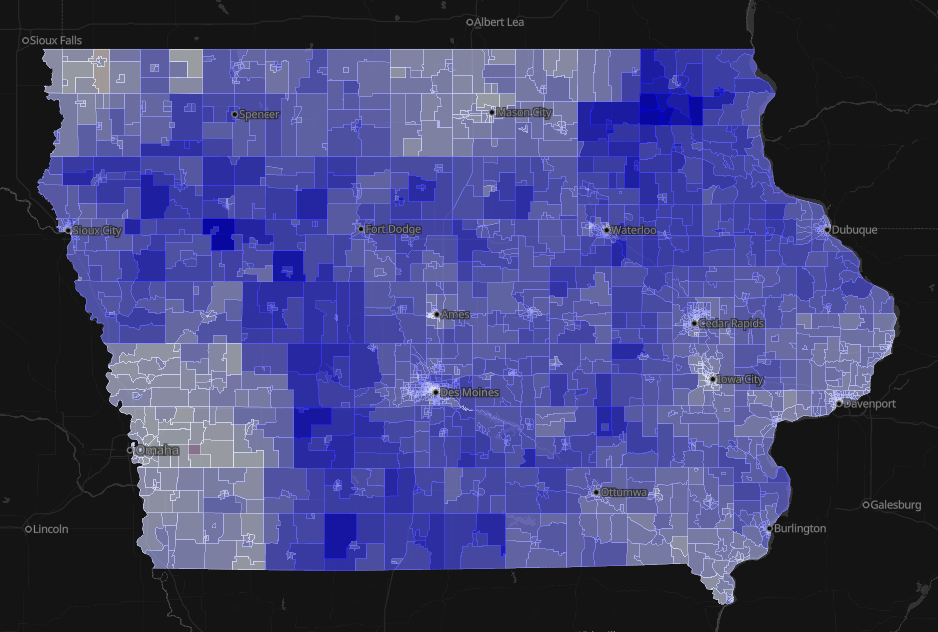
The darker the shade of blue, the more Sand outran DeJear in that precinct.
How was he able to win while every other statewide Democrat was defeated? Well, for one, Sand has been relentless in prosecuting financial crimes while in office, to the point where the Legislature passed a law trying to limit the Auditor’s powers. Additionally, he has eschewed national politics, declining to endorse in the 2020 Democratic primaries for president and tends to focus only on local issues. He does 100 town halls every year, visiting every county at least once to talk to voters. This combination of being a relentless prosecutor on financial crimes and being a strong retail politician has kept him in office for 8 years now, and he is attempting to parlay that into the Governor’s mansion.
The State of Iowa’s Current Government
Current Iowa Governor Kim Reynolds has been in office since 2017, after her predecessor Terry Branstad was appointed as the US ambassador to China. She was able to win reelection in 2018, even as the now-infamous Ann Selzer had her opponent Fred Hubbell defeating her by two points. By early 2019, she had close to a 60% approval rating. However, in recent years, her approval rating has taken a massive tumble. In September 2024, her approval rating sat at 45%, making her one of the most unpopular governors in the nation. In a Morning Consult poll conducted in early 2025, she was the most unpopular governor in the nation.
There are many reasons why Reynolds’ approval rating has declined so much. One of which is the school voucher program, which diverts hundreds of millions of public money into private schools. Reynolds even went a step beyond that and backed primary challenges to Republicans who opposed the voucher program. With the state economy stagnating, and only 40% of Iowa voters saying that the country is on the right track, it is easy to see where the dissatisfaction with Reynolds is coming from and will be a key reason in a potential Sand victory.
The Republican Primary
In April 2025, Kim Reynolds announced she was not running for reelection, likely reassuring some Republican operatives that someone untethered to the Reynolds administration would be more likely to hold the Governor’s mansion in the fall. The establishment coalesced around Randy Feenstra, a congressman for Iowa’s fourth congressional district. In the past, Iowa Republicans have been able to notch narrow wins statewide despite losing the other three congressional districts by running the margins up in Iowa’s fourth congressional district. The hope was likely that Feenstra, as someone who represents that district, could do the same thing. But on the day of the primary, Feenstra was defeated by Zach Lahn, a farmer and a businessman, in a massive upset. The establishment quickly coalesced around Lahn after the primary, but he comes with his own baggage, like his residency issues, and the fact that he started a private school founded by the Koch family in Wichita at the same time as Iowa reckons with its school choice laws. You can even tell that Rob Sand was taken aback by Lahn winning the primary as pre-primary polling was primarily done with Feenstra as his opponent.
Downballot Implications
Aside from the gubernatorial race, there are many downballot races that will also grab many people’s attention as Democrats try to win back the US House and the US Senate. The Democratic nominee for US Senate, Josh Turek, will face Ashley Hinson in November. Turek is a State Representative from the Iowa State House, who managed to outperform Sand in his district in 2022 by close to 7 points, while Ashley Hinson is a Representative from Iowa’s 2nd Congressional District. While Sand and Turek have been seen together, Sand hasn’t explicitly endorsed Turek, likely in an effort to keep his campaign local. As we have seen in Pennsylvania and Ohio in 2022, where Josh Shapiro outran Fetterman by 10, and Mike DeWine outran Vance by 19, respectively, people are often willing to split their ticket between gubernatorial and federal races.
The US House races are more interesting. In 2022, when Attorney General Tom Miller lost, he still carried Iowa’s second congressional district by 2.52%. This likely indicates that Rob Sand will also carry the district if he is coming close or winning statewide. Thus, there is a possibility that Democrat Lindsay James wins Iowa’s second congressional district (which is Hinson’s vacated seat) and Josh Turek comes up short statewide.
Two other congressional districts in Iowa are more likely to flip, those being Iowa’s first and third congressional districts. Mariannette Miller-Meeks, the Representative for Iowa’s first congressional district, won the narrowest victory of any House Republican in 2024 and massively underperformed Trump in the district. Sand won her district by 4 in 2022, so this is a top target for Democrats. Iowa’s 3rd district is also a big target for Democrats, as it is only Trump + 4 and contains one of the few counties with good trends for Democrats (Dallas County). Sand won Iowa’s 3rd district by 12 points, so if he is headed for a comfortable win statewide, his coattails could carry Democrat Sarah Garriott to victory.
As far as legislative races go, Democrats did break the GOP supermajority in the Iowa State Senate in 2025. This, like the Governor’s race, will depend on how angry voters are and whether or not they take out their dissatisfaction with Reynolds on their State House members and State Senators. Democrats are likely not going to flip any chambers outright, but on a good night expect them to break the GOP supermajority in the state house.
Conclusion
Rob Sand has consistently led Zach Lahn for the entire campaign cycle thus far, indicating that Sand’s personal strengths as a candidate and the weaknesses of Lahn and the Reynolds administration have outweighed Iowa’s shift to the right over the last decade. Republicans appear to be worried as well, as the Iowa legislature voted to reduce the powers of the Governor earlier this year. Ultimately, the Iowa Gubernatorial race will show whether or not a disciplined campaign focused on local issues can override the national story.
About the Author