

Cities take up a good deal of oxygen in the Democratic milieu, for good reason. For decades, Democrats have won urban areas, across coalitions, time, and space. In all likelihood, they will continue to win cities in the future. For example, in New York City, the last time the five boroughs were outright won by a Republican was in 1924. The last time a Republican won San Francisco? 1956. When we talk about the “Democratic base”, we have been discussing urban dwellers for at least 50 years, if not longer.
Still, Democratic margins in cities during the 2024 elections fell to the worst in recent history. In many cities across the country, the Democrats in 2024 received their lowest voteshares in decades, with Kamala Harris often performing worst of all. As the final part of our series on urbanity (check out our rural and suburban entries!), we are covering cities, where many of our readers reside.
In Los Angeles, the Democrats had their worst performance since 2004. Cook County, Illinois (Chicago) saw its worst voteshare since 2000. And in New York, Democrats fell to numbers they last received in 1988. These astonishing declines cost Democrats the popular vote and greatly contributed to an Electoral College defeat in the swing states.
And it wasn’t just the famous cities. Across metropolitan areas, Democrats struggled badly in 2024.
Democratic Presidential Results in Areas Considered “Urban” by ElectionCord (1,000 per km^2)
2016: D+39.3
2020: D+37.8 (-1.5pp)
2024: D+29.0 (-8.4pp)
That is not good. Notably, cities were already swinging right relative to the nation from 2020 to 2024, but the 2024 election saw a drastic decline beyond what Democrats could have expected. We were already seeing issues from 2016 to 2020, when urban areas moved right relative to the nation, but matters got substantially worse under Biden.
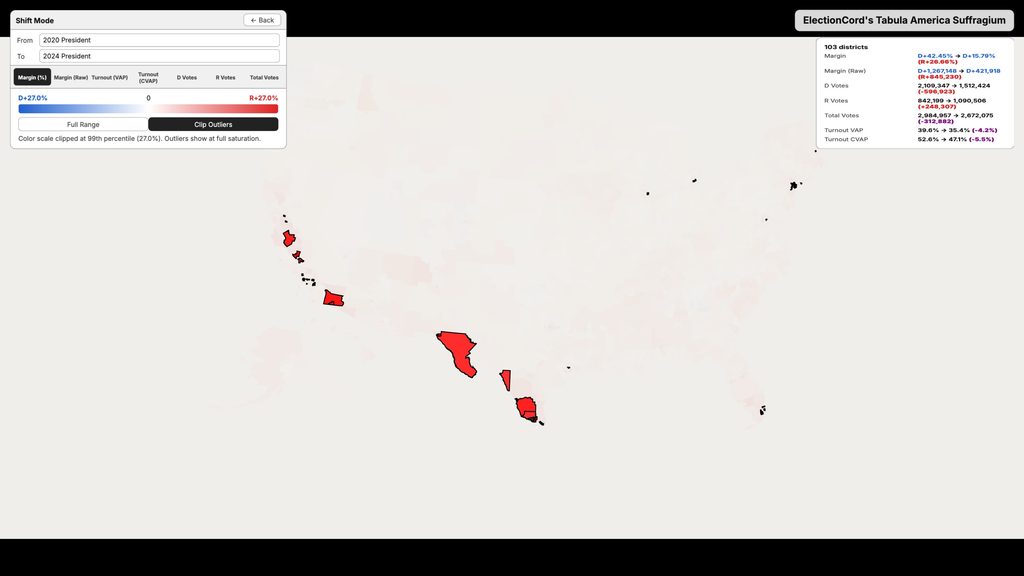
In the 103 100K districts that swung more than 20pp right from 2020 presidential, most of them were in urban areas (the cities of the Rio Grande Valley, New York, Los Angeles, South Florida). Democrats lost an almost unbelievable 845,230 net votes in these areas, which accounted for roughly 10% of the net votes lost from 2020 to 2024 despite these districts only being about 3% of the country.
So, in short, things are not going well for Democrats in cities. The Democrats are facing their biggest challenge to their urban control in decades, with a furious party base of educated professionals and equally unhappy group of angry minority groups. How they manage this part of their coalition will shape the party’s policies and electoral success.
What the hell happened?
The city-dweller has become the prototypical Democratic voter envisioned in the minds of all Americans. Whether they are demonized on Fox News or triumphant in Instagram stories, you know the type. They are the engines behind Democratic margins, often splitting 80/20 for Dems. In certain precincts, those margins are known to reach 90/10 or even 95/5 levels, in both the classic “young/progressive/artsy” and the “inner-city neighborhood” sense. Remarkably, Democrats did better in 2016 in some urban areas than they had in 2012 thanks to Hillary Clinton’s strong numbers with college-educated and Latino voters. So, what the heck happened?
Who Lives in Cities Now?
From a compositional perspective, cities continue to retain the typical sorts of people that many envision. Their average income is still high due to a clustering of high earners (we have it at $103,000, just below suburbanites at $108,000). They are less than 50% White, with America’s melting pot of ethnicities and religions all featuring as meaningful presences depending on the region.
Was there a significant demographic swing post-2020? Maybe. There was a large exodus from cities due to the COVID-19 pandemic that shook out from 2020-22, with many leaving due to remote work and cheap interest rates for housing in the exurbs or suburbs. In their place, many recent immigrants and younger professionals arrived, but overall populations went down.
Cities consistently have a younger and more diverse population of transient people, and it’s hard to get a solid baseline of what is “normal” in US urban life. Unlike Europe, where large cities have often been quite stable in the post-war era, American cities have had recent periods of rapid growth and contraction. Yet it basically didn’t matter if you were from a growing city like Houston or a shrinking city like Cleveland: Democrats just did badly across urban areas regardless. So, we have to figure out why (using our invaluable Suffragium and Charta tools).
Education Polarization Strikes Again
In 2016, we saw an enormous cleavage appear between college and non-college-educated White voters. Surely you’ve heard of this by now! It’s only caused what could be considered the Seventh U.S. Party System. But this education divide has leaked into nonwhite voters, as Democrats lost far more ground with less-educated minorities, many of whom live in urban areas.
On Catalist, Democrats lost with every racial demographic of urban voters. Swings among Latinos and Asians were particularly bad. This was backed up by our 100K Districts project, which found horrible swings among Latino and Asian voters as well.
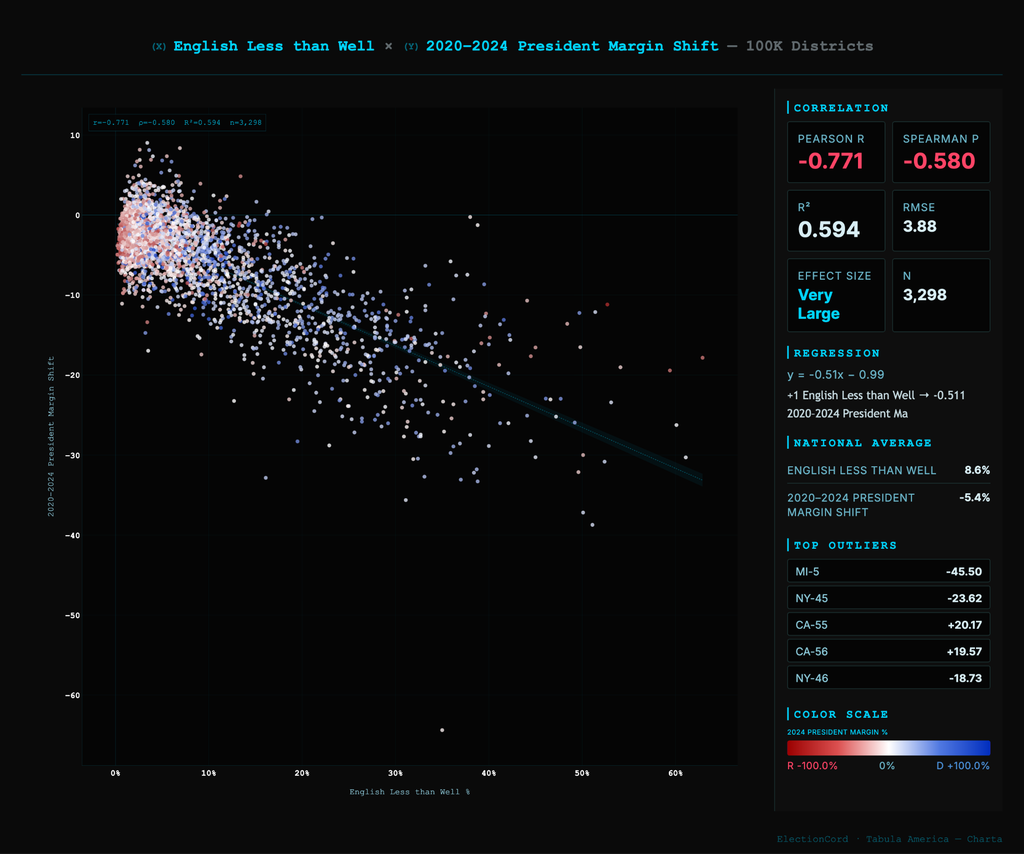
As we found out last newsletter, the swings from 2020-2024 and 2016-2024 were strongly correlated among those who “spoke English less than well”. Here’s that chart again. Many of these residents also live in cities.
We also saw Democrats have a trend where they markedly did better in areas with what we classified as “white-collar” jobs from 2016 to 2024 and 2020 to 2024, further illustrating the new political landscape.
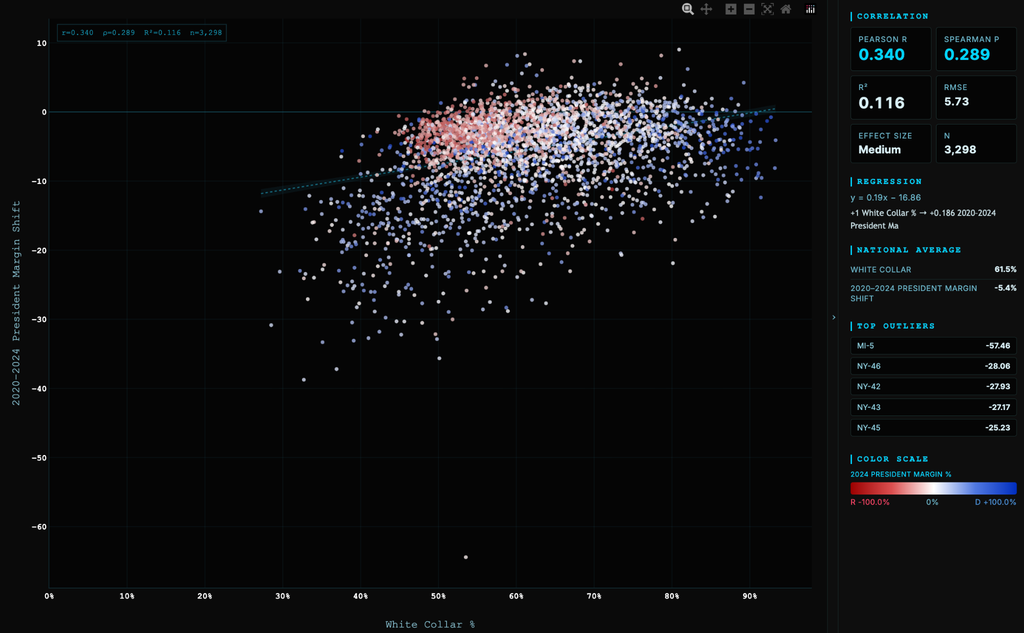
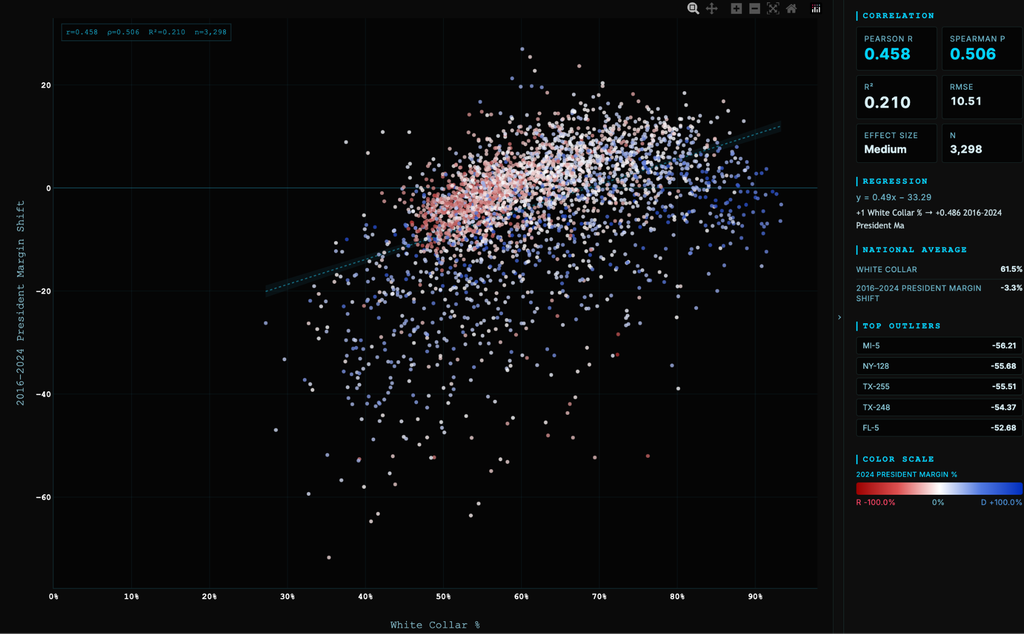
While cities do have many white-collar workers, they are often juxtaposed with some of the most “blue-collar” areas in the entire country, with many of them outpacing rural or suburban areas. For example, when we have Houston mapped by ElectionCord 100K Districts, you can see the “Houston Arrow” of White professionals right next to areas where less than one-third of people work in white-collar jobs.
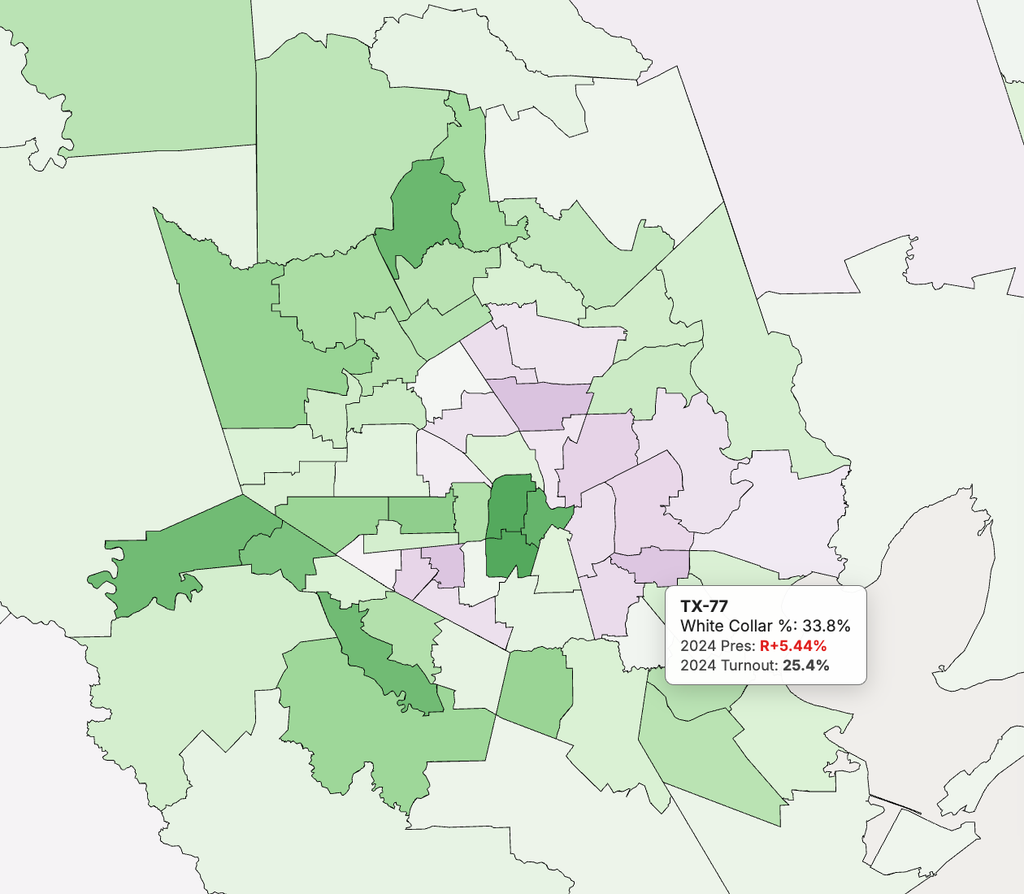
So, as education polarization leaks into minority populations, cities suddenly open up a large area where Republicans can make up ground.
Garbage Turnout
Urban turnout was really bad in 2024, especially outside of the swing states. Urban turnout is always rather bad as poverty and age have a direct negative relationship to political engagement. But, relative to an increase in political engagement everywhere else during the Trump era, urban areas just did not keep up in 2024.
On the whole, this was awful news for Democrats, as rural and suburban turnout largely matched 2020’s record turnout. This meant most of the turnout drops disproportionately hurt Democrats. Even if you assume the worst margins with these urban voters, Dems simply got fewer votes out of their strongholds because of the turnout decline.

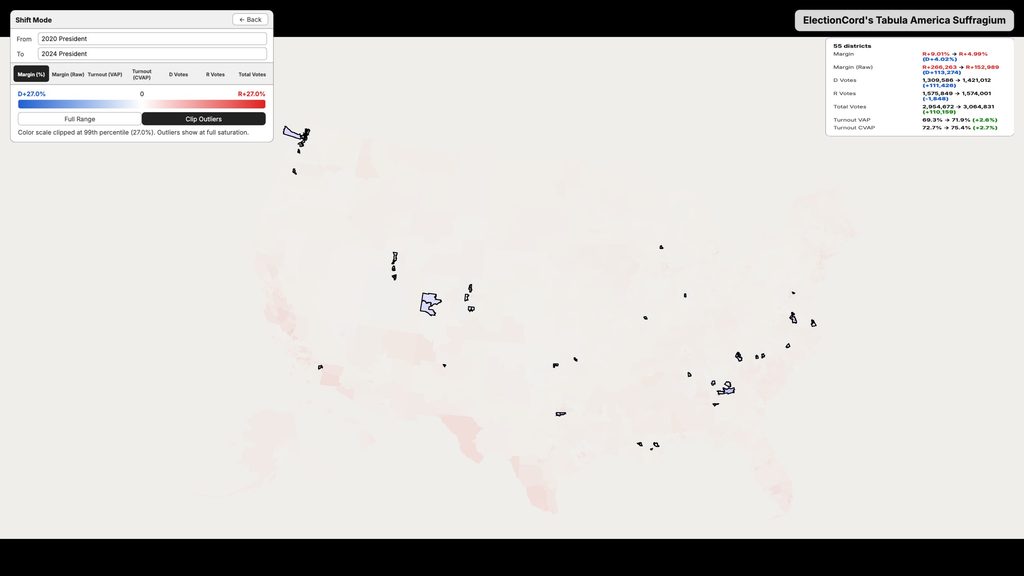
We have a great 3D visualization of this at ElectionCord, where you can see that anywhere there was a city, turnout went down.
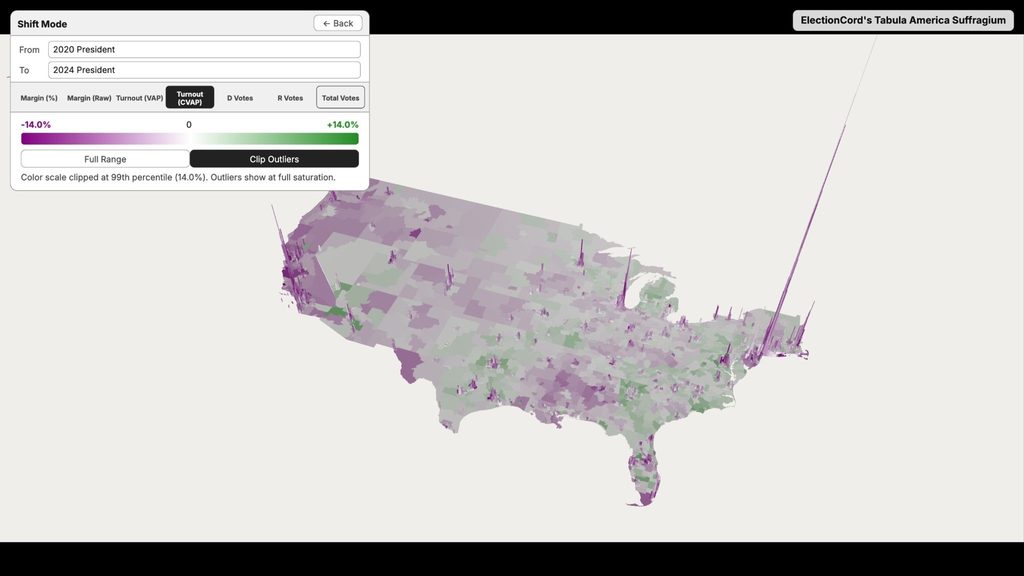
And those voters were, for the most part, disproportionately previously Democratic voters. Many voters went to the couch and didn’t vote, and there is ample evidence in the map and results that Democrats outside of the swing states realized their vote was meaningless. In addition, plenty of Democrats switched sides, moved, or died, and there was little mobilization to get them back due to an unpopular administration.
Among nonwhite voters, the turnout situation was particularly awful, with White voters largely holding their record turnout from 2020, while every group of nonwhite voter suffered significant declines. For Black-majority districts, the turnout was worse than 2016.

As we saw in party registration data, during the entire Biden administration, Democrats struggled to register voters. In Pennsylvania, for example, Democrats lost 7.5pp in registered voters from 2020-2024, while Republicans gained. While some of this was younger Democrats registering as independents, by default, those voters are going to be less reliable for your cause.
There was some evidence of protest voting over Biden’s support of Israel, but it wasn’t meaningful enough to change the result. While youth turnout was down, the damage was already done by persuasion alone, and, if anything, the turnout collapses were greater among areas that were poorer and presumably less influenced by foreign policy.

There were also turnout declines in wealthy areas, but since both make up a relatively small number of areas clustered in safe states like New York City and San Francisco, it can’t really be inferred that protest voting cost Democrats the race. Although it did occur: just look at how Dearborn swung right/toward Jill Stein.
Ideological Mismatches
For the entire Biden administration and the Harris 2024 campaign, Democrats played the role of holding on to a collapsing center. Americans consistently demanded radical changes during the election, and Democrats were not willing to offer much in return. Of note, these changes were not very ideologically motivated on the left/right spectrum—there were voters angry about liberal immigration policies, an inability to make sustained improvements to the welfare state, Palestine, prices, you name it. If there was a problem, the Democrats were to blame.
While some pundits claim that “economic issues” were merely a byword to avoid discussing other issues, it’s worth taking voters at their word here. We’ve seen in 2025-26 that voters were actually quite serious about their focus on cost-of-living, as it has been Trump’s worst issue and has significantly contributed to his polling decline. Now, is this merely a different set of partisans saying the economy is bad? Yes, but a large number of independents and soft Republicans are providing the critical “swing” numbers of people who are mad about prices, jobs, and the economy.
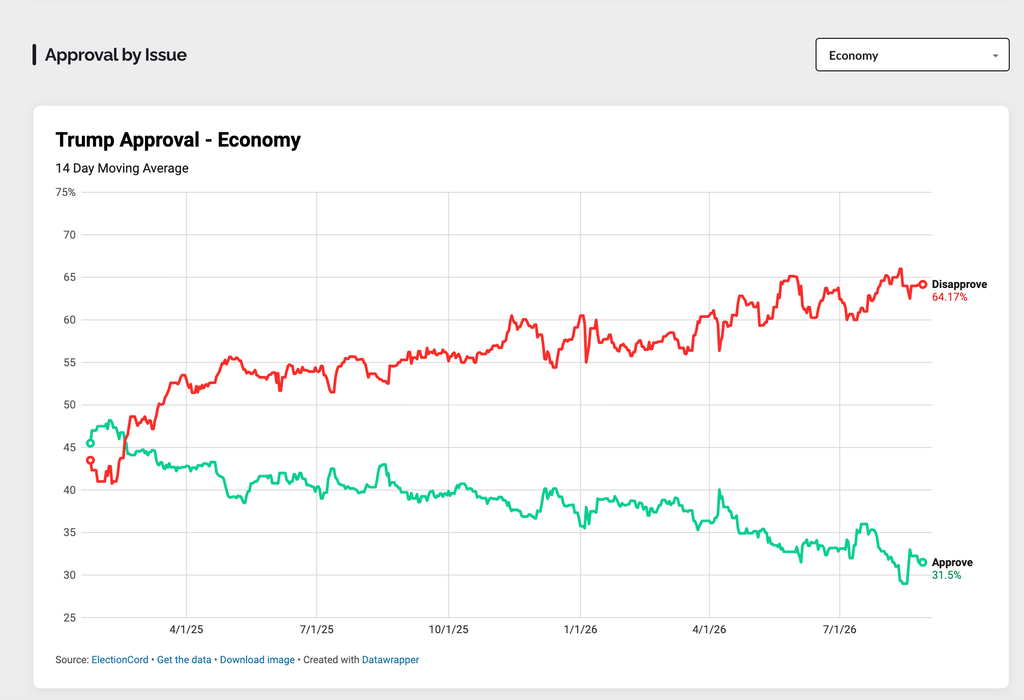
Those economic issues have permeated through urban areas as much as anywhere else. Rising dissatisfaction over increased costs and a (mistaken) sense that Democrats have abandoned them have led to a decrease in engagement and some outright side-switching. As a result, some Democrats have had to concoct new messaging to recover their urban base, which partly explains the rise of Zohran Mamdani and candidates from the Democratic Socialists of America (DSA). Aggressive positioning on cost-of-living has become the talking point of the day, and Republicans are now finding themselves in a similar position to Democrats 2 years ago: every problem is now their fault.
The major decline in persuasion and turnout from 2020 to 2024 suggests that Democratic policies, economic dissatisfaction, and a lack of media producing good vibes all led to enormous problems for Democrats in all cities.
Look at this R+11 swing in a city like Bakersfield, California. It’s not exactly a hotbed of unpopular woke activism; it just had a bunch of Democrats who clearly could not be bothered or were persuaded to the other side.
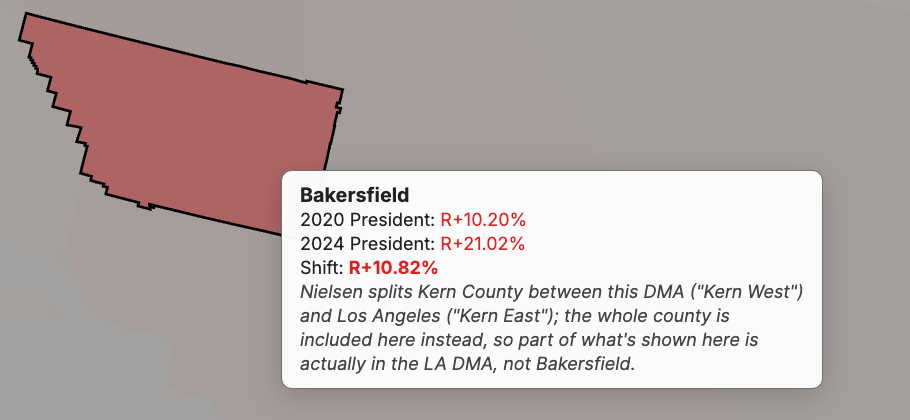
We had the Dems losing roughly 25,000 votes here, while the Republicans gained just 2,700. While the national media remains focused on the US’ superstar cities, the truth is that any urban agglomeration saw disproportionate anger with Democrats during the Biden administration. Indeed, the few urban areas that seemingly avoided the trend and moved left were either attracting a large number of D+90 Black in-movers (Richmond or Atlanta) or the type of affluent, college-educated voters that Democrats were gaining (Seattle).
The Future: A Rebound?
In the 2025 gubernatorial elections for New Jersey and Virginia, we saw Democrats rebound to margins in cities they had in previous cycles. I am going to focus on New Jersey here because Virginia’s urban areas had some unique effects due to DOGE and Richmond’s leftward march (however, Dems did see smaller rebounds there).
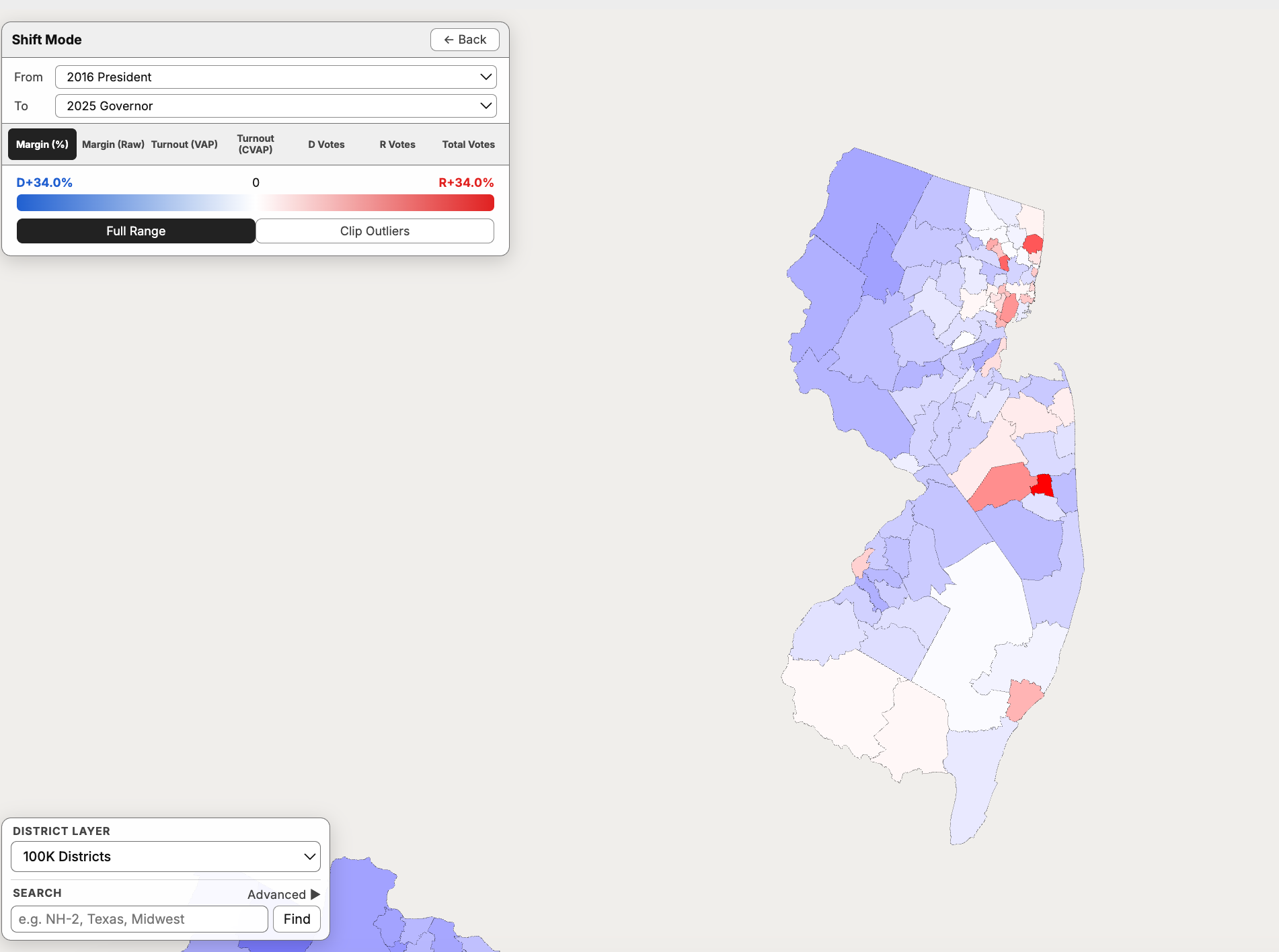
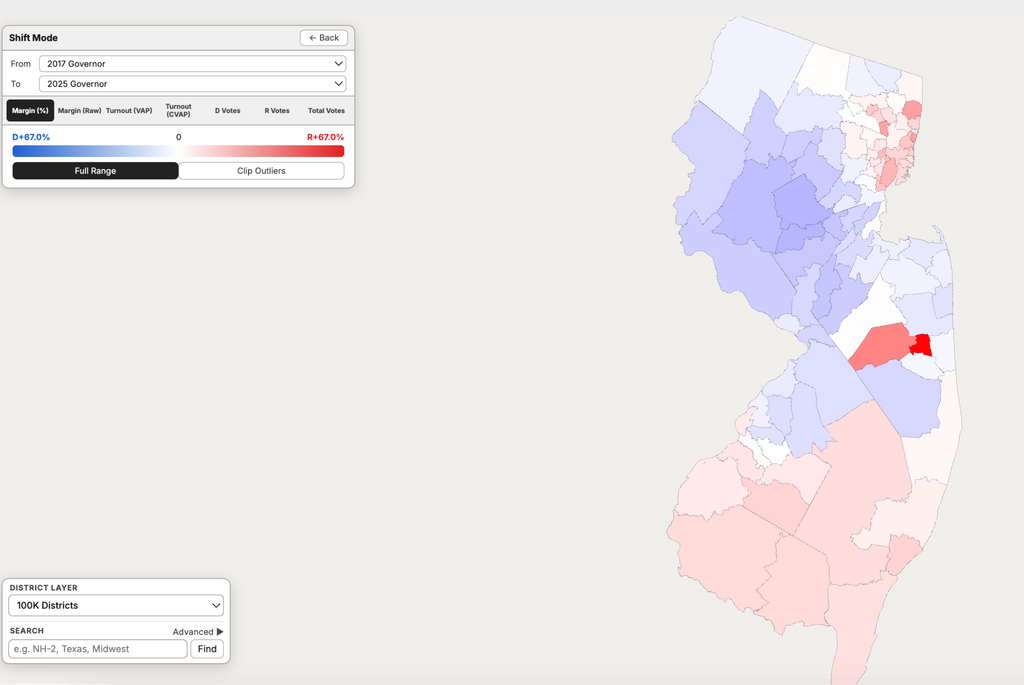
North Jersey is about as urban as America gets, and its urban areas swung hard back to Democrats in 2025.
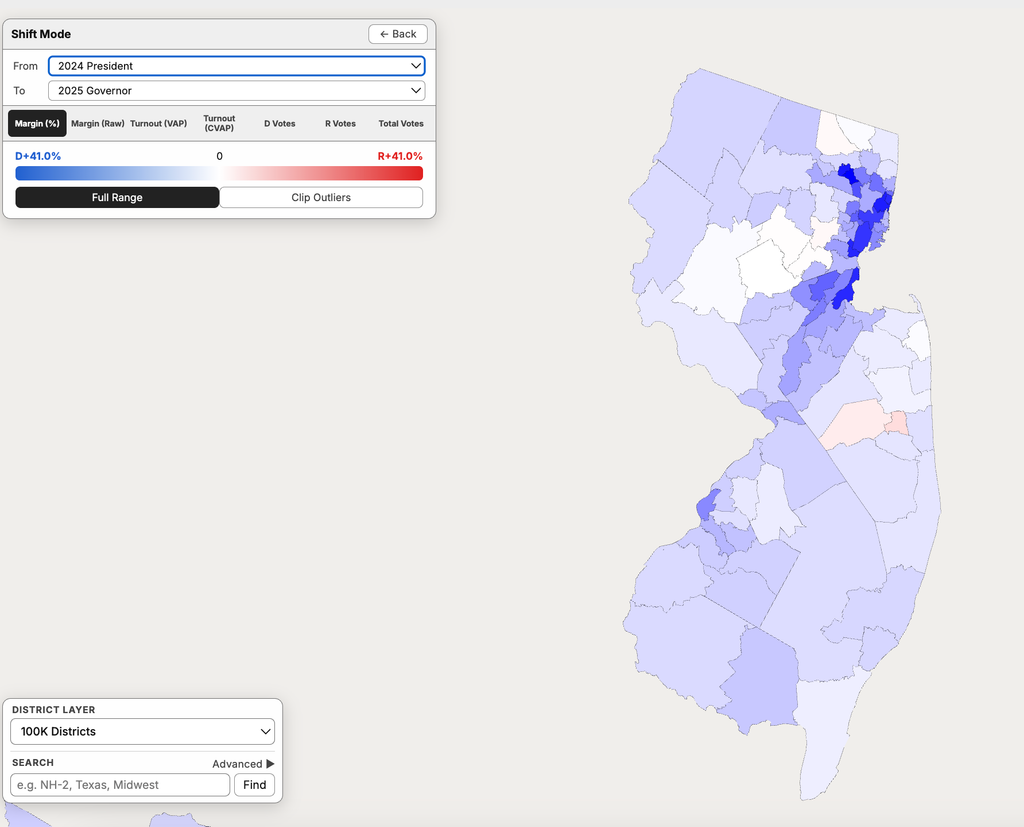
However, interestingly, Sherrill did do worse than Clinton 2016 in urban areas.
And struggled to match Murphy 2017 as well.
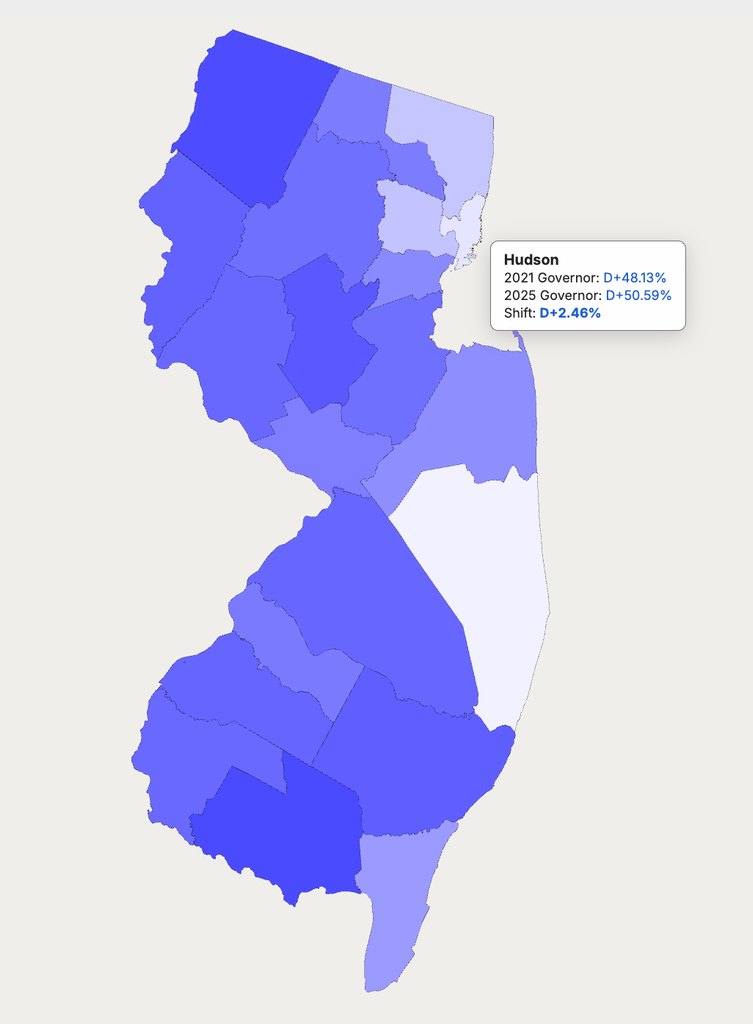
Switching to a county map to illustrate the point better, Sherrill only did 2.5% better in Hudson County in 2025 than 2021, even as she won the state by 11.1% more than Murphy in 2021.
Using Suffragium, we find that Sherrill and the Democrats made up for this by absolutely crushing their turnout numbers compared to 2021 in urban areas. And almost all of these were eventual Democratic voters.
In Essex County, New Jersey (Newark, basically), we saw:
+9,961 votes for Republican Jack Ciattarelli compared to 2021
+56,157 votes for Democrat Mikie Sherrill compared to 2021
This repeated itself in Jersey City, Trenton, Paterson, and other cities.
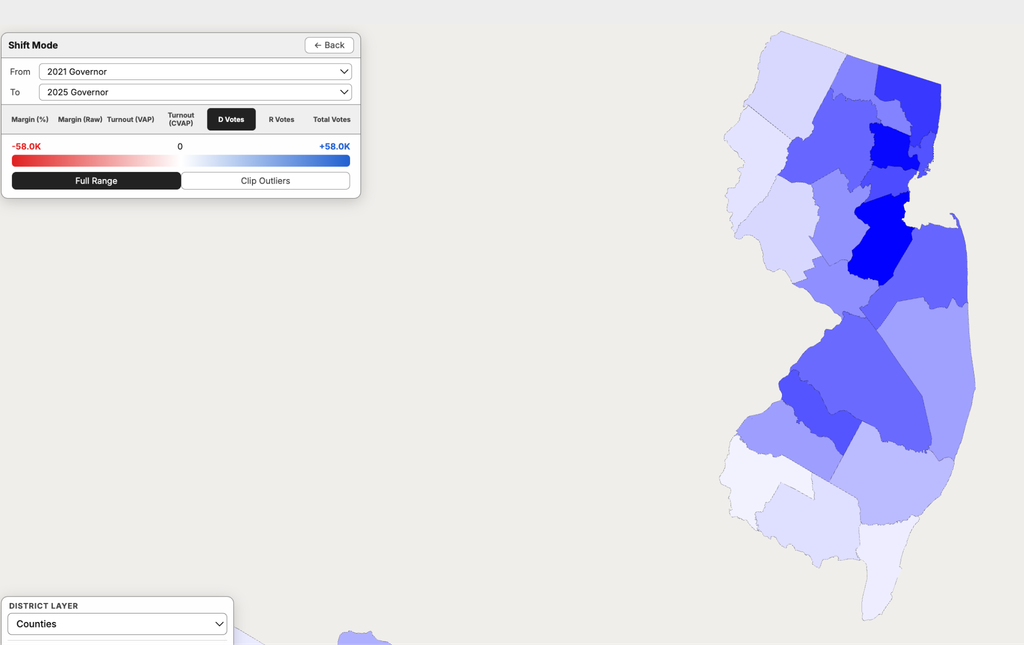
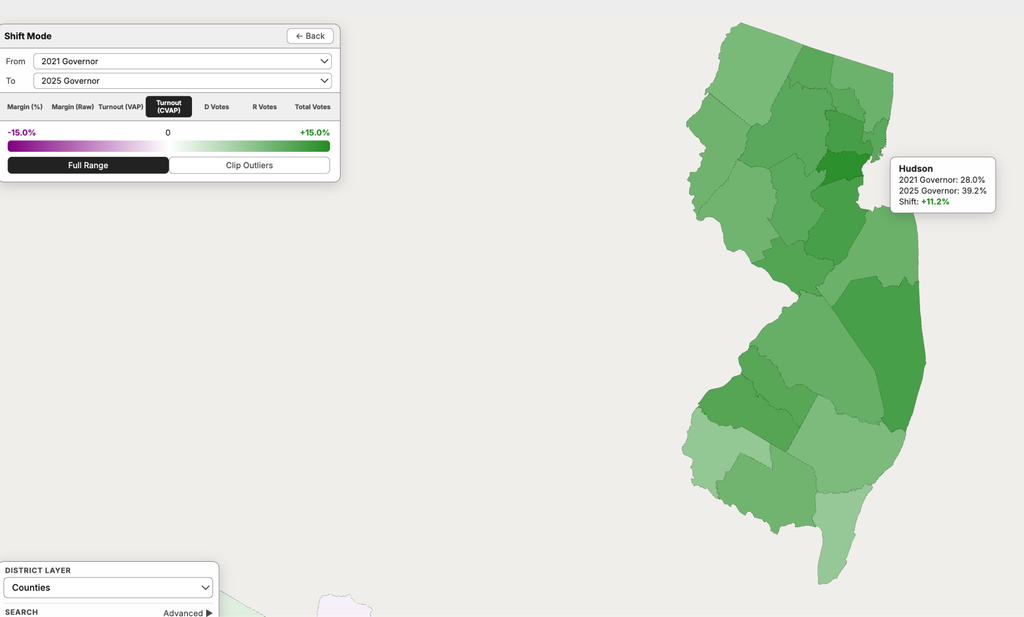
Even as Jack Ciattarelli got roughly 162,000 more votes in 2025 as he did in 2021, Democrats were able to add about 557,000 more votes in response.
In the 2025 New York City mayoral election, we also saw record turnout, meaning that Democratic urban get-out-the-vote efforts can have a serious effect. Sheer rage over the Trump administration’s actions and demoralized Republicans (yes, there are a few who live in cities as well) are also having an outsized effect on Dem margins.
So, for 2026, we should expect both a strong persuasion and turnout rebound for Democrats in urban areas. Those factors are likely linked: as long as Trump is deeply unpopular, more and more partisan Democrats are going to show up and get engaged in politics. In addition, Trump is going to lose support among independents and Republicans, just as almost every unpopular president has throughout US political history.
Does this mean Democratic issues in cities are truly fixed? Probably not. The economic and sociopolitical factors affecting American cities are, frankly, beyond the control of a loosely-defined coalition of competing anti-Trump interests. Efforts to create more affordable housing, more jobs, and better transportation for urban areas have all been underfunded for decades. Municipal budgets are stretched thin again after COVID aid dried up and federal funding has been slashed. Reductions in immigration have sapped some growth potential. And then there are the potential effects of AI or high interest rates crushing the type of high-income professional work needed to keep cities afloat.
As the second Trump term has painfully gone on, we are starting to see Democrats return to focusing on their urban bases. Policies like rent relief, universal healthcare, and better childcare have taken off in municipal elections. However, as we’ve seen with many of the DSA-backed mayoral runs, they have been paired with some classic “neoliberal” or even straight-up conservative reforms that include deregulation and relaxation of restrictive zoning and small business laws. This policy mixture is a must-have at this point: there are just too many votes up for grabs; even a 5-10% decline in urban areas, as we’ve seen, is absolutely devastating.
About the Author