

It goes without saying Bluesky’s favorite topic is the ideological direction of the Democratic Party. And boy, was 2026 a banner year for spewing as many takes as possible about that topic. Amidst the self-destructive id of the Trump administration, foreign wars, and incipient far-right nationalism, the chattering classes have had a series of contested Democratic primaries across the country to yap about endlessly. With the final primary complete, it’s time to take stock.
What did it all mean? Good question!
The Democrats (Sorta) Move Left
During the last two years of the Biden presidency, there wasn’t much time to ponder the future. The vision for Harris’ term was vague, and there wasn’t much appetite to move on from Biden’s policies, even as he had approval ratings in the mid-30s. After the 2024 election, the traditional jockeying for ideological control ensued. As always, the instantaneous reactions were mostly hasty and ill-conceived. Once Trump’s second term began, the battle lines began to be drawn, and we are thus in a different political environment than late 2024, no matter how much people would love to think otherwise.
Since the dust has settled and we’re in general election mode, the Democrats are once again (mostly) united in trying to oust the Republicans from any elected office. Across polling, Democrats and left-leaning independents are giving, as tradition, 95-99% of their votes to their candidates, and are more motivated to vote than ever. Democrats are outpacing Republicans in enthusiasm regularly, and Dem primary turnout has consistently outpaced their opponents. Even Maine’s Susan Collins is only getting 4% of Democrats to defect now, according to CNN/SSRS.
There is no way the Democratic primary electorate could have ignored this. The resulting shift has led to a different party, with much greater focus on populist economics than whatever came before. Insofar as there is a “social” component, it has been typified by lockstep hatred of anything Trump does, whether it’s terrorizing Minneapolis with ICE agents or trying to rename the Kennedy Center.
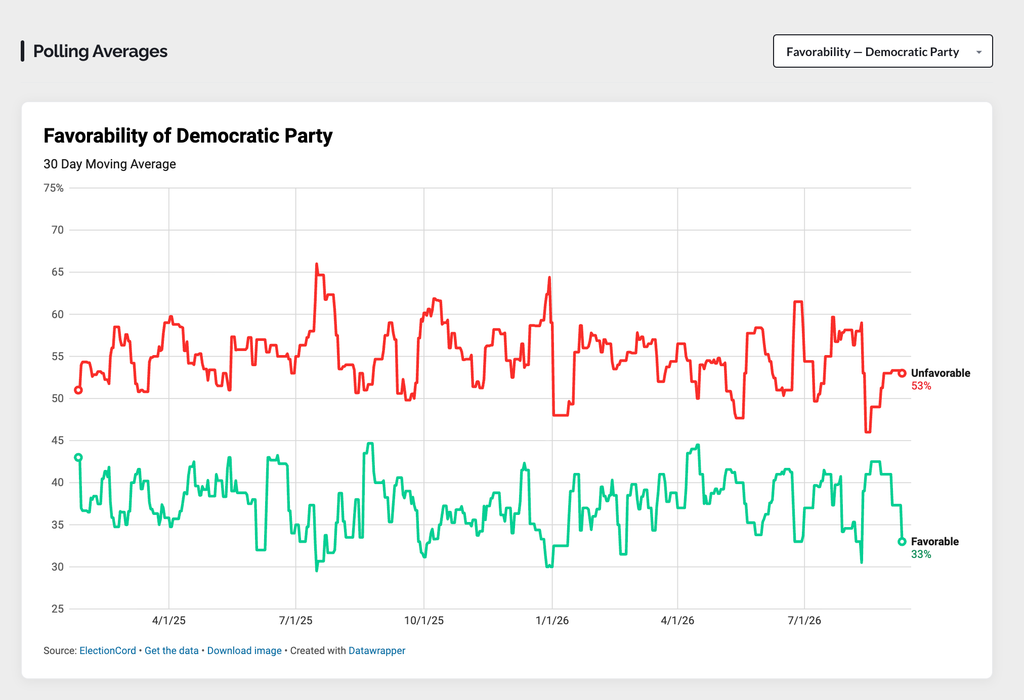
So, all is well? Hardly. While the Democratic Party has widely coalesced to halt their opponents, favorability of the organization, leadership, and policies is often horrible. As our ElectionCord average shows, Democratic favorability has largely oscillated around the -20 mark since Trump began his term, with some outlier polls showing them beyond -30. This has resulted in more Dem House incumbents going down than in 2018, and more than the original Republican Tea Party managed in 2010!
Ideology, while powerful, is not the only factor. Money, institutional backing, and plain old “likeability” have persisted throughout the months-long primary cycle, even as the party starts to realign. Later, we will see how these new ideas work with the nationwide electorate, but within the Democratic primary electorate, the changes have been stark.
Where did we start, again?
Believe it or not, the first Democratic primary of any substance happened on June 10, 2025, when New Jersey ran a statewide primary for governor. The headlines made it seem like a coronation for Mikie Sherrill, but election nerds will note she prevailed with just 34% of the vote.
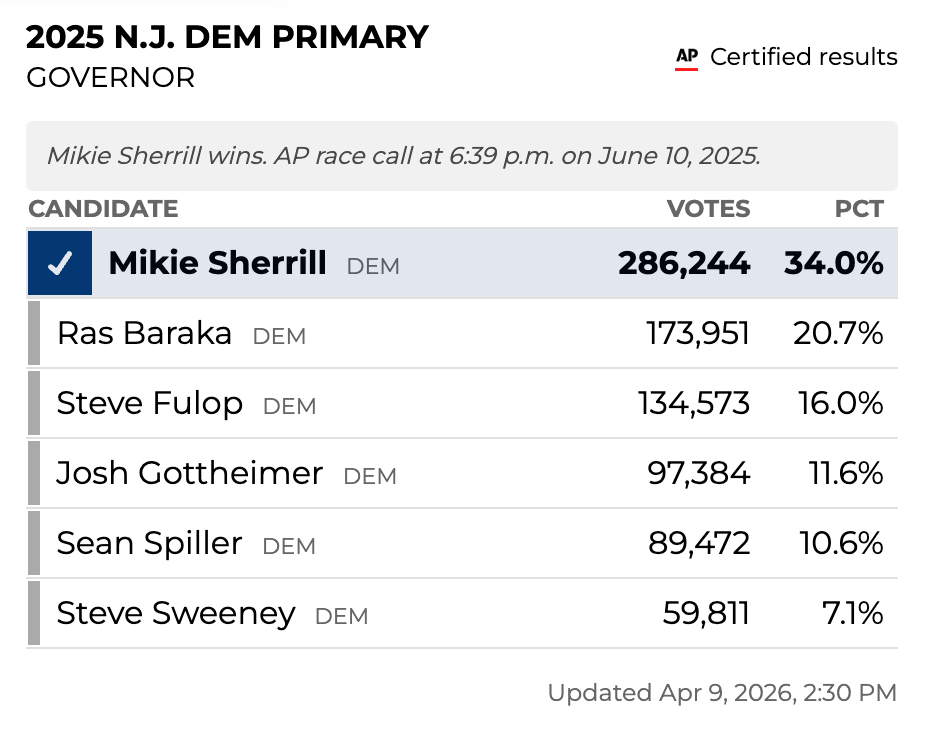
Believe it or not, this primary actually presaged the upcoming fight over the Democratic coalition as much as the Cuomo vs. Mamdani primary two weeks later. In addition, this was the first New Jersey primary run without the “party line” system, where county machines were able to effectively rig the process by putting their preferred candidates first on the ballot under the Democratic Party’s banner. Thus, we got a fully-contested six-way race that represented different factions of the party.
The utterly disastrous performances of Gottheimer, Spiller, and Sweeney, who received a collective 29.3% of the vote, were a warning shot to more conservative Dems. Sweeney and Gottheimer, in particular, were clear “conservative” candidates, while Spiller was largely seen as a tool of the teachers’ union. They all flopped spectacularly, despite raising boatloads of cash.
Ras Baraka ran on a campaign largely appealing to Black voters and a few progressives, while Sherrill ran on an aggressive program focusing on cost-of-living and opening up fronts to challenge the Trump administration. In the end, Sherrill mobilized the support to win, and then turned in a better-than-expected general election performance in November.
It’s worth noting that New Jersey statewide is far more representative of the country writ large than New York City. Yet the Cuomo vs. Mamdani primary, despite occurring in a much more progressive locale, echoed similar themes. For all of Mamdani’s branding as a democratic socialist, the real key to his campaign was an aggressive focus on local cost-of-living issues, paired with a strong anti-Trump message (although, ironically, it’s Mamdani who has met with Trump thrice, while Sherrill hasn’t). This enabled Mamdani to handily defeat Andrew Cuomo, who was heavily favored to win by most prognosticators.
Both Sherrill and Mamdani were able to activate their bases on key issues that mattered, and successfully broadened their tent while their opponents shrank into factionalist infighting. However, we shouldn’t discount the impact that media and money played here. For one, both Sherrill and Mamdani were able to make use of public matching funds, which helped establish a baseline for their campaigns. Then Sherrill was able to print money for her Super PAC, which contributed to her victories. Mamdani went a different direction, focusing on developing his own personal brand through social media, and also making use of his campaign dollars on said media. It also certainly helped that both candidates were on the younger side for US politics.
We shouldn’t discount the impact of money on helping Mamdani get into the race (and also keeping Cuomo from completely collapsing). As you can see in expenditures, Mamdani actually spent even more campaign funds than Cuomo in his bid for mayor. Cuomo’s spending advantage came from less effective PAC spending.
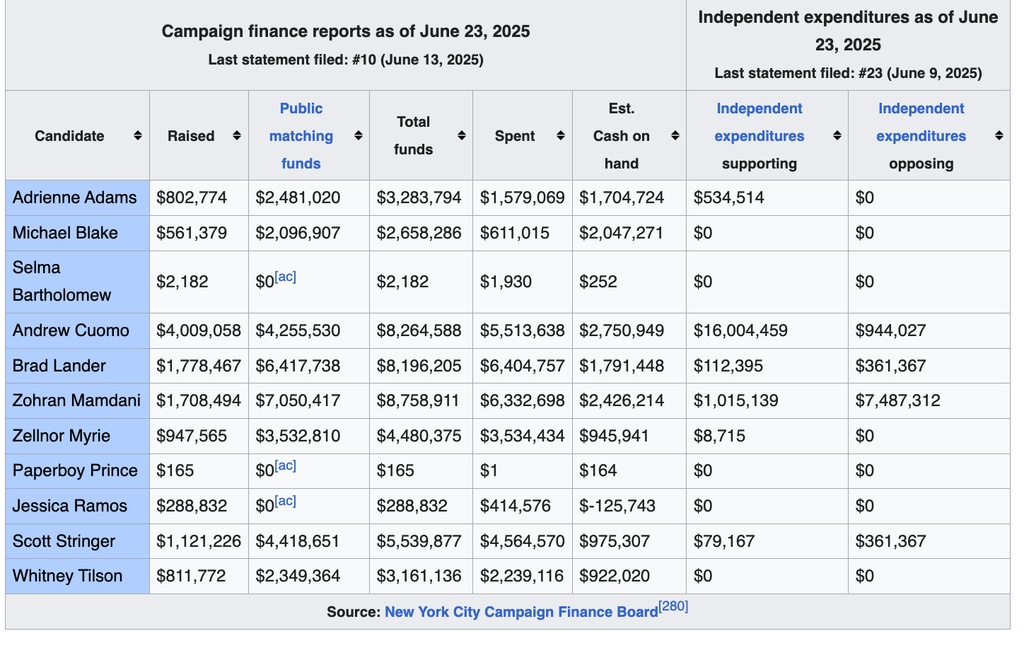
Throughout the 2026 primary cycle, a compelling economic message + money + generational change + hating Trump would become the formula to victory. In hindsight, the 2018 and 2020 primary cycles, by comparison, arguably had more to do with personality, identity, and “vibes”. Many candidates that would have done well in those cycles notably flopped in 2026.
Left vs. Center
The progressive left certainly notched a series of victories in primaries across the country. It won’t be necessary to go through all of them, but defeating several House incumbents and getting an array of left-leaning Senate candidates is a huge win for the left flank of the party.
Was every election Mamdani vs. Cuomo? Sorta. Across the country, the left flank of the party ran a series of races against older members they viewed as unsatisfactory. At our ElectionCord results compendium, we have chronicled as many primary results as we can find by precinct and county and done some precinct analyses for these races. Most House incumbents didn’t have viable challengers, but some that did really caught fire, leading to 7 Dem House incumbents losing and multiple high-profile wins in open seats (though two Texas incumbents partly lost due to running in new districts).
What did these districts show? The districts with five high-profile DSA wins (Melat Kiros, Chris Rabb, Darializa Avila-Chevalier, Claire Valdez, and Donovan McKinney) combined to be:
- Very nonwhite (34.9% White)
- Above-average college-educated
- D+57.6 in 2024 (8.4% right of 2020)
In general, I would classify this as the heartland of progressivism and now democratic socialism throughout the country. There weren’t many districts outside of these where outright leftists were able to succeed. In the future, DSA candidates will need to expand their brand into other large and midsized cities, as well as further attract nonwhite voters who are frustrated with the Democratic Party, but are not fully in the socialist fold.
On the other flank of the party, it’s clear that some kowtowing to the left goes a long way. Indeed, we saw several candidates gain credibility on the left and the establishment through careful politicking, who are now doing well politically (Kathy Hochul comes to mind). The Democratic base continues to age along with the rest of the country, and older voters are simultaneously more open to hearing the progressive message and still conscious of electability concerns. In competitive areas, Democrats largely nominated their typical slate of candidates, with only Sam Forstag, Randy Villegas, and William Lawrence as progressives nominated in competitive seats. Forstag and Villegas are probably better candidates to begin with, and Lawrence won due to a truly stupid moderate vote split.
In some of the districts surveyed, the DSA candidates did remarkably well with presumably nonwhite voters, but worse with older, more reliable nonwhite voters (this makes sense, younger and educated nonwhite voters are probably the most left-wing in the country).
Take the race between Donovan McKinney and Shri Thanedar. Despite Thanedar being an objectively weak candidate, he still managed to win poorer and less-educated precincts. However, McKinney was able to win Black and White voters outright, earning him a very narrow victory.
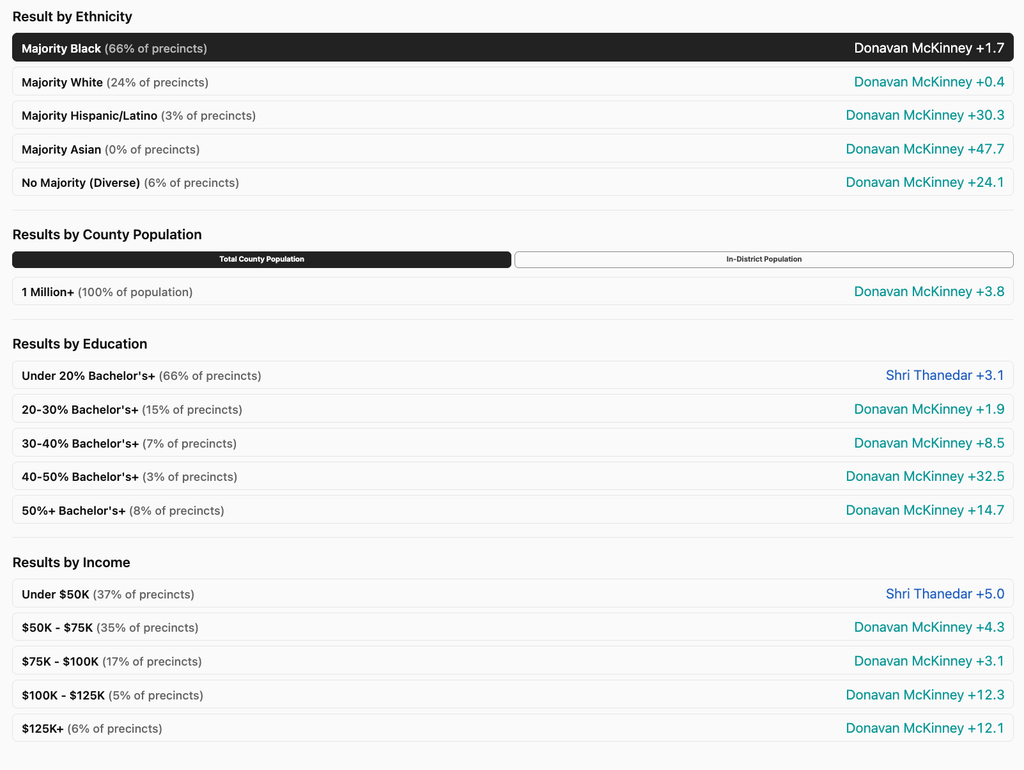
Incumbents did particularly worse with younger, college-educated voters (income was less clear). This is essentially due to ideology: these are progressive voters; there’s nothing that would suggest otherwise. They were angry about a perceived lack of opposition to Trump, cost-of-living, and unpopular positions on Israel. This segment of the base moved left, and largely succeeded wherever it tried. Indeed, with more money and institutional backing, they likely could have won several more House seats such as IL-08 or NC-04.
On our Proportio tool, we found districts that were demographically (and thus ideologically) similar to CO-01, where DSA-backed Melat Kiros ousted longtime incumbent Diana DeGette.
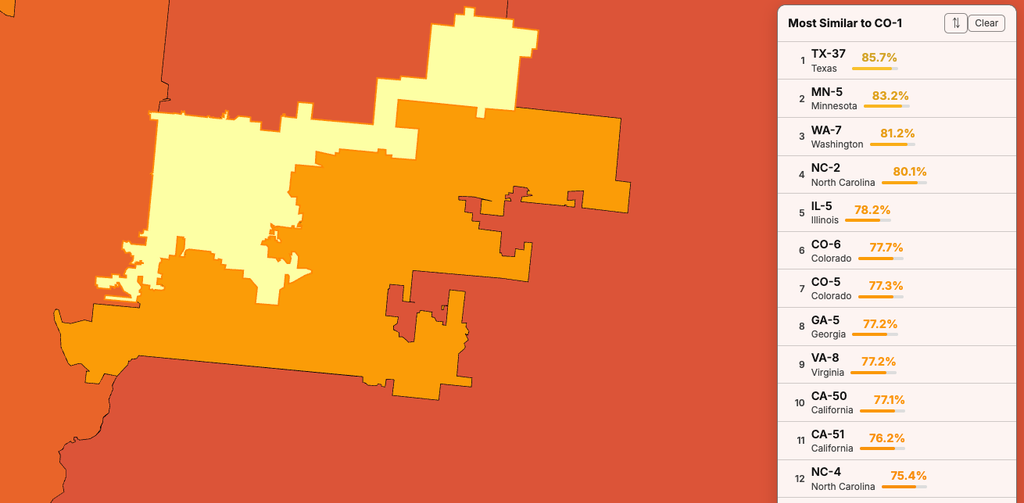
TX-37 (Casar), MN-05 (Omar), WA-07 (Jayapal) are all already occupied by staunch progressives, but the rest aren’t!
Television Rules the Nation
Throughout primaries, we saw that running TV ads essentially buys you a ton of votes from low-info voters, particularly those in rural areas. In the major statewide Senate and governor primaries, where those Democratic votes mattered far more, we saw the enormous impact that television ads and spending can have.
The first big primary of the cycle, James Talarico vs. Jasmine Crockett, illustrated this well. Talarico outspent Crockett five-to-one in advertising, and thus he survived despite losing Black voters 97/3. Then there was Illinois, where a three-person race between Lt. Governor Julianna Stratton, Rep. Raja Krishnamoorthi, and Rep. Robin Kelly essentially devolved into a battle of advertising. At the start, Krishnamoorthi blanketed airwaves and earned a solid floor of support. However, Governor J.B. Pritzker poured in money for Stratton, getting her up on TV and sparking a late comeback. With the money, Stratton was able to get on air and pitch herself as more “anti-establishment”, and thus had a familiar winning coalition to Abdul El-Sayed and Zohran Mamdani. Stratton also captured a significant share of the Black vote.
Instead of heeding such warnings, left-leaning candidates in statewide races were often unable to scale up their campaigns to get on television. In Colorado, Julie Gonzales came very close to unseating Senator John Hickenlooper, but she lost largely due to the margin Hickenlooper ran up with rural voters. In Wisconsin, DSA-backed State Representative Francesca Hong ended up losing to Milwaukee County Commissioner David Crowley in a stunning upset. Crowley actually dropped out of the race and then got back in, and proceeded to use a two-week TV ad blitz to make up huge ground. Finally, in Michigan, we saw Haley Stevens outperform expectations thanks to millions in AIPAC ads, which may have seriously hurt her standing among younger progressive voters, but certainly benefited her with lower-info Dem voters.
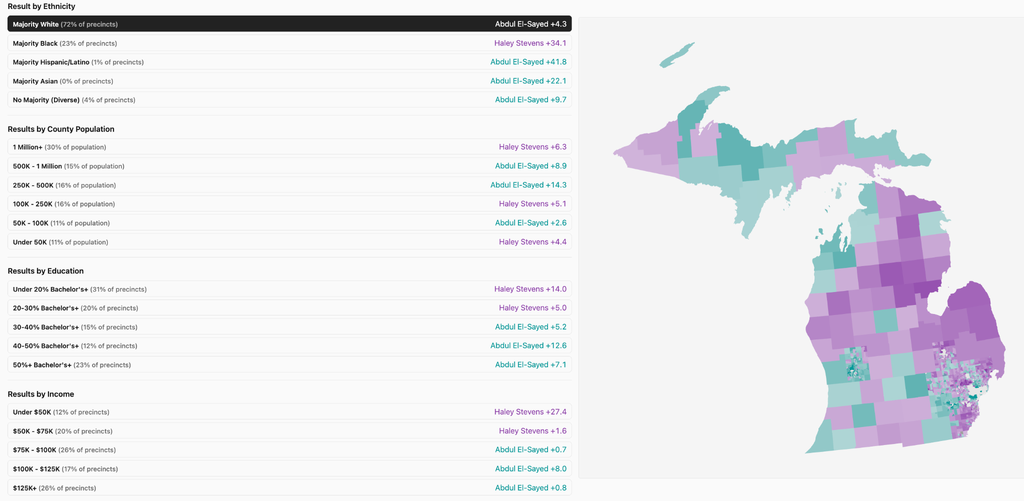
The Stevens case was particularly illuminating, as she ended up outright buying a ton of rural voters who saw her ads and then reflexively voted for the woman in the primary (a real effect). We also saw evidence of the new “young progressive middle-class” cohort, with many of them voting for Abdul El-Sayed. El-Sayed actually did rather well with nonwhite voters, all things considered, but while he cut the margins to a reasonable Stevens +34, the net result was that he narrowly won the primary at 2 AM.
Edge Cases
More so than other cycles, the 2026 primaries saw things get outright bizarre. Perhaps this is natural: a well-educated party that just lost the presidential election often stops taking orders from elites and starts doing whatever the hell they want—as evidenced by the 1994 Republican “Contract with America” and the 2010/2014 “Tea Party” primary movements.
Thus, we had some episodes that showed Democrats are less interested in getting with the program. Let’s just get through them in a bulleted list.
- Graham Platner. That is all.
- Angie Nixon’s upset victory over the well-funded Alex Vindman in Florida.
- Dan McKee’s loss as an incumbent governor to Helena Foulkes in Rhode Island.
- Four Democratic House members passed away in office (S. Turner, Grijalva, Connelly, Scott), and their seats were vacant for a good while. This added to the urgency around the Dems’ anti-senior citizen campaign triggered by the Biden presidency. In a particularly weird moment, David Scott’s seat (GA-13) was won by Jasmine Clark, a state rep who had campaigned against Scott’s advanced age. But Clark didn’t run in the special to replace him, and Everton Blair ended up defeating Scott’s daughter. The age penalty seemed to go beyond generations.
- The age penalty also affected Janet Mills in the Platner debacle, and most spectacularly doomed John Larson in CT-01. Larson, who had a partial seizure on the House floor in February 2025, ended up losing to popular Hartford politician Luke Bronin, in a race that was almost solely determined by age and not policy.
- And yet, one of the oldest Democratic Senators, Ed Markey, managed to defeat a much younger challenger in Rep. Seth Moulton. Markey successfully turned the race around by painting Moulton as a conservative, but it required more effort than it should have. The whole matter was a waste of time, and Markey may have served his constituents better by simply retiring.
- Other than that, Massachusetts saw some interesting House primaries as well, for once. For instance, 71-year-old Stephen Lynch was challenged by Patrick Roath from the left. Roath was specifically hit Lynch for his vote for the Laken Riley Act, and actually ended up outraising Lynch towards the end. But Lynch ended up winning by over 10%. Turns out, it is actually fairly difficult to oust incumbents!
- On the other hand, 77-year-old Richard Neal ran for reelection in MA-01. Neal was arguably to Lynch’s left, but he only ended up winning his primary around 8% against Jeromie Whalen, a teacher who raised and spent almost no money. Given that Neal almost lost to underfunded opposition, he will definitely be on retirement watch for 2028.
- Moderate/establishment candidates in open primaries did still prevail in suburban wealthy districts. Dan Koh emerged victorious in MA-06, and Stefany Shaheen won in NH-01 despite being the daughter of an incumbent Senator. Shaheen sprinted left in the primary, but it doesn’t scream hatred of Washington DC to just hand Shaheen (prior experience: City Councillor) a House seat. However, many of these races appeared to be polarized based on personality, or had some inexplicable vote split.
- However, other races were very much polarized on ideology, such as Peggy Flanagan’s commanding win over Angie Craig in Minnesota, and Ed Case’s decisive victory over Jarrett Keohokalole in HI-01. In both cases, a candidate’s personal stances and brand took precedence over spending and momentum.
- In California, Oregon, and Washington, the Democratic establishments all held firm despite having demographics that seemed much more favorable to the left. In California, Tom Steyer spent one morbillion dollars on his campaign to run as a progressive, but he was unable to get over the line against Xavier Becerra. Becerra was elevated after disturbing rape allegations from frontrunner Eric Swalwell emerged, which caused Swalwell to drop out and then resign from Congress. Still, Steyer’s campaign showed the impact of money, as there would be no way an uncharismatic older man could have gotten so many voters in the first place.
- Finally, we have to shout out the primary to replace Jan Schakowsky in Illinois’ 9th Congressional district, referred to as the most Bluesky primary to have yet existed. In the most age-polarized race by far, Kat Abughazaleh won many younger voters, but she could not defeat Biss among older liberals.

About the Author