

Democrats are not doing well electorally in rural areas. This has become one of the defining political stories of the last decade, as an almost ritualistic flogging of Democratic interests from the lens of “left-behind” rural voters has flooded the news. For good reason, this has led to a lot of bad blood between the stereotypical Dem urban-dweller and rural Republican diehard, who have become the opposite poles as they fight over the suburbs for votes.
By our metrics, our definition of rural areas (defined as 100K blocks with fewer than 200 people per square kilometer in our handy spreadsheet) voted:
- 2016: Trump +27.5%
- 2020: Trump +24.8%
- 2024: Trump +28.4%
This is a significant drop-off from previous elections. We don’t have data fully mapped from 2012, but Catalist estimated about a 12% swing from 2012 to 2016 in rural areas, which can be easily seen on the election swing maps out there. Prior to 2016, Democrats consistently hung on to enough votes in rural areas to win at the federal and congressional level in states like Iowa. Now that doesn’t happen. Iowa was redder in 2024 than it had been in any presidential election since 1972.
[Note: there’s less clarity on why Democrats crashed over the 2000-2016 period than one would assume. The education polarization of Trump was certainly a factor, but Democrats had been flagging in rural areas during the Clinton-Gore-Kerry cycles. While many argue it’s Democrats continuing to get more socially progressive or whatever, it’s reasonable to assume a lot of New Dealers also just…aged out.]
So, what can we do? What’s the future for Democrats in rural politics? My thesis, unfortunately, is a giant 🤷.
I will note that this is part one of a three-part series chronicling political changes in Rural, Suburban, and Urban America during the last decade. We will be getting YIMBY urbanism commentary soon enough, don’t worry.
Rural Demographics in the 2010s and 2020s
The conventional wisdom is that rural areas are in general population decline. As conventional wisdom goes, this is actually quite accurate. Since the 1980s, when the United States began to decisively move toward a service economy, rural areas have declined as a share of the US population from around 30% in 1960 to around 20% today, as seen in this chart from the World Bank.
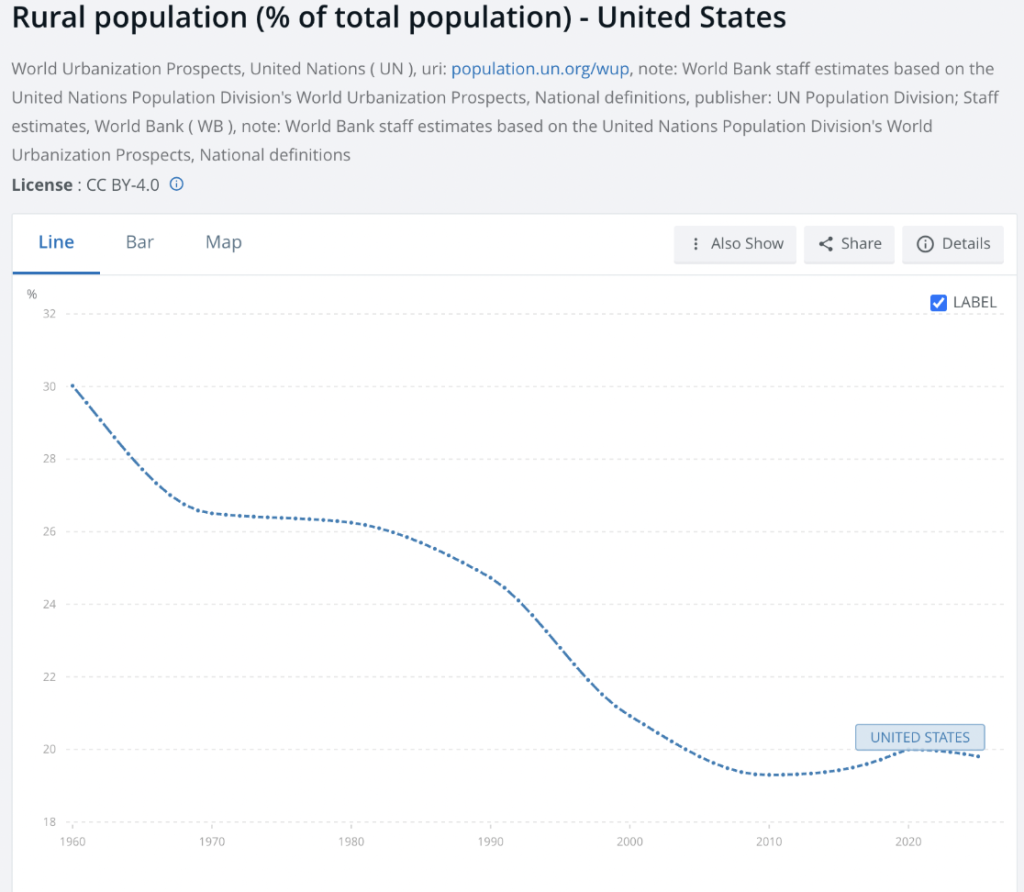
These losses have broadly tracked with rural population decline. There was an initial abandonment of Democrats in rural areas in the early 2000s, a small rebound with Obama, and then a great rural Dem-exit happened starting around 2014. Still, as we’ve seen, it’s not a linear path downward. Indeed, on Catalist and in our data, rural areas have actually been fairly static over time.
Democratic Congressional voteshare in rural areas, according to Catalist:
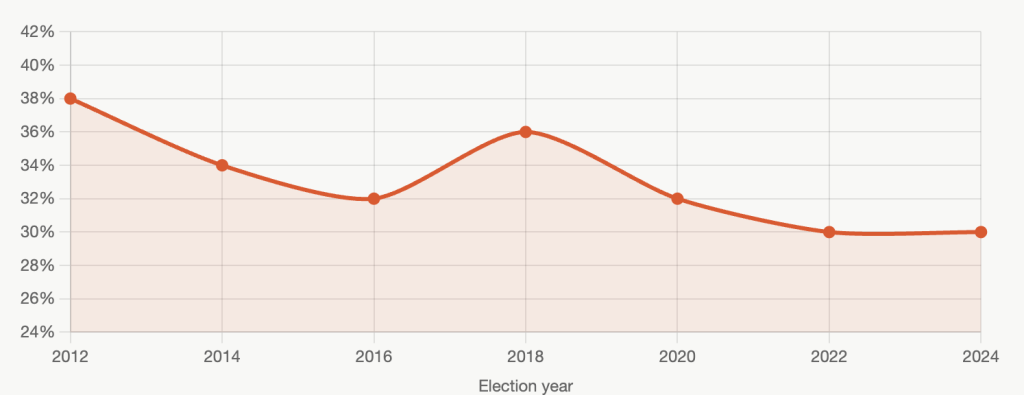
Outside of 2018, rural voters are consistently voting between R+32 and R+40. Millions of rural voters have been added to the electorate as turnout has spiked between 2012 and 2024, but Democrats have not gained anything.
Rural turnout over time has increased dramatically. Indeed, our defined rural areas were the only parts of the country that saw better turnout in 2024 than they did in 2020.
2016: 52.1%
2020: 62.5%
2024: 63.4%
The Rise of the Exurbs
You might be wondering how this could happen despite a general decline in population? Well, for one, Trump juices Republican turnout in rural areas. Secondly, we are now seeing a post-2020 phenomenon of people moving to the “exurbs” or formerly rural areas
One interesting chart from the USDA Economic Research Service corroborated the earlier chart showing a substantial increase in rural population after 2020.
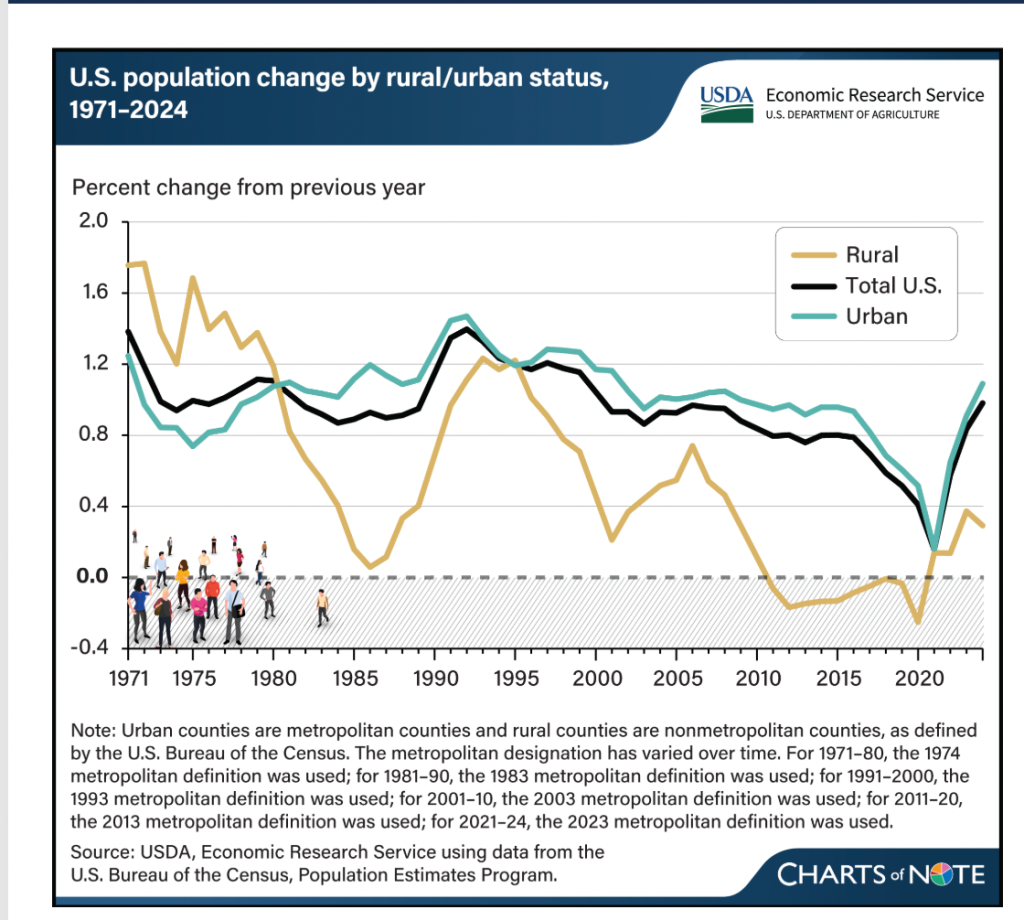
What happened was the COVID-19 Pandemic spurred a flight to rural areas, reversing a decades-long decline and providing rural areas with consistent year-over-year population growth for the first time 2000.
You can spot this in our 2020 Census – 2024 ACS maps on ElectionCord, where rural areas have seen a modest rebound. The starkest changes have been in the South, where some formerly rural collar counties continue to see major gains.
Indeed, many rural areas across the South are still in decline (notably, many of them are in the former Black Belt communities). However, there has been a lot of population growth from 2020-24 in “exurb belt” or “collar counties” that surround major urban areas like Nashville, Atlanta, or Dallas. These exurban areas have cheap housing due to being formerly depopulated rurals, but decent access to the city.
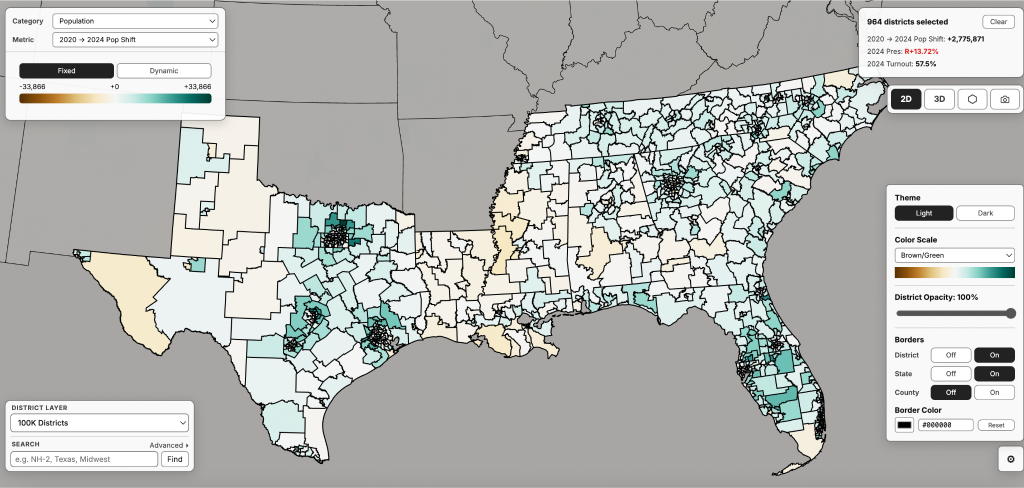
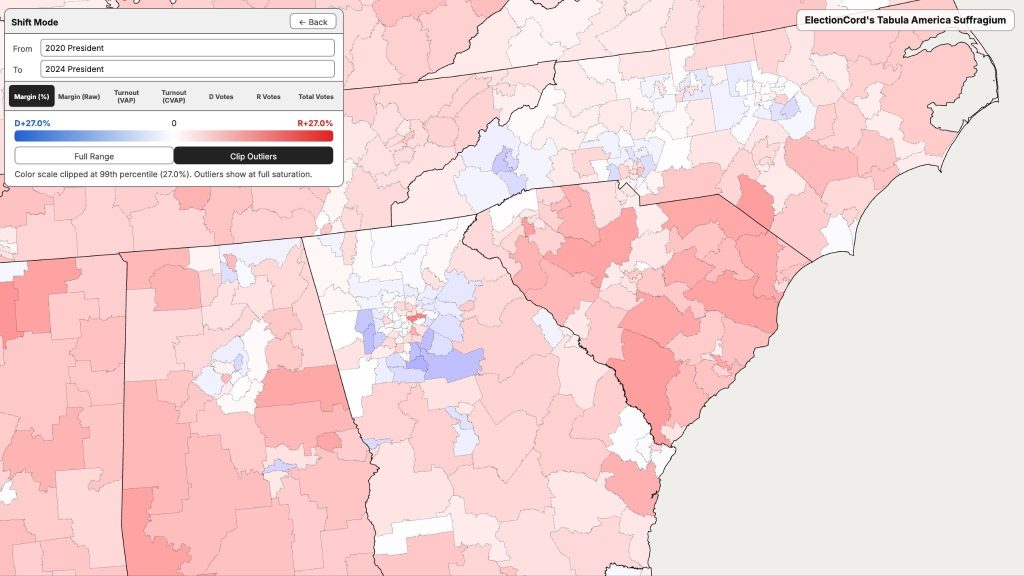
These are some of the most vote-rich Republican areas in the entire country. While there are actually some Democratic voters moving there, the problem is that the exurbs are stuck at around R+30. There were minor shifts in North Carolina and South Carolina toward Dems between 2020-24 in these exurban and rural areas, but it didn’t matter. And in South Carolina and Tennessee, where Dem turnout was worse due to lack of a campaign, the Democrats went into freefall.
Economic Factors
Not to get too into the economic weeds, but rural life has changed considerably from 2000. The traditional industries of rural areas were agriculture and manufacturing. Those went into steep decline from the 1990-2020 period. When you factor in human capital loss, the opioid crisis, and other depopulation factors, the overall outlook for rural areas nosedived.
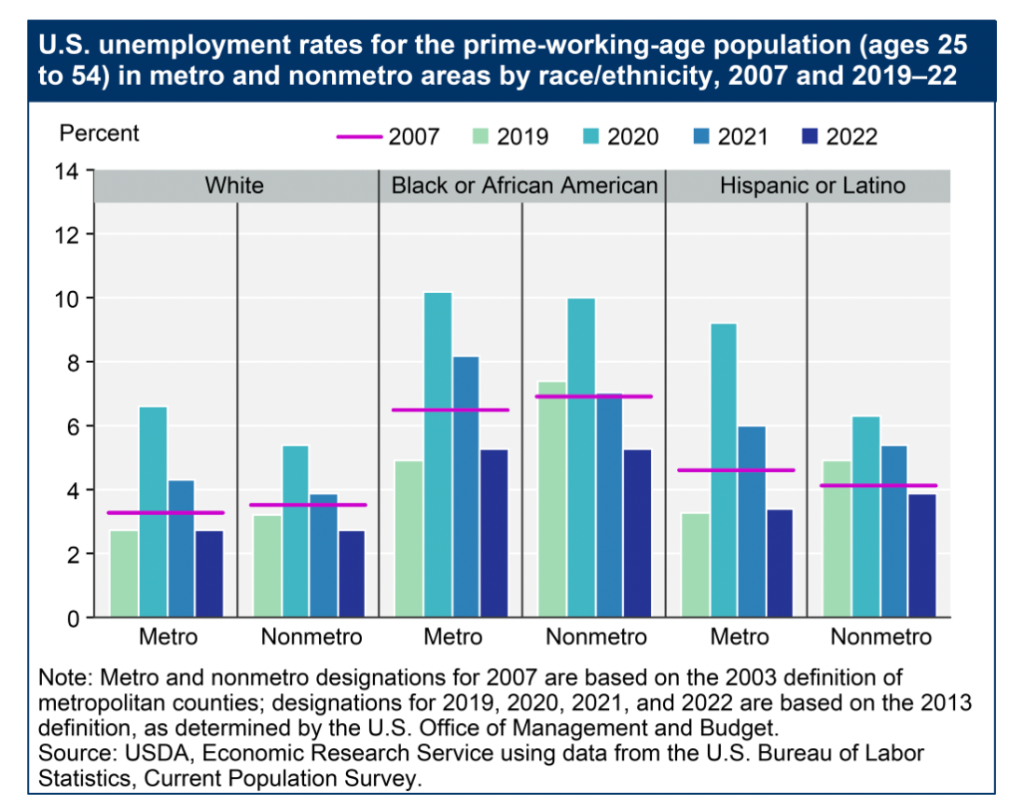
Yet far from the idea of millions of jobless rural Americans, the prime-age employment rate in nonmetro areas for people 25-54 is actually better than in metro areas relative to 2007. This suggests that rural communities are more or less making do with what they’ve got, nowadays, as opposed to an enormous contraction.
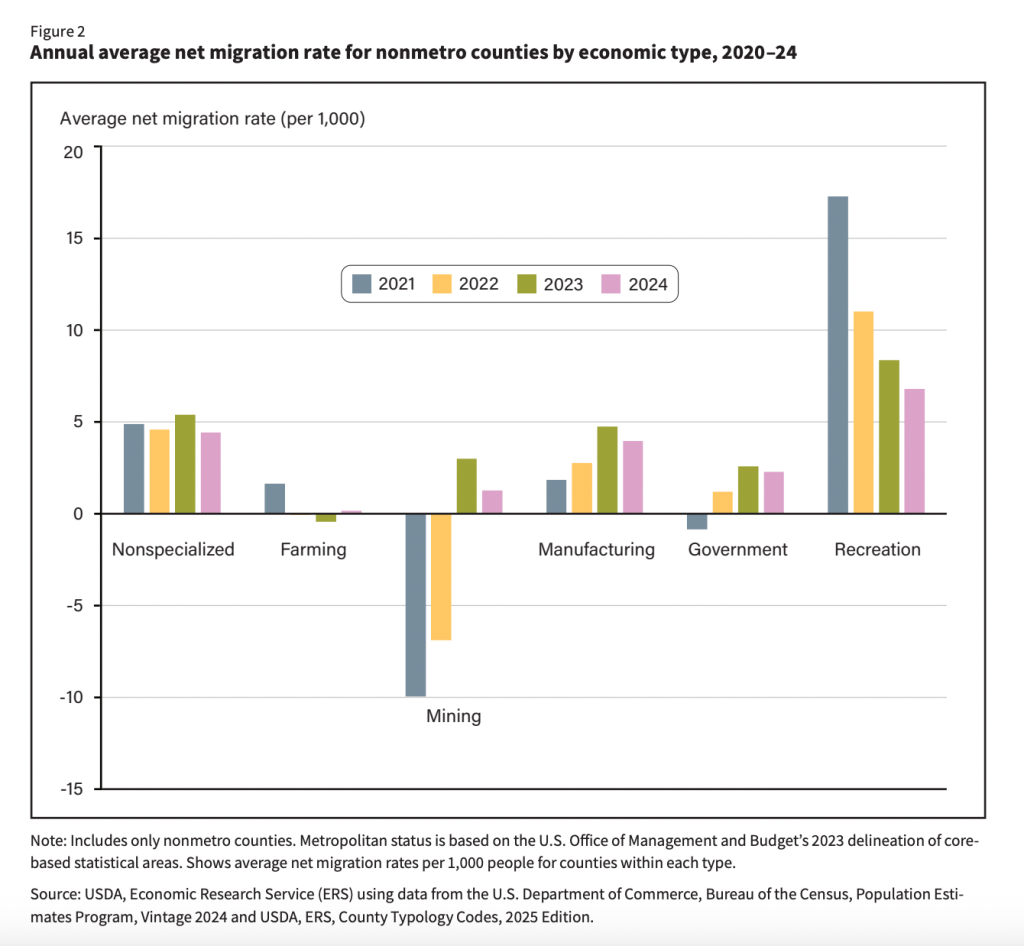
According to the USDA’s yearly report on Rural America in 2025, the largest net migration gains in nonmetro counties are going to recreation, nonspecialized labor, and some manufacturing. Farming jobs are flat.
As America becomes an aging society, the largest employer in nonmetro areas has now become healthcare and social assistance. Agriculture now takes up a shockingly low amount of employment.
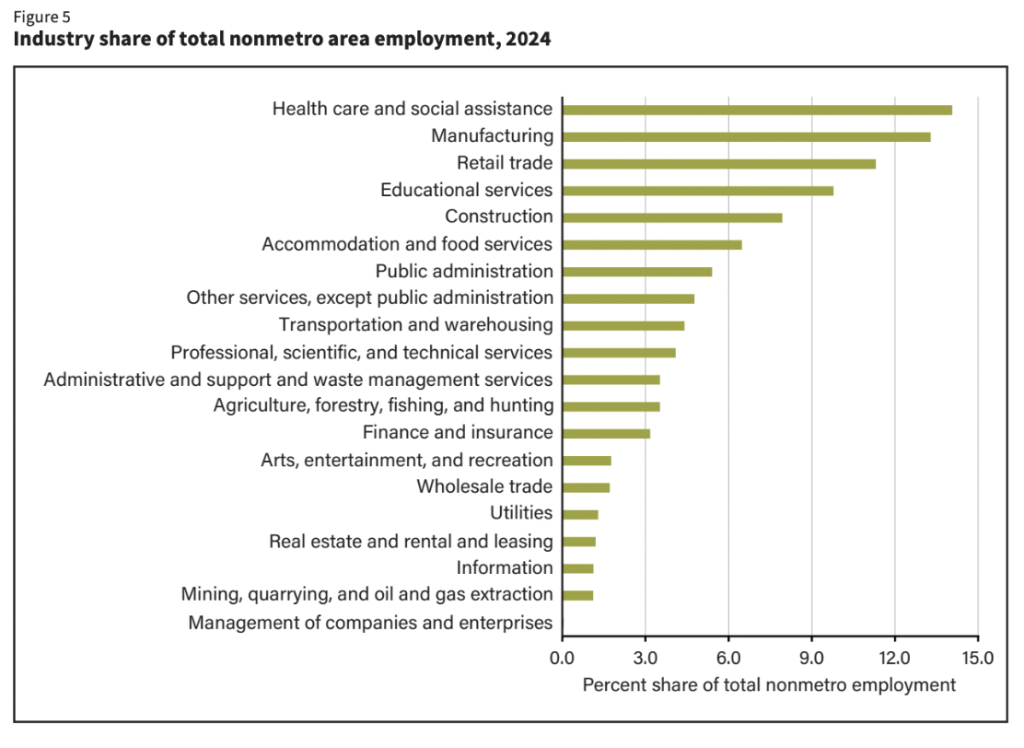
Almost all of this growth is likely people moving back out into the exurbs. The “traditional” ways of rural life are increasingly dominated by older people and continue to exhibit signs of decline.
What does this mean for Democrats?
In many cases, the Democrats benefited from one of the surefire ways to win back rural voters: have a very unpopular Republican running. This strategy has allowed Democrats to flip back states as rural as Kansas on the gubernatorial level, and helped propel Dan Osborn to a shocking overperformance against Deb Fischer in 2024. It’s the reverse of Republicans running moderate throwbacks like Larry Hogan in Maryland, who also had a huge overperformance.
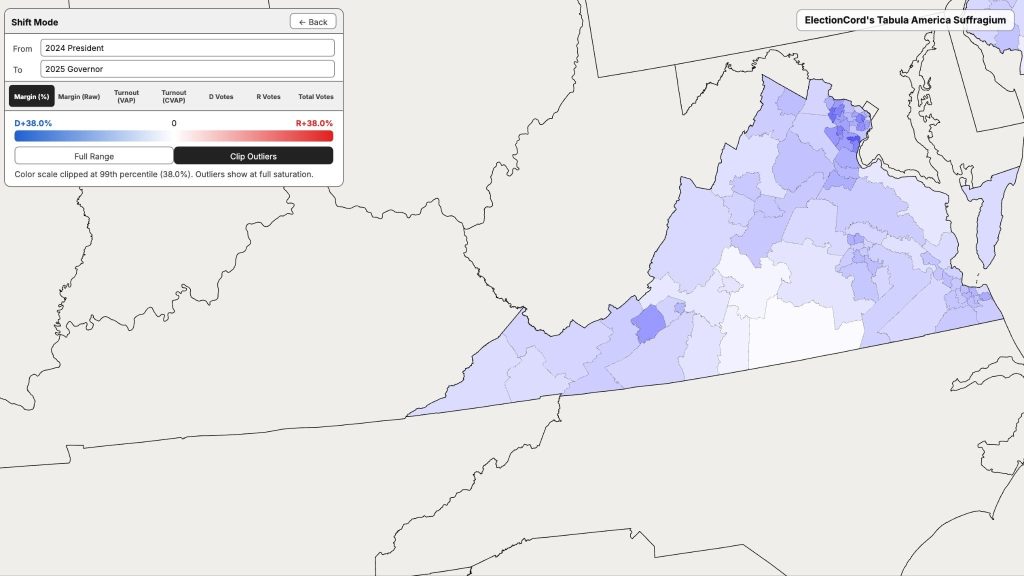
Virginia 2025 was an example of Democrats running against a very unpopular Republican: Winsome Earle-Sears. Now, was some of the unpopularity driven by the fact that Earle-Sears was one of the only Black women who have ever run for office as a Republican? Probably. Did that still cause a major drop in support? Yes. Here we have Virginia Presidential 2024 to Governor 2025 swings by 100K District:
And by county:
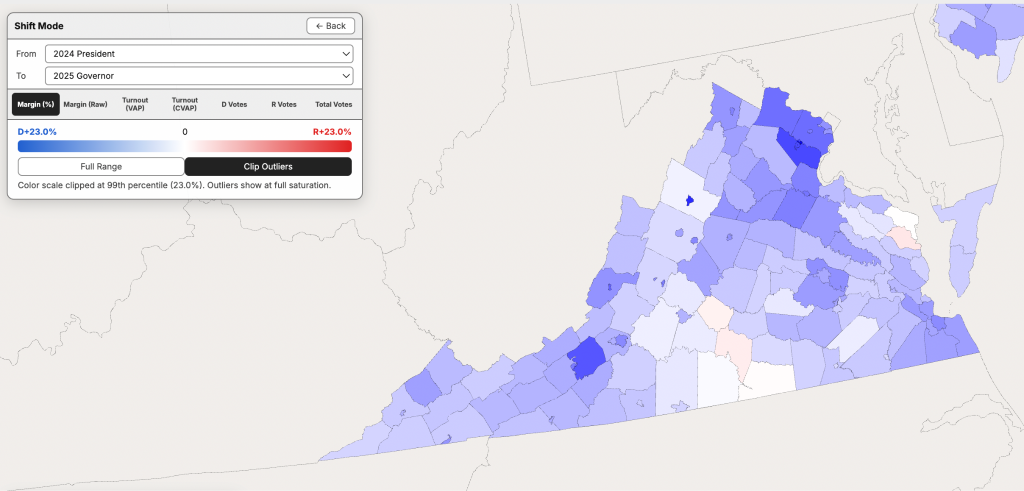
You will note from the colors that despite an improved performance from Spanberger in rural areas, she still
A) had rural areas where she did worse than McAuliffe 2021 (formerly Black rural areas that are now depopulating)
B) still had much more significant swings in the vote-rich suburbs around NoVa, filled with minority and white college-educated voters
Much of this was also driven by turnout, as the rural areas had especially bad turnout swings relative to 2021.
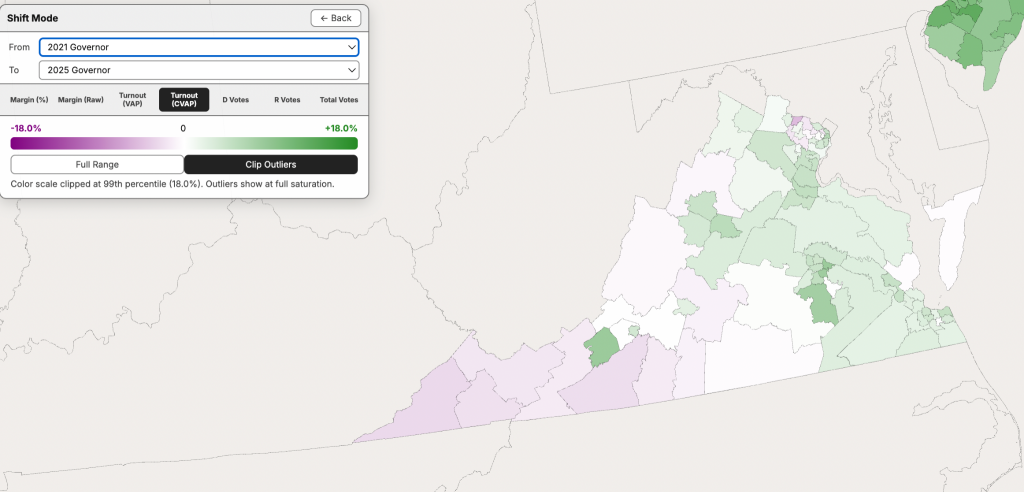
Indeed, when we saw Republicans go back to having a more favorable turnout environment in the redistricting referendum, some Southwest Virginia rural areas were even redder than Trump 2024 or Youngkin 2021.
So, it’s not easy. Just hoping the opposing rural voters won’t show up for elections without Trump on the ballot is a very bad idea, especially when they’ve demonstrated their turnout is far more durable than the Democrats’ urban base. The best way to win is to hope Republicans are dramatically unpopular on a local or state level. Running more moderate or socially conservative Democrats can occasionally help, but often these seats are too red or too polarized to get them over the line. We might see a few outlier rural wave babies in 2026, but it’s hard to say those gains will be durable long-term, as we saw in 2018.
In terms of winning back “traditional rural voters”, that ship has largely sailed. The Democrats’ best play is to win over the growing number of service work-oriented new arrivals, who are far more gettable. While there’s pretty solid evidence that the types of people moving out to rurals and exurbs are markedly more conservative than urban dwellers, they’re still not as completely jokerfied as the original inhabitants.
If this does happen in November 2026, expect to start seeing rumbles of Republicans potentially losing suburban-exurban fringe districts.
On the other side, Democrats are currently dealing with major disturbances in their urban base (see part 3), and it’s likely that those voters get prioritized first.
About the Author