

There’s a misconception among a lot of people who follow politics casually that Christians tend to overwhelmingly vote for Republicans because their values align more with them than with Democrats. While it is true that White Christians identify with the Republican Party (52%) more than the Democratic Party (16%) or Independents (23%) per PRRI, there’s a lot of diversity of opinion within these groups, to say nothing of Christians of Color.
To explain how this could be, first you have to know that American Christianity can really be broken into three groups: Mainline Protestant, Evangelical Protestant, and Catholics. There are other groups like Latter-day Saints, Jehovah’s Witnesses, and Orthodox Christians, but all these groups are still quite small, at under 2% of the population (Jehovah’s Witnesses don’t even like to vote). American Christianity is very diverse, both in theology and regarding social issues. Because it isn’t tracked on the Census, it also is one of the hardest qualities to measure, even if it clearly has a huge impact on voting behavior.
Let’s try to go over each of the three and see the differences, along with their overall political leanings.
Mainline Protestant:
Mainline Protestants are generally older, more established churches that tend to be less interested in proselytizing and converting newcomers, and instead take care of their established members. Many of these churches are “descended” from Northern European peoples that immigrated to the country during the 18th and 19th centuries.
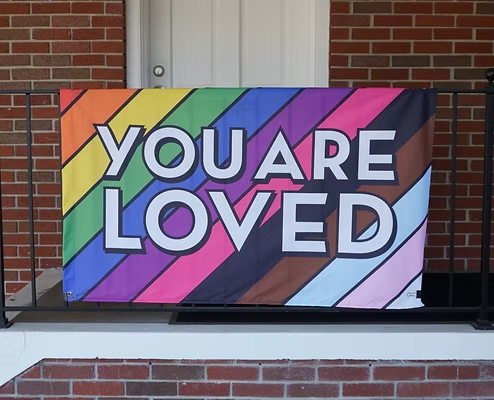
Denominations generally seen to fit in here include the Methodists, Episcopalians, Presbyterians, and Lutherans. There can be a wide range of opinions on social issues in Mainline Churches, but they are usually seen as more liberal and progressive than Evangelical Protestants. Some denominations and churches, for instance, are pro-LGBTQ+, such as the First Congregational Church of Winter Park. Their website states: “FCCWP is proud to be a home for our LGBT+ community as well as all of those who, for whatever reason, have felt alienated or cast out of Church.”
There are also denominations that allow women in clergy, such as the Anglican Church, which recently promoted Sarah Mullally to the position of Archbishop of Canterbury (the most important person in Anglicanism, basically). Some Mainline denominations also see parts of the Bible as not literal, but rather symbolic, more meant for religious lessons rather than history.
Pew Research in 2023-24 said that 51% of Mainline Protestants were Republican, while 41% were Democrats. 69% of Mainline Protestants also say abortion should be legal in some or most cases, 71% are in favor of same-sex marriage, and 84% believe in some kind of evolution, divinely inspired or not.
Evangelical Protestant:
Evangelical Protestantism can be traced back to the First Great Awakening in the 1700’s, where interest in Christianity, particularly among the everyday people, greatly expanded due to figures like John Wesley and George Whitefield. However, the evangelical movement also had a major revival in the post-WWII era, where you saw people like Billy Graham take advantage of mass media to greatly expand the church. Evangelical Protestantism is probably what you think of when you hear “American Christianity” in your mind, particularly if you are a non-Christian or non-religious.
Evangelicalism is much more conservative than Mainline Protestantism, teaching that the Bible is literal, generally being against gay marriage, women in clergy, and abortion. Denominations generally categorized as Evangelical include Baptists (particularly Southern Baptists), Pentecostalists, and… non-denominational churches. (Side note here, but non-denominational churches usually can be categorized theologically into a denomination; they just act as if they’re independent.)
According to Pew, a full 70% identify as Republican, compared to 24% Democratic; only 33% say abortion should be legal in all or some cases, and 36% are in favor of same-sex marriage. Surprisingly, 71% believe in evolution, divinely inspired or not, although only 6% believe it’s a natural phenomenon.
Catholic:
Catholics are in some ways like Mainline Protestants, and in some ways like Evangelical Protestants, and in some ways their own thing. Because the Catholic Church is so extensive worldwide, you can find a wide range of opinions around its 1 billion members. European and American Catholic Priests and Bishops may, for instance, be more open to homosexuality and a non-literal interpretation of the Bible than in other areas like South America and Africa.
The Catholic Church, like Evangelical Protestants, is also concerned with converting and proselytizing people to Catholicism, through outreach missions and charity work. Above all else, Catholics are most concerned with tradition. Their history (according to them) goes back to Saint Peter himself, who they say was the first Pope after Jesus “gave him the Keys to Heaven”. You can see these keys today on Vatican City’s flag.
According to Pew, 49% of Catholics identify as Republicans, and 44% identify as Democrats, although this is starkly divided among ethnicities. Per PRRI, which breaks down these groups by ethnicity, 39% of Hispanic Catholics identify as Democrats, 25% as Independents, and 20% as Republicans. Compare this with White Catholics, of whom only 23% say they identify as Democrats, 25% as Independents, and 45% as Republicans. Even if they might identify more as Democrats, they are probably more culturally conservative than Mainline Protestants (but less than Evangelicals).
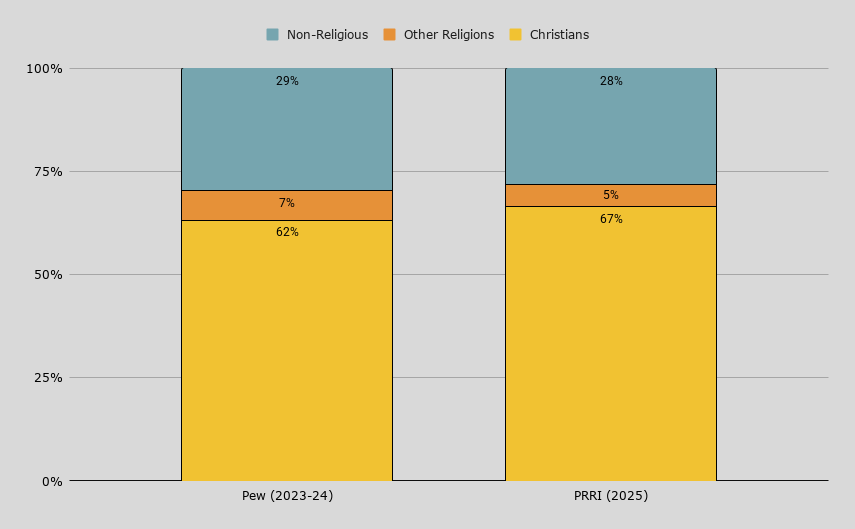
How big are these groups in the US? Per both Pew and PRRI, around 2/3rds of Americans are Christian, 5% are some other religion like Judaism, Islam, or Buddhism, and 30% are not religious at all, whether atheist, agnostic, or just unaffiliated.
Because PRRI puts Hispanic Protestants and other Protestants of color into their own group, I just split them between Evangelical/Mainline, although the majority are likely Evangelical. Around 20% of the US is Evangelical, 15%ish is Mainline, 20% is Catholic, 5% are Historically Black Protestant Groups, and 5% are Other Christians.
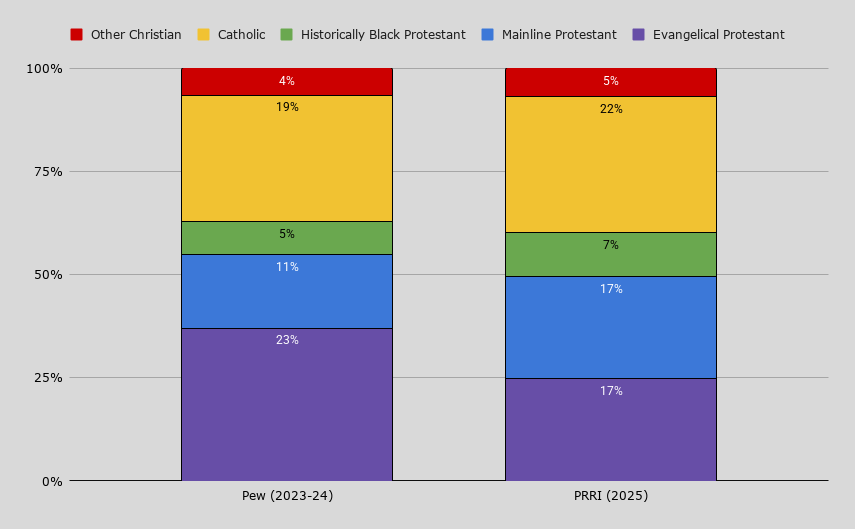
I didn’t note on Historically Black Protestant groups, as they vote overwhelmingly Democratic (72%), but they’re usually considered separate as they don’t fit neatly into either category. Their worship style can be similar to Evangelical Protestants, while their beliefs on social issues usually (but not always) align more with Mainline Protestants.
Conclusion:
Whether you’re a politician, campaign, or just an elections enthusiast, throwing all Christians in the same bucket of beliefs and perspectives can be dangerous. They’re a very diverse group, and you can find different perspectives even within the same church or denomination. It’s not even a big deal if you’re Christian; people just want to make sure their opinions are heard and feel that they can be free to believe what they want to believe!
Resources:
If you want to know more about specific denominations and their beliefs, I highly recommend checking out Ready to Harvest:
https://www.youtube.com/@ReadyToHarvest
Other Resources:
https://www.fccwp.org/openandaffirming
https://prri.org/spotlight/2025-prri-census-of-american-religion/
About the Author