Just when you thought the 2025 elections were over, Tennessee has gifted us with one more key special election for the US House of Representatives. In another time and place, a special election in a gerrymandered seat with presidential results that haven’t been close for Democrats since 2008 would be a snoozer, but we are in uncharted territory. After their resounding wins in November, the Democrats are now riding strong generic ballot numbers while Trump’s approval ratings have hit a second term low.
Tennessee’s 7th Congressional district was opened when Mark Green retired from Congress and left for the private sector (maybe the real reason was he reportedly had an affair with someone in DC). The candidates for this race are Democratic State Representative Aftyn Behn and relative political newcomer Republican Matt Van Epps .
How Republican is this district, again?
Very Republican. Here are the margins from recent elections on the current lines, all of which were carried by Republican candidates.
Presidential Margins:
2012: Romney +10%
2016: Trump +17.3%
2020: Trump +15.2%
2024: Trump +22.1%
Congressional Margins:
2022: Green +21.8%
2024: Green +21.1%
Other Statewide Races:
2018 Governor: Lee (R) +11%
2020 Senate: Hagerty (R) +19%
2024 Senate: Blackburn (R) +22%
The district shifted hard right in both 2016 and 2024, both more than the nation overall.
Interestingly, the ticket-splitting that benefited Hagerty in 2020 disappeared in 2024, following a trend of Harris voters not voting for Republicans downballot nationwide. In the first Congressional result on the new lines, Mark Green did slightly worse than Trump and worse than he did in 2022. Was this because of his divorce or just voter dislike? Either way, Green had almost no effect on candidate quality
Who are these people? What happened in the primary?
Both the Democratic and Republican primaries were hotly contested. On October 7, 2025, Van Epps defeated Tennessee House Representative Jody Barrett with 51.6% of the vote, a strong performance given that Barrett was a local elected representative and Van Epps’ previous experience was as a high-ranking civil servant for Tennessee in the Governor’s office.
Van Epps benefited from strong fundraising numbers and the coveted Trump endorsement, but he got just over 50% against a divided field. From an ideological perspective, everyone in this crowd was various types of MAGA, so it’s not worth delving in too deeply. Van Epps hasn’t had any scandals and constantly advertises that he served in the US Army, but otherwise, his background is relatively low-key for a Republican House member.
The Democratic side was more exciting, with Behn winning a narrow four-horse race. All four major candidates were Tennessee House legislators from the area, and Behn likely won thanks to raising twice as much as her nearest rival. In a strange quirk, Behn only won one county in TN-07 during the primary, but emerged victorious because the field was so divided due to the others having very localized support based on their districts.
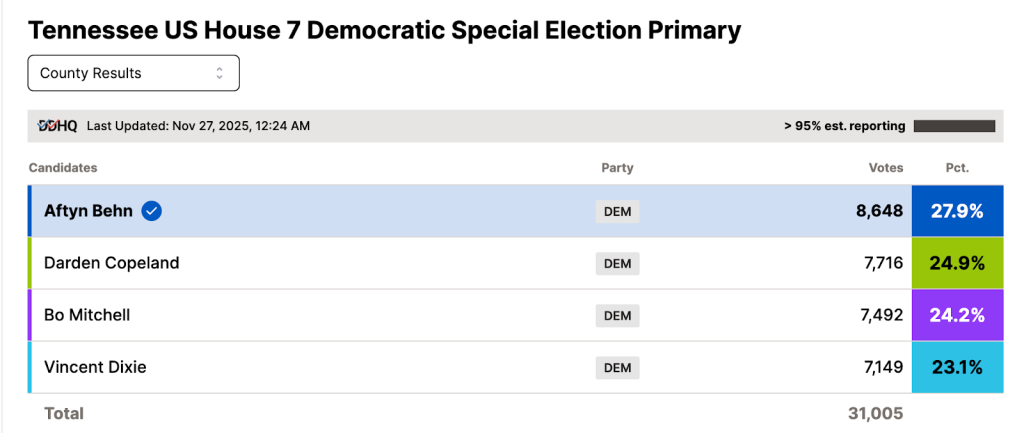
The primary composition was a much narrower R+6, showing that Democrats had far more enthusiasm for their primary than Republicans. Does this mean much? Not much other than Democrats are very enthusiastic about voting.
Okay, tell me what’s going to happen on Tuesday.
The unsatisfying answer is “we don’t know, but that’s already a terrible sign for the GOP”. This district was won by over 20 points in 2022 and 2024, and we have a nonpartisan poll showing the race within two points. The only question is how much Aftyn Behn will overperform by, not
Thus far, special elections have been notably more Democratic than even the 2025 elections in Virginia or the generic ballot. The average in federal races has pointed to something like a D+11 environment, while the Virginia and New Jersey results looked more like D+7. This is likely due to the Democrats’ coalition being more likely to turn out in special elections than Republicans, as they’ve started to win over more college-educated voters.
This special election is happening on a very unusual Tuesday, one week after Thanksgiving and a full month after Election Day. The primary did not have very high turnout, and this election will not match 2022’s or 2024’s turnout. From rather L2 early vote modeling based on previous primary turnout, Republicans are leading the early vote, but at a much-reduced rate from the partisanship of the district. On VoteHub’s early vote tracker, Democrats have a medium-sized turnout advantage at the precinct and county level, but it doesn’t seem like quite enough to flip the seat. The 2024 vote in the electorate is at least 10 points better for Democrats (e.g. at least Trump +12 rather than Trump +22), but that’s only half the game.
Behn will need to have a solid amount of persuasion (e.g. winning over former Trump and Mark Green voters) to have any chance. The good news for her is that national polling and the scant district-level polling show that Behn likely will win over some Independents. As has been seen in most polling and election results this year, anyone running as a Democrat in a two-party race has been lining up close to unanimous support from Democrats, so there shouldn’t be issues there.
I’d give the chances of a Democratic flip at around 15%. To contextualize, this is about the same amount of time that pitchers got a hit when they came to bat before the DH. It isn’t likely, but it is possible.
Other Demographic Data of Note
Ethnicity
71.2% White
16.1% Black
7.4% Latino
2.0% Asian
Education
89.8% High School Degree
31.8% Bachelor’s Degree
11.6% Graduate’s Degree
This district is very white and doesn’t have high educational attainment, which typically makes it very Republican. However, there is a significant minority of Black and Latino residents in the greater Nashville area, and their turnout on Election Day is key to any Behn victory.
Income & Poverty
$86,080 Average Yearly Household Income
13.3% Poverty Rate
For a Trump-won district, this is actually a rather high-income area. In the South, the median income of Trump voters tends to be much, much higher than anywhere else in the country. This is because of a long history of these White voters supporting more conservative candidates, all the back to the founding of the country.
Other
15.7% Population Growth from 2010-2020
37.2 Average Age
41.7% Born In State
51.5% Born Out of State
5% Foreign Born
About the Author