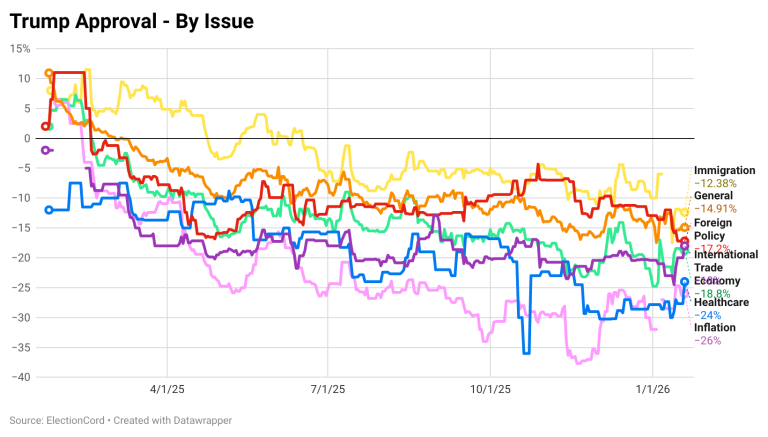
As you may have heard, Donald Trump is unpopular. According to the hallowed averages, he’s even less popular than he was in his first term, when he was one of the most unpopular presidents in US history.
But where does it end? Does Trump have an appreciable floor of support, or is it something that only exists in Democrats’ fevered imagination? Clearly, while Trump has been unpopular in the past, it hasn’t lasted. And there is a solid core of people, for whatever reason, who support Trump in virtually every matter. The goal of this piece is to determine how large that group is.
After January 6, 2021, Trump hit the lowest point of his two terms so far, with just 35% of Americans approving. Given the events of January 6, that low point appears more impressive than many have made it out to be. You can instead frame it as: even after trying to violently overthrow the government, 35% of Americans said they approved of Trump. That’s still quite a large floor.
Since then, Trump’s popularity has gone up and down in waves. As late as 2023, he was still very unpopular, but he made a sudden surge in the fall of 2023 that lasted until his inauguration in 2025. In January 2025, he had slightly over 50% approvals, which is the first time that had happened since his first inauguration in 2017. From that point, it’s all gone downhill. After Liberation Day, his approvals sank into the negatives. During the shutdown, they sank even further. After the murder of Alex Pretti in January 2026, his approval ratings have hit new lows.
Part of this has to be Democrats and left-leaning Independents, both new voters and those who checked out of politics during Biden’s presidency, finally returning to answer surveys and driving down Trump’s approvals. Some of it also has to be conservative people suffering from buyer’s remorse. Still, throughout all the chaos and disasters of the last year, Trump retains around 37-40% in polling, depending on who you ask. This is driven by a relatively strong number with Whites, with whom he remains at only slightly underwater or even net favorable, depending on the crosstab.
What are we to make of this? Trump’s approval, contrary to the propaganda, fluctuates and usually trends downward. It is somewhat responsive to events, but it also clearly has some kind of floor. But what is Trump’s floor, then?
To be honest, some people are just ride-or-die with Trump no matter what. To them, Trump is more than a politician; he’s a brand or cult figure that cannot be questioned. This weekend, I saw a Volkswagen Touareg with the license plate “DJT-047”. That sort of behavior does not happen for most politicians. And it’s not a small number of people doing this, either.
For example, when asked in a January YouGov poll, about 16% of respondents both approve of President Trump, and say he has done nothing they disapprove of. A presumably similar group (17% of respondents) says that Trump will go down in history as an “outstanding” president. You also have “MAGA identification” which 23% of respondents said they are MAGA supporters, according to an average of the last 4 YouGov polls.
We shouldn’t underestimate the volume Trump is getting here. The fact that 16% of voters do not question Trump at all, for any reason, and can’t even imagine it, is insane. I imagine an equivalent number for Joe Biden would’ve been less than 2%. 16-20% of the electorate is somewhere around 25-30 million people. So, given an adult population of 267 million, you can plausibly argue that around 1 in 9 US adults believe Trump can do nothing wrong. These are the people who think it’s good to invade Greenland, like “Gulf of America”, and so forth. You can often see this movement in polling when Trump suggests something no one has ever heard of, like invading Greenland, then suddenly 20% of people think it’s a good idea.
By contrast, the number of people who say they are “very liberal” in polls of registered voters is typically around 11-14%, and I don’t need to tell you that the “very liberal” contingent contains a vast array of views on politics that cannot be outlined coherently. More importantly, that segment is much smaller than the MAGA faction, which we often observe in Democratic primaries where progressives or socialists fail to get pluralities or majorities.
From a political perspective, the level of power Trump has over his supporters is lethal. It’s quite hard to get 1 in 9 people to get involved with a television show or a sports league, let alone a politician. Are there people churning in and out of this group? Yes, disaffected MAGA like Marjorie Taylor Greene exist, but Trump almost always manages to replace his following, no matter what happens. For his opponents, it’s his most frustrating capability; for some reason or another, Trump always rebuilds this base of support. Keep in mind that Trump almost certainly lost voters to Haley or DeSantis in the 2024 Republican primary, but he simply replaced them with new ones.
In sociology, we refer to this replacement ability as “social reproduction”. Trump’s ability to reproduce celebrity-like support among new cohorts of voters is uncanny, and it usually amounts to that magical 17-20% of the electorate. The diehard MAGA contingent is usually:
- Older, typically 65+, but also often significantly more prevalent among Gen X relative to millennials or Gen Z. 65+ are the most polarized and hard-to-move demographic since they’ve been around the longest, so this makes sense.
- Whiter than the general population, although going along with some strong Hispanic support
- More male than female
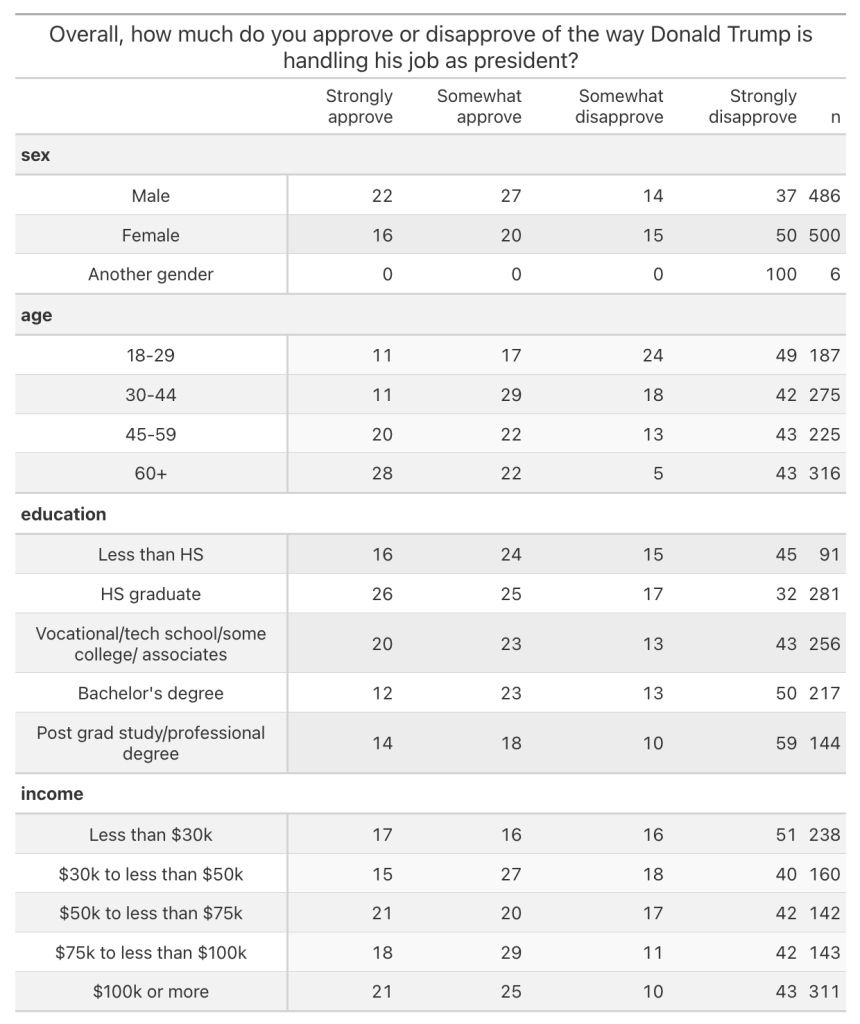
All of these stats have to be taken in aggregate, however. While there is a gender gap, it’s often around 5-6%, which isn’t as wide as you’d think. At the end of the day, Trump almost always pulls at least 10% “Strongly Approve” with every cohort except Black voters…rich, young, poor, Independent, old, middle-aged, it doesn’t matter. The more detailed Marquette poll that came out in February 2026 displays this curious trend. Trump even got 14% of post-graduates to “Strongly Approve”, despite otherwise being his weakest segment.
But is the diehard population really Trump’s floor? Clearly, some people disagree with Trump on one or two issues, but are so conservative/hate Democrats so much that they will vote for Trump and Republicans every time. Functionally, they are Trump supporters, even if they aren’t necessarily MAGA.
This added group generally brings Trump to about 29-33% of the electorate. For this number, a good barometer is “People who think that recent tactics used by the U.S. Immigration and Customs Enforcement (ICE) officers and Border Patrol agents have been about right or not gone far enough” (33%) from NBC or “People who say President Trump was not involved in crimes allegedly committed by Jeffrey Epstein” (29%) from YouGov. Many of them stuck with Trump after January 6th as well.
There’s also another tranche of voters, let’s say around 20%, comprising conservative-leaning Democrats, soft Republicans, and conservative Independents, who agree with Trump on some issues and are willing to give him the benefit of the doubt whenever possible. These are the types of respondents who give Trump a bad rating on the economy, but like that he’s closed the border. At some level, many of these voters are winnable for Trump and could be considered part of his electoral “floor”, but they rarely say so in polling. One wonders if they would stick with Trump if he, I don’t know, decided to do January 6th again, or plunged the US into an unwinnable war. It appears that the murder of Alex Pretti by ICE agents was too much for many of this cohort, but their ultimate loyalties are to be determined.
To conclude, Trump definitely has a strong floor of support, and despite everything that has happened since 2016, it still exists. One wonders what will happen to these voters when Trump…exits…but for now, they are a fundamental portion of American political life.
About the Author