The 2026 midterms are starting to ramp up. With just a few days left, one of the most contested Senate seats is having its primary election, where Democrats and Republicans both have competitive primaries for this seat. On the Republican side, incumbent John Cornyn is facing a serious threat in the controversial Texas Attorney General Ken Paxton, and Representative Wesley Hunt. That race will almost certainly go to a run-off, which will take place in a few months. The Democratic primary though, is a lot more straight-forward, and we should know the winner on the day of the election, March 3rd. House Representative Jasmine Crockett, and Texas House Representative James Talarico are in a tight race to determine who will face off against [TBA] in November. With the focus being more on the Democratic primary, we thought we would go over 5 of our 100K Districts, where we divided up the US into areas of 100,000 people, in Texas, and look to see what the race will come down to.
TX-251 (Edinburg Metro/Rio Grande Valley)
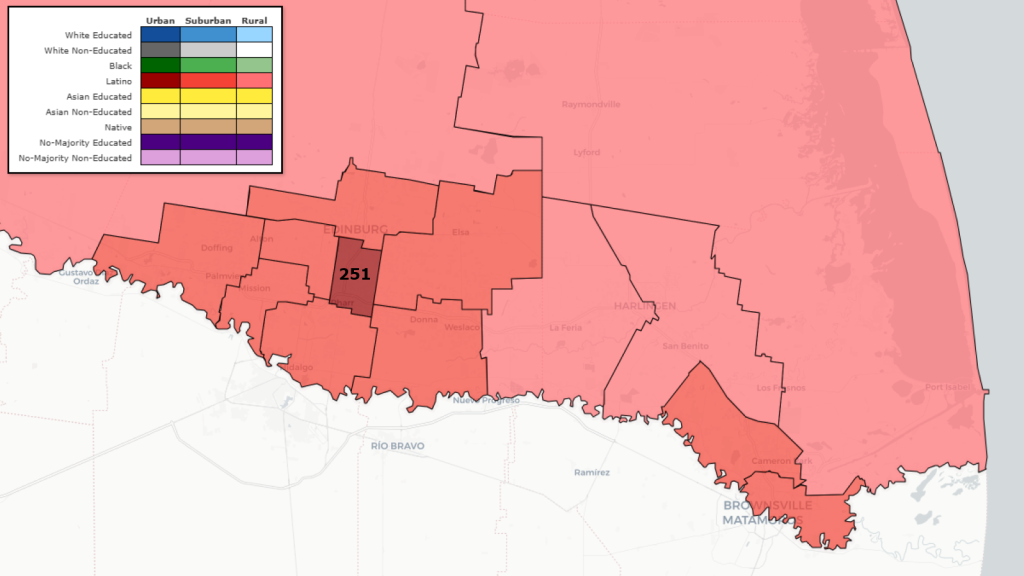
When talking about what happened in the 2024 Presidential election, the first thing that gets brought up is how well President Trump did with Hispanic voters, and one area that he did particularly well in was the Rio Grande Valley bordering Mexico. Although it is not mentioned, this shift actually began from 2016 to 2020, when this district went from Clinton winning it by 47%, to Biden only winning it by 21%. The difference is just that it didn’t change anything for Biden. 100K District TX-251 is in the heart of Hidalgo County and the Edinburg Metro area, and is almost entirely (93%) Hispanic. This district voted for Biden by about 21%, but Harris only won TX-251 in 2024 by 2%, a shift of about 20%. This was a big reason why Texas as a whole went from Biden losing it by 5% to Harris losing it 15%, and something Democrats will hope to reverse if they want to compete in the Lone Star State in the future.
One potential reason for why this Hispanic shift happened is because of education polarization. Hispanic areas in the US are some of the least college-educated, and TX-251 is no exception. Only about 18% of people in this area have a bachelor’s degree, and by comparison, 34% of Americans have a bachelor’s degree. What we have seen in the Trump era is that people with a college education have shifted from the Republican Party, and people without one have shifted to them. In 2016, it just was concentrated to white non college-educated people, whereas in 2020 and 2024 it extended to almost everyone.
Based on primary polling we believe that Talarico will do better with Hispanic voters, particularly in the RGV and the Austin/San Antonio Metros. Talarico has also been trying to appeal to Hispanic voters particularly hard, with ads like this one, called “¡Vale la pena!” (It’s worth it!). Questions do remain though, like just by how much can Talarico win Hispanic voters, as well as turnout both in the primary and general. Just as a reminder, the average turnout in the Presidential Election in 2024 was around 59%, but in TX-251, the turnout was only 37%. While low turnout is pretty typical of Hispanic areas, it’s also something Democrats hope to change in 2026 and 2028.
If Talarico hopes to win the primary, he will not only have to run up the margins in the RGV, but also hope for relatively high turnout in a place like TX-251.
TX-204 (Austin Metro)
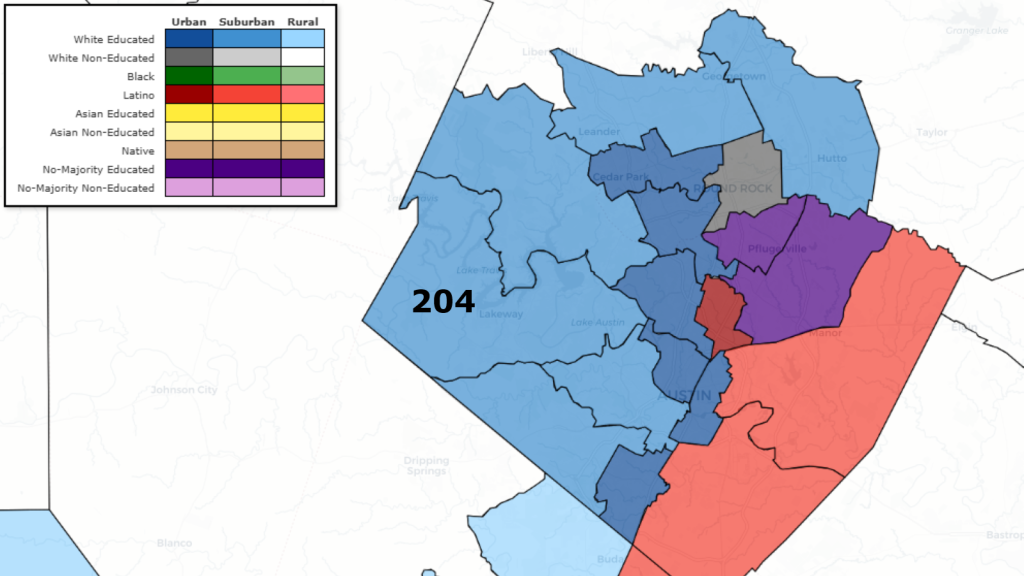
Let’s move from a demographic where Democrats have floundered in the Trump era, to one where they have had big gains: white, educated, and suburban people. 100K District TX-204 is in the outskirts of the Austin Metro, and shows this trend well. Trump won this district by 13% in 2016, but only by 4% in 2020. While he gained a bit of this vote back in 2024, the area is still to the left of what it was before the Trump era. Turnout has also exploded in recent elections, with turnout increasing by 23% between 2016 and 2024. Part of this is due to population growth in the area, but a good amount of it can also be explained by increased political participation.
About 2/3rds of people in TX-204 have a college education, well above the national average of 34%. It’s also one of the wealthiest areas of Texas, with the average household income being at $181K a year, compared to the US average of $97K. Talarico also happens to represent a district in the Austin Metro, and he hopes to do well within his home metro. According to recent polls, he has a slight edge among white voters and educated voters, although they also may be the true “swing voters” in this primary election. Turnout will also not be a huge factor, as areas like TX-204 will have very high turnout to begin with. That being said, it should be mentioned that turnout in the Austin Metro is already 3x higher than at this point in the 2022 primary elections (Per VoteHub). This is most likely a good sign for Talarico, but it remains to be seen exactly where the chips will fall.
TX-2 (Dallas Metro)
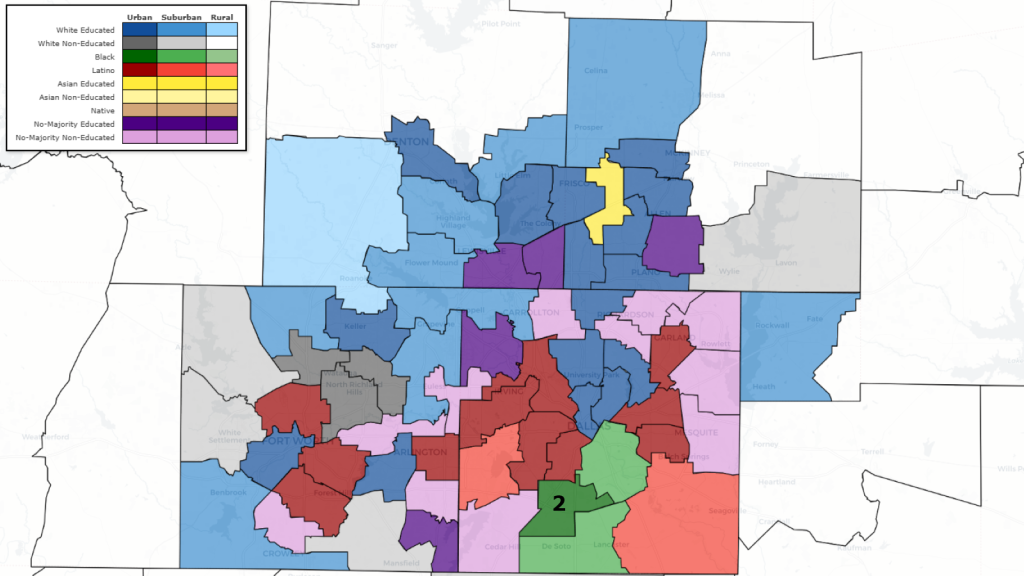
Going from areas where Talarico should do well to an area where Crockett will do well, 100K District TX-2 is actually in her current House district in the southern part of Dallas County. TX-2 is 66% Black, and based on polling, we expect that Black people will go heavily to Crockett. This will be her base, and there’s really no questioning that. The question is, what will turnout be of majority black areas like these? Black people really have not shifted away from Democrats since 2016, as in 2024, TX-2 voted for Harris by 73%. However, turnout dropped in majority-black areas from 2020-2024, more so than just about any other demographic. In 2020, turnout in TX-2 was about 52%, just a bit under the average of 60%. Turnout in 2024 though, was only 45%, well below the national average of 59%.
It’s unclear why this happened, but one possible explanation was that black voters were unsatisfied with their choices, or that Democrats just did not appeal to them enough. One thing is clear though, and that is that Democrats need Black voters to win, and they need them to turn out. Just because a county looks very blue on a map does not mean that you can’t get more votes out of it, and that’s why we keep preaching about turnout.
TX-126 (Houston Metro)
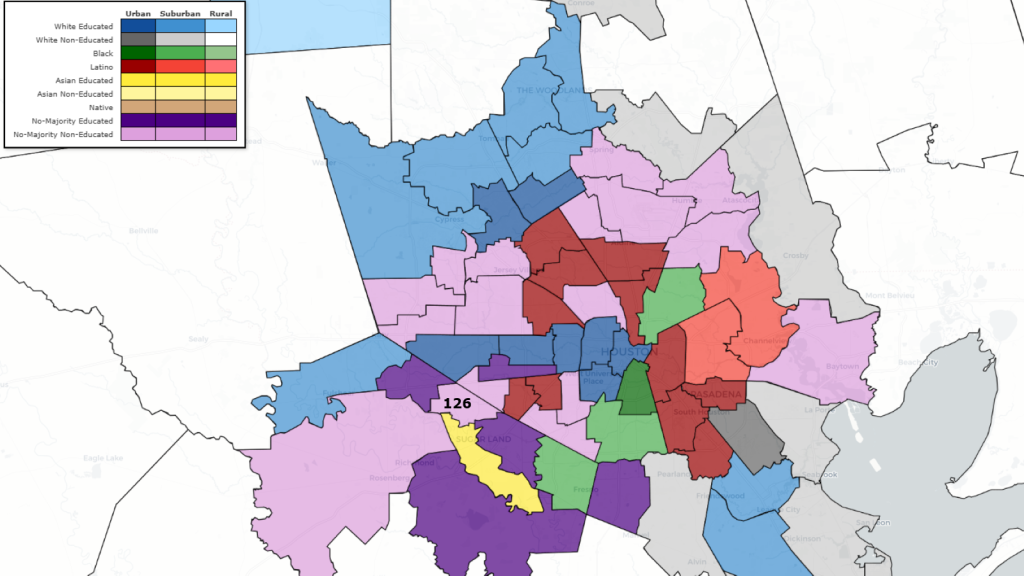
The one metro we haven’t touched on yet, Houston, is home to the next district, 100K District TX-126. The Houston metro is probably the most diverse metro area in Texas, and TX-126 is a small microcosm of that. The area is more or less split down 4 ways between White (17%), Black (27%), Latino (29%) and Asian (28%). With all being said and done, 42% of the area has a bachelor’s degree (33% is the average), and is right at the national average household income, $99K a year.
While TX-126 voted for both Biden and Harris, there are serious warning signs here, with the area voting for Biden by 33% in 2020, and only for Harris by 17%. In addition, turnout, which already wasn’t particularly high, went from 50% in 2020 to 44% in 2024. With these 2 things combined, Democrats lost around 7,000 votes in TX-126 ALONE from 2020 to 2024. With all of this in mind, we expect TX-126, and areas like it, to be a tossup in the Democratic primary. As explained before, Talarico should do better with Hispanic voters, Crockett should do better with Black voters, and White voters (may) lean Talarico’s direction.
We really don’t know how Asian voters will vote though, as there’s been no substantial polling about Asians in the Democratic primary. Based on data from Redistricter, and our 100K District averages, most of the Asians in TX-126 are South Asian and Vietnamese, which is an interesting split. South Asian areas tend to be some of the highest educated ancestries in the country, and heavily vote Democratic, while Vietnamese areas tend to be lower college-educated than the average, and only voted for Harris by 10% in 2024. With this in mind, it’s more likely that they will tilt Talarico, based on how educated TX-126 is.
TX-152 (Rural Eastern Texas)
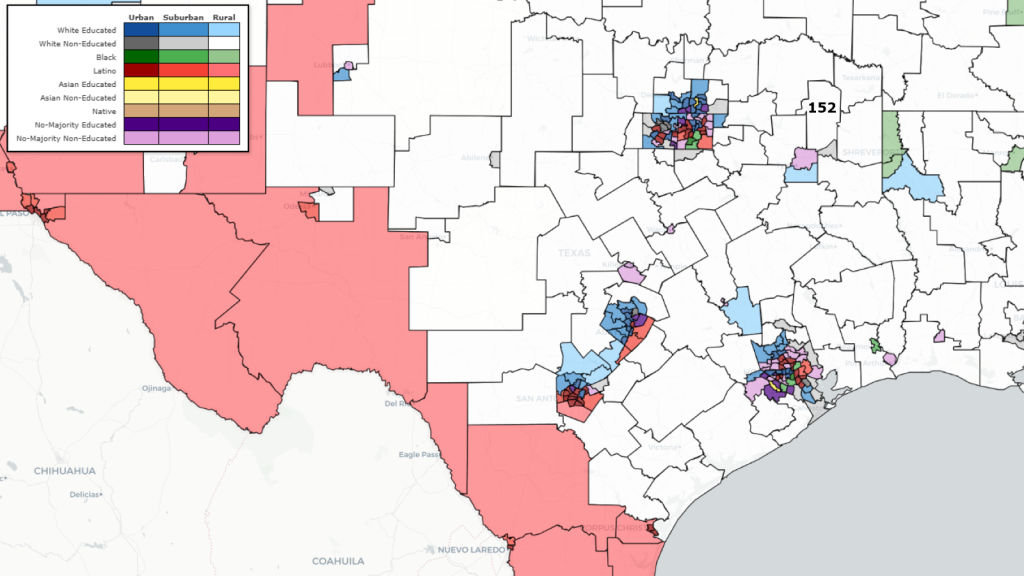
Finally, a bit of a wild card. In Rural Eastern Texas, 100K District TX-152 is not the place you’d expect any Democrat to care about. It voted for Trump by over 50% in both 2020 and 2024, and will certainly support any Republican that gets nominated for the Senate seat. However, in regards to the Democratic primary, it may be areas like this that decide what happens in the primary. To illustrate this, here’s a map of Texas divided into 6 distinct areas, those being the 4 major metro areas, the Rio Grande Valley, and everything else.
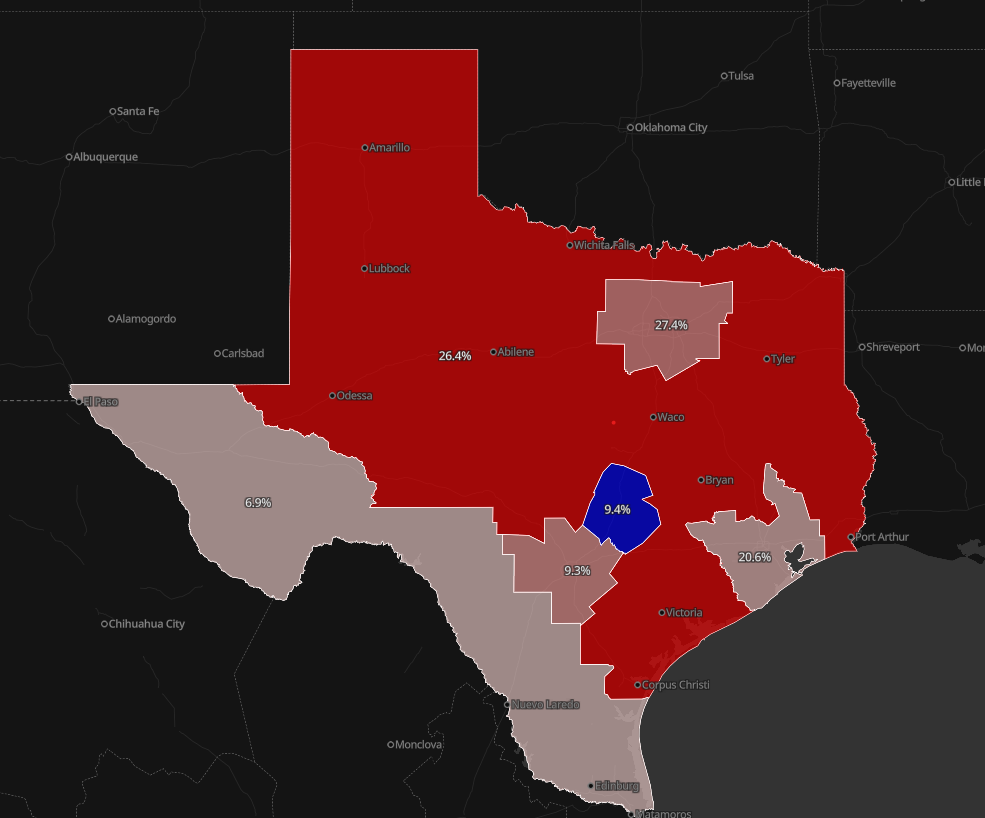
On the map are percentages, each one representing the percentage of the vote in 2024. Just as an example, the Dallas metro represented 27.4% of all the votes cast in Texas, and the Austin metro represented 9.4% of all votes. “Everything else” represented about 26.4% of the vote, and even if it won’t be that much of the Democratic primary vote, it will still be a significant amount. That whole area, including TX-152, is white, rural, and non-college educated. It is, however, not completely white, with about a third of people living in TX-152 being either Black or Hispanic, and it’s these voters that will likely decide how “everything else” votes.
With the election coming up on Tuesday, it’s important to stay educated on what might happen, and hopefully this guide using our 100K districts helped educate you on how the primary may go, with a demographic spin.
About the Author