

On August 18, 2025, a user in our ElectionCord chat posted a campaign launch. The screenshot on the tweet was the now-infamous oysterman with no political experience from Maine, and there was little buzz. No one notable had announced a run for Maine’s all-important Senate seat, the last Harris-won state to have a Republican Senator. For those who follow politics intently, random people decide to run for Congress all the time, and typically get nowhere. There was a splashy hype video and a video that seemed to tout progressive and leftist views. Whatever. Surely, not a big deal.
11 months later, the Graham Platner campaign is over. My personal opinion is that the rape allegations are true and that Graham Platner should’ve been out of this campaign months ago. But our opinions hardly matter now. We started this newsletter during the break between the Colorado primary and the remaining big primaries in August, and now we have been doomed this entire period being taken over by Maine coverage.
Think about all the cycles we endured:
- The Reddit posts
- Original Nazi tattoo story, campaign manager quits
- Mills jumping in, and then flailing around
- Campaign manager reveals Platner was sexting women outside of his recent marriage
- The first abuse allegations
- The rape allegations, Platner drops out
We checked our Discord receipts and found Platner had been brought up over 1,500 times by name, and countless other times in the context of Maine or Senate control. The number of online Democrats weighing in on Maine far outgrosses the number of voters in the actual state. Even though Platner sits at just 39% national name recognition on YouGov, that number among the terminally online politics set is closer to 99%.
The Democrats have not run a candidate as scandal-ridden as Graham Platner in a competitive race in decades. The last Senate candidate to get replaced in such a situation was Robert Torricelli of New Jersey, who received an admonishment from the Senate Ethics Committee for receiving improper gifts (as if that level of corruption isn’t normal from Republicans now). Torricelli was replaced by Frank Lautenberg, who successfully regained his Senate seat in the 2010 election. The candidate swap is a rare tactic, but it is valid. And as we saw with Joe Biden to Kamala Harris in 2024, it can turn an electoral disaster into something more competitive.
There is now a convention being held by the Maine Democratic Party on July 25th to pick a new candidate. The main contenders are all the losers from the gubernatorial primary won by Hannah Pingree. You may have heard of them, but to my eye, they all seem like various flavors of Generic Democrat.
We have:
Troy Jackson – State Senator who repeatedly won a very Trump-leaning district deep in northern Maine, backed by unions and progressives, but has a track record of winning over Republicans
Shenna Bellows – former state legislator and Secretary of State
Nirav Shah – beloved state public health official
Crazy that all of them decided not to run in the Senate primary and doomed us to Platner. Or maybe they would’ve lost the primary, and this is actually a good thing! Whatever the case is, the Democrats’ chances of defeating Susan Collins are now a little better than they were last week.
To be honest, the whole situation has been a massive bummer. I feel very bad for Jenny Racicot, the woman who spoke out to Politico about Platner sexually assaulting her. I also feel bad for the women who brought up prior allegations to The New York Times. They are brave, and the cost will be steep.
Does this mean anything?
From a national perspective, the short answer is a resounding no. Maine is a tiny state effectively cordoned off from most of the country, and I’m sure national political reporters and consultants are tired of making trips up from New York City to talk to the same five senior citizens about their opinions. Life will go on. Political memory fades quickly. The number of people who actually live in Maine and will decide this race would not even make the top 50 metro areas in the US by population.
For the Democratic Party base, which is what most written commentary cares about, there will be slightly greater ramifications. The metacommentary within the Democratic Party about the Mills vs. Platner race had far greater impacts than the primary itself. It shows the Democrats are still a perplexingly divided party, even in opposition. The rise of Trump and right-wing populism has permanently shifted the Democratic base into its eternal 2016 split, and while the big tent does come together for most general elections, the bad blood between them is intense.
In 2016, Bernie Sanders won Maine’s caucus with 64% of the vote. In the subsequent primary in 2020, Bernie and Warren combined for 57% of the vote. The Democratic base in Maine was already primed to vote for an outsider, anti-establishment left-winger, and they simply latched on to Platner with a few well-placed videos and messages. Chuck Schumer’s candidate recruitment process landed him on sitting governor Janet Mills, who was dinged by the primary electorate for being too old and in politics for decades. In the end, Mills didn’t even campaign all the way through the primary, which I’m sure frustrated the DC Dems who gave her the light of day.
It’s worth noting that Platner was able to build his profile through a lot of smart campaigning. The furor over Fight Agency and Morris Katz, while justified, misses that they did a remarkable job at turning a random person into a politician. Platner was actually their third choice; they tried to find a different working-class-coded man to run against Collins, but the first two declined. The candidate vetting process may have been rushed and deeply flawed, but
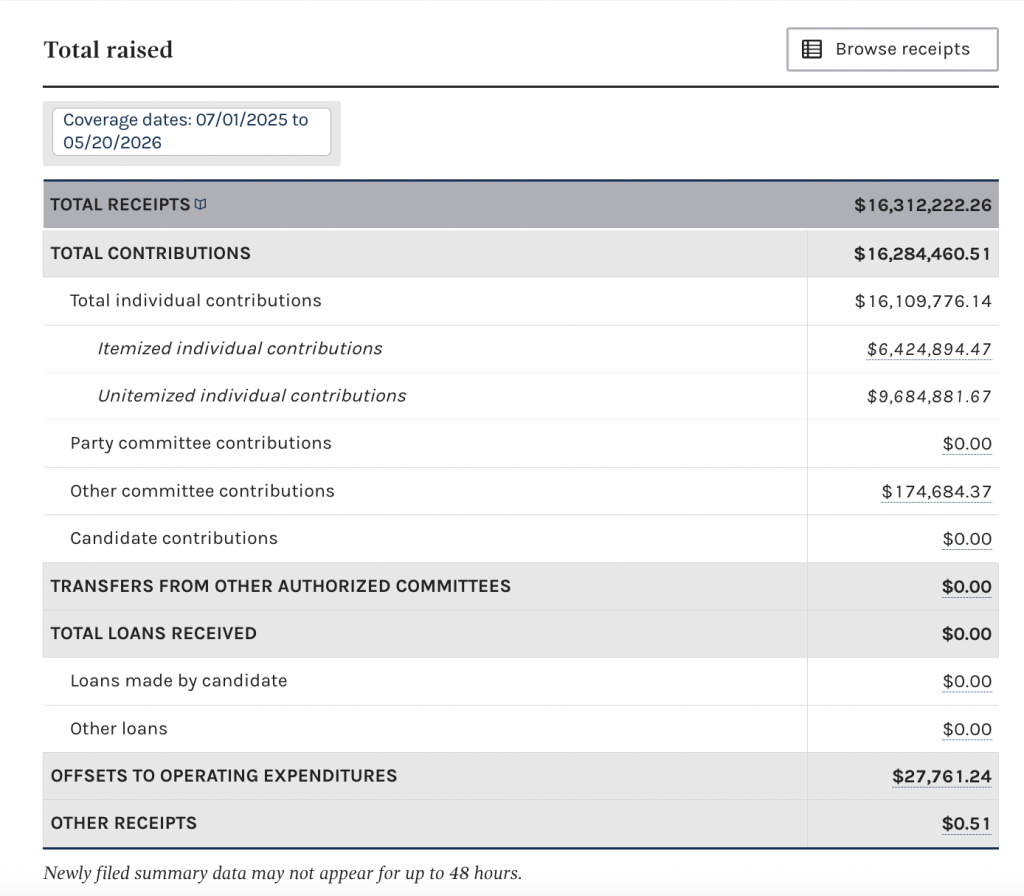
I think people are missing the point with Platner repeatedly focusing on AIPAC, billionaires, and corruption as his main topics. Right now, these are the Democratic red meat base issues. By talking about them in digital fundraising appeals on Instagram, you can raise a lot of money. Platner raised somewhere north of $19M ($16M through May 20, and then millions more after).
What’s ironic is that Democrats, many of them who spend most of the day complaining about Chuck Schumer, are now appalled at the sausage-making process of the Dem Tea Party. After all, didn’t Fight Agency and Morris Katz make it work with Mamdani? Didn’t we just see them elevate Darializa Avila Chevalier, a random grad student, to unseat the Chair of the House Hispanic Caucus? Platner outspent Mills on ads roughly 3:1, and his ability to sustain the momentum via massive ad spending forced Mills out of the race entirely.
Fight Agency has worked with Ruben Gallego, Summer Lee, and Zohran Mamdani. Their strategy, for the most part, works like a charm both in primaries and generals. They just completely blew it by deciding on Platner, and then continuing to believe that he wouldn’t have more scandals, possibly because the campaign was handing them tons of cash. Then the opposition was Mills, who the progressives found completely unpalatable, thus forcing everyone to double down on a clearly flawed candidate. The whole Platner campaign feels like gambler’s fallacy: “surely there wouldn’t be another scandal; we’re finally in the clear!”, only for the next scandal to be even worse than the previous one.
We cannot escape the role of the media in this story, not as some conspiracy to take down Platner, but as an institution that Democrats still take seriously. It feels like Democrats have higher standards than Republicans, who just this week confirmed they’ll be running a gubernatorial candidate in Colorado who claims to have killed multiple people. But that only happens because Democrats have higher trust in institutions and read the news frequently. This effect will continue to trip up candidates trying to run from the left as anti-institutionalists, not because of some ipso facto tendency to be a sex pest (see Eric Swalwell, Andrew Cuomo), but because a critical mass of Democrats believe in the system. Even among leftists, there is not enough cultlike loyalty to absolve someone like Platner, no matter how much Platner and his advisors wish otherwise.
Still, Platner had supporters throughout this campaign saying that the stories were being published by a scurrilous press intent on bringing down someone with a progressive, anti-establishment message. In this era of paranoia and declining social trust, people are now increasingly viewing anything that doesn’t conform to their worldview as some far-reaching conspiracy to silence them. And to be sure, there is a real problem with progressives being unable to get their messaging across, which leads to the creation of parallel ecosystems, which then tend to circle the wagons. But I can’t even find it in myself to blame Platner’s supporters. I’ll readily admit I fell for some of the Platner shtick at one point or another. Plus, his ads were everywhere; he became a recognizable, even iconic face, shooting videos on his phone where he calmly explained why it was his turn. Society is now so optimized toward tribalism that disentanglement becomes nigh-on impossible.
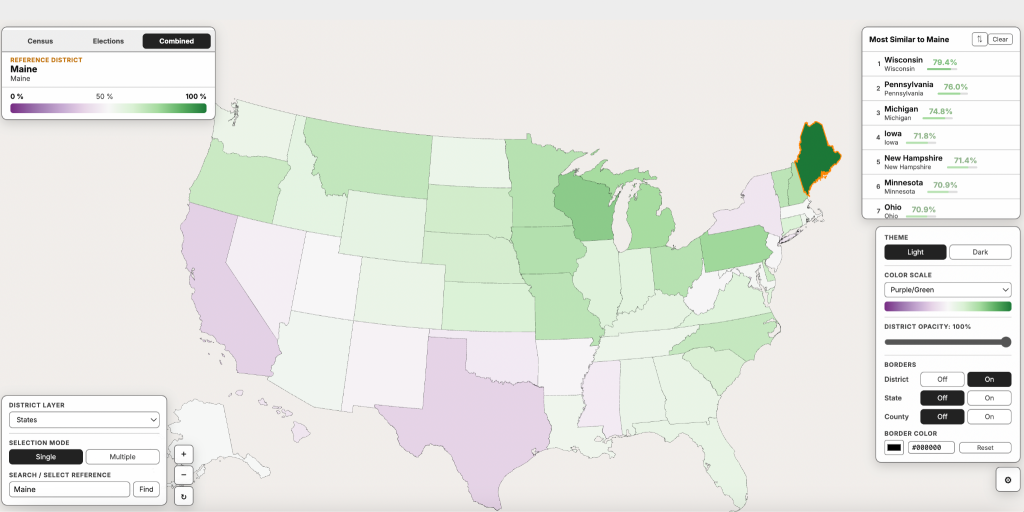
As a final note, we released a new tool on ElectionCord that allows people to determine how similar certain geographic regions are to others. We mapped out a “similarity index” involving demographic and elections data, so you now understand what areas are alike or not alike.
You can now see, for example, that Maine is more similar to the Upper Midwest/Rust Belt states like Wisconsin and Michigan.
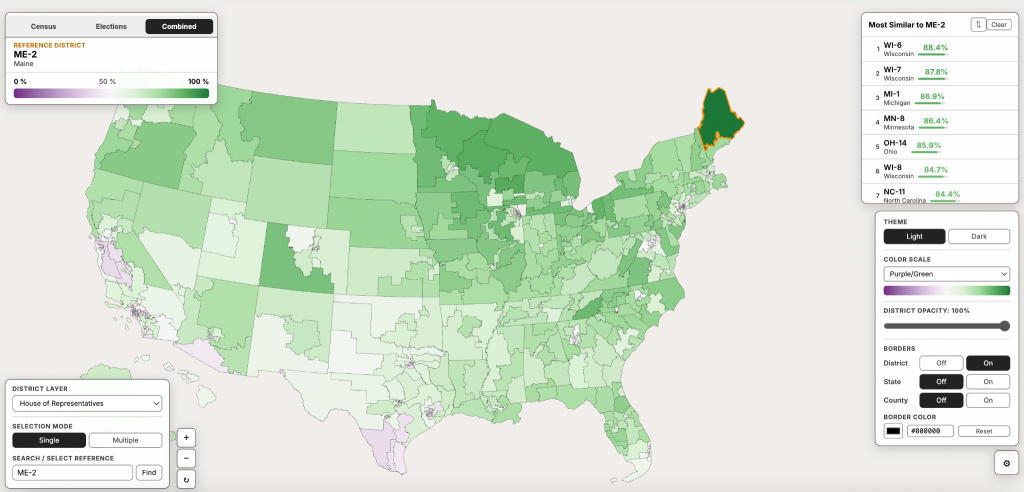
On a more granular level, Maine’s First Congressional District is very similar to its Northeastern neighbors, particularly New Hampshire and Vermont…

But Maine’s Second Congressional District is more similar to Republican-held swing districts in Wisconsin and Michigan.
We will have more to share from this tool next week. However, we encourage taking a nice weekend to go outdoors and not think about Maine for a while.
About the Author