

By now, most sickos who pay attention to American politics on a daily or weekly basis are aware that Democrats have been doing very well in special elections. At The Downballot, their special election tracker has Democrats doing about 13 points better than their 2024 presidential results, on average. This has resulted in several high-profile state legislative seat flips from the start of 2025 to now, and caused House Republicans to worry about vacating any seat less than R+20.
But does this mean anything? For decades, special election swings were seen as proxies for the overall national environment. The theory makes sense: if one party is doing well in smaller elections, then it should be doing better in larger ones. Prior to 2024, the special election swing did a remarkably good job at predicting the overall swing in the generic ballot. But in 2024, that pattern broke in spectacular fashion, as Republicans significantly outperformed the special election indicator. This recent experience has caused many political prognosticators to ignore special elections, even going so far as to say that Dems are “the party of special elections” due to their high political engagement.
Of course, that might be an overreaction. For all we know, the trend of a party’s special election success equaling general election success will return, possibly as soon as this November. In a study from 1990-2008, David Smith and Thomas Brunell found that specials do have predictive power and can indicate the national environment. This trend held true during the Trump era up until 2024, when Democrats overperformed in specials in 2017-18, but did slightly worse in 2020. The trend of House specials breaking down really began in 2023, when Democrats started to do markedly better in specials even as the generic ballot and Biden’s polling dropped.
A precinct analysis of special elections often reveals little. For example, I looked at Virginia’s 11th House of Delegates seat, which conveniently had elections in 2023, 2025, and a special election in 2026. In addition, the Democratic candidate in the special election was the incumbent’s wife, which helps to control for variance in candidate quality. In this case, the Democrat did slightly worse in the special, but better than 2023.
- Big turnout drops: total votes plummeted in the special. There were 7,361 votes in the 2025 general election, but just 3,093 in the special election.
- Precinct differences: There was a lot of random variance in precincts, but in general, they tend to go semi-uniformly toward the over/underperformance
- Example: the Republican did better in all of the Fairfax City precincts in the special election.
- Example 2: In the VA-11 special election for Fairfax County, Walkinshaw did better than Harris in nearly every single precinct, usually by double-digit margins.
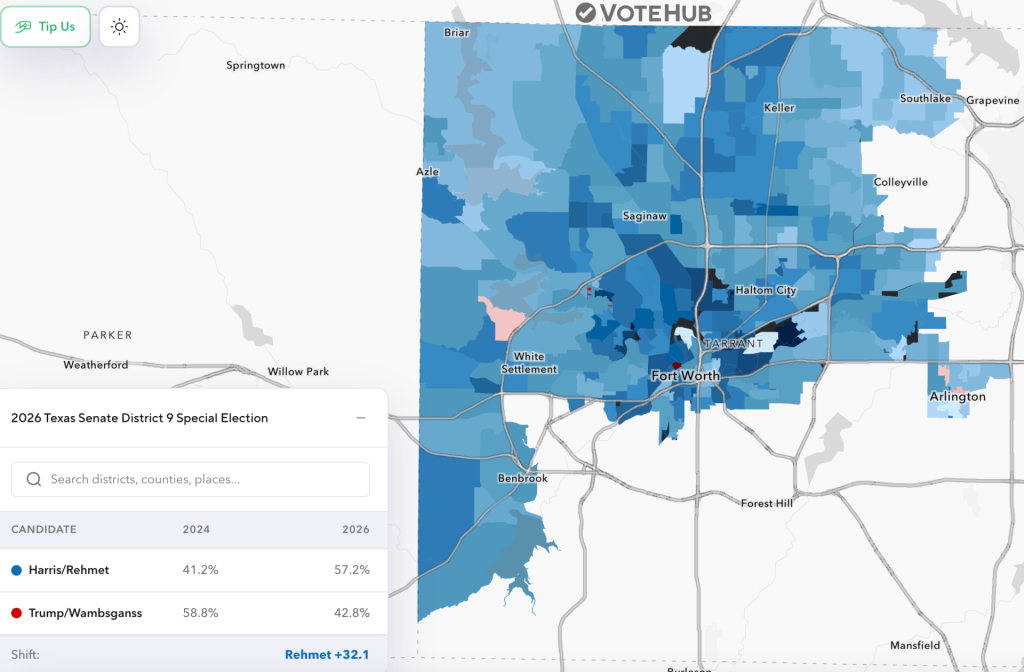
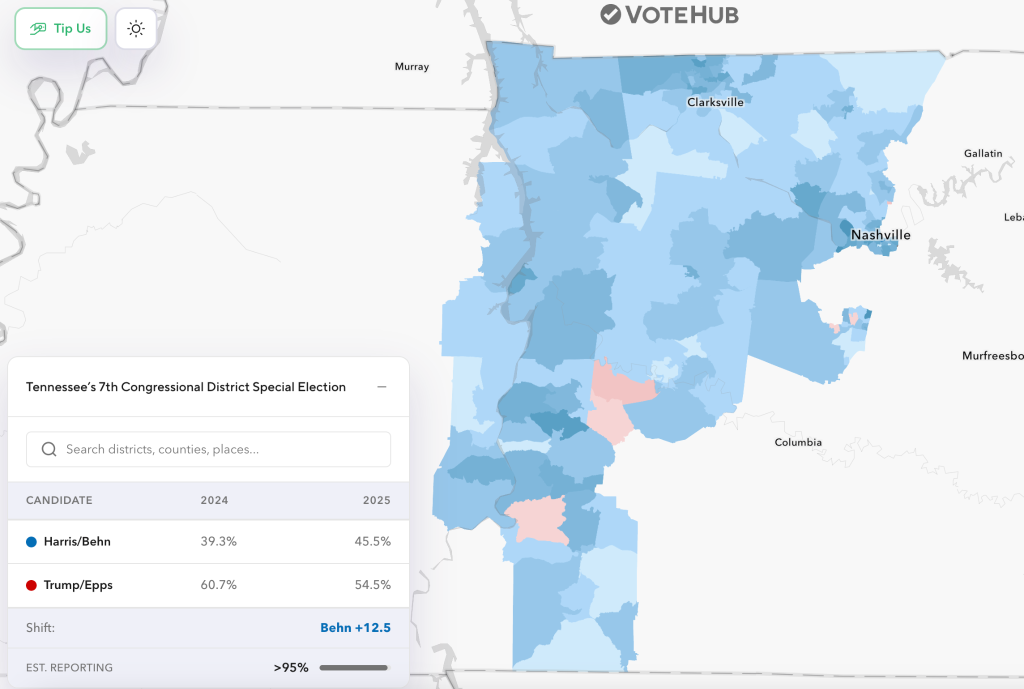
- Example 3: You can see the same effect in TN-07 and TX SD-09 on VoteHub.
Specials often tend to be more turnout-based than general elections due to the smaller pool of voters. In another Virginia special, this time in the Virginia Beach area, there was more partisan turnout for a strong Republican candidate. As we later saw in the 2026 Virginia redistricting referendum, this doesn’t necessarily go the Democrats’ way, even when turnout is a more acceptable 48%. Differential turnout still matters.
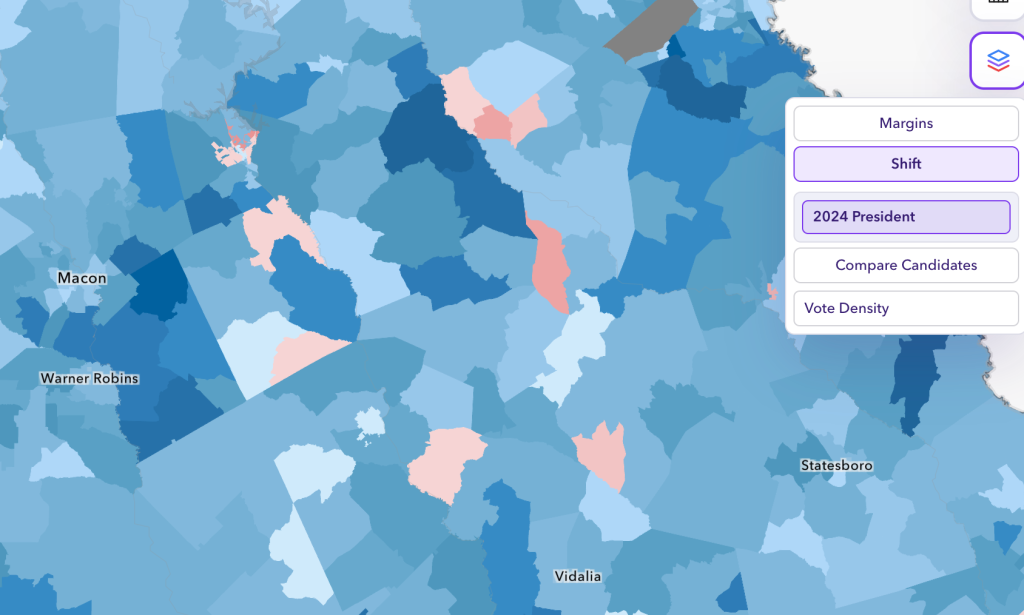
Thus, whichever side has a strong reason to show up in an obscure election typically does better in low-turnout environments; take the Georgia Public Service Commission election from 2025, where the Dem won by a ludicrous 25% margin. But hidden in that enormous swing were a few towns with contested mayoral races where the swing was nonexistent (the red patches below). In those, the Republicans actually felt they needed to show up (see map).
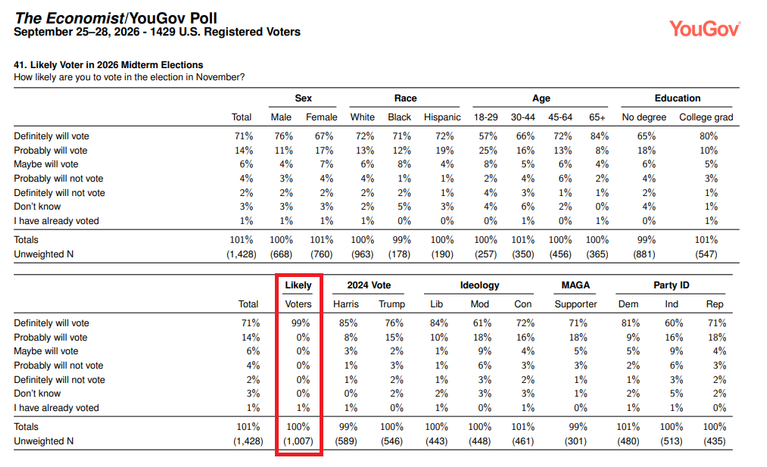
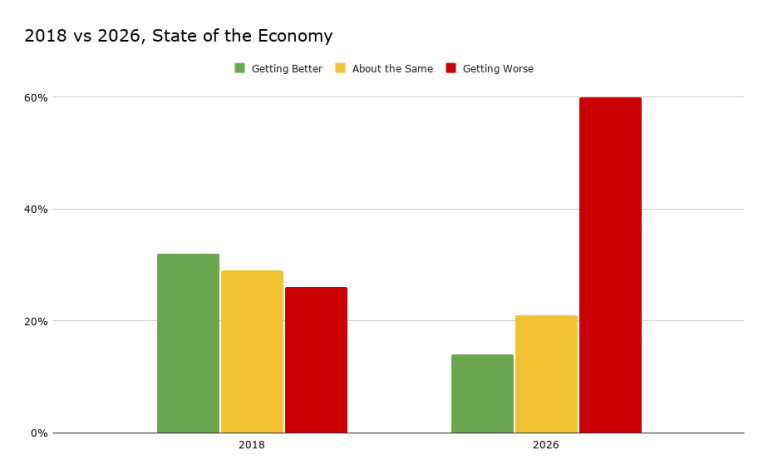
In general, however, the party with greater enthusiasm is more likely to turn out. And as we’ve seen repeatedly in polling, Democrats are more likely to turn out right now, while Republicans are more likely to be depressed, as midterms have gone since the beginning of US political history. Democrats are also winning over swing voters and independents, though there are fewer of them in these turnout environments. As a result, we’ve seen very large special election swings that suggest something like a D+10 environment. No amount of campaign spending or policy changes can dilute the fact of an unpopular president. And there’s no doubt Trump is very unpopular in current polling.
Trump Approval by Issue
So what was going on in 2023-24 when Democrats were overperforming in specials despite not having reasons to vote? First, there was a small shift away from Democrats in specials from late 2023 to early 2024, right as Biden’s polling started its major decline. The special overperformance relative to 2020 dropped from 3.5% to just 0.8%. That did indicate a slight deterioration for Democrats, so perhaps the specials were reflecting the change in the political environment.
But still, we did not get 2020 results in 2024, so why did Dems do so well? There are two theories. One is that Democratic turnout is just permanently skewed toward showing up for special elections. The other is that the types of people who turn out for special elections happen to be more persuadable than the midterm or presidential electorates—and since Democrats often do better among voters who pay attention to politics, this could also be playing a role. Which one is correct? Beats me. As we see, there are occasions where Democrats get defeated in differential turnout even when turnout is relatively high, and cases where Democrats do well even when turnout shoots up (like TN-07, where Behn overperformed in a midterm turnout electorate).
In a very disappointing cop out, I’ll say it mostly depends on the situation, and the general curvilinear turnout of the Dem base. Since the Dems have a coalition of very high-propensity older voters and a lot of younger and nonwhite voters, getting the latter to turn out isn’t always a guarantee. Republicans have shown the ability to motivate their “super-voters” as well as that middle band of propensity where they seem to thrive (e.g. people aged 50+ who usually vote, but not always).
At some level, it seems insane that the remaining voters who don’t turn out for special elections or off-cycle elections like the Wisconsin Supreme Court could be very skewed against a certain party. Yet in 2023, Democratic-aligned Justice Janet Protasiewicz won by 11%, which is more than the 10% margin for Susan Crawford’s 2025 race that was so hotly contested. But, as we know, Trump would win Wisconsin in November 2024, so there had to be voters who didn’t show up or were persuaded to vote for the Democrat. Since the Supreme Court elections had a relatively high turnout, almost to the level of a midterm in the pre-Trump days, one has to assume the remaining voters had to be quite conservative. Since lower turnout often draws out more partisan voters, it’s hard to imagine so many people changing their minds from year to year.
Ultimately, the jury is still out on whether special elections mean anything, but from my view, I still think they are a worthy tool. Without them, the gaps between election cycles have almost no data, so we take what we can get. Still, the remaining electorate can be so volatile that you can never quite be sure anymore, not like in previous decades.
For a midterm election where there are more partisans and fewer opportunities for a “swing voter” demographic to appear, the special elections should track with reality fairly well. Even after 2024, when specials appeared to “break”, we should continue to “monitor the situation”, as the recent saying goes.
About the Author